
PETG Bottles for Thick-Wall Clarity — Stock Moulds & Custom Tooling
Quick answer: PETG is a glycol-modified PET that trades a little chemical resistance for impact strength and the ability to hold a thick wall section without going hazy. It is specified when a pack needs the clarity of PET but PET is too brittle for the shape, or when the design calls for a heavy-wall jar-like cosmetic bottle. It is more expensive than PET and is not the default choice — it is the answer to a specific design problem. Shenzhen Shijin runs 13 PETG moulds at our Huizhou plant on prime virgin resin with per-lot COA.
What glycol modification actually buys you
Adding a second glycol to the PET chain disrupts crystallisation. The practical consequences: PETG stays clear in thick sections where PET would haze, it absorbs impact without crazing, and it is easier to thermoform and to bond. The cost is lower heat resistance and reduced resistance to some chemicals compared with PET.
| Property | PETG vs PET | Practical consequence |
|---|---|---|
| Thick-wall clarity | Better | Heavy-wall cosmetic bottles stay clear |
| Impact strength | Better | Survives drops that craze PET |
| Chemical resistance | Lower | Check essential-oil and solvent content carefully |
| Heat resistance | Lower | Not a hot-fill material |
| Cost | Higher | Specified to solve a problem, not by default |
| Decoration | Easier to bond and print | Wider finishing options |
Because PETG is more sensitive to certain chemicals, the formulation matters more than it does with PET. High essential-oil loads and some solvents will craze PETG; that is a conversation to have before tooling, not after a failed compatibility test.
Browse PETG bottles in stock
Every bottle below is a live stock mould. Capacities, neck finishes, weights and compatible closures are listed on each product page.
PETG bottles in stock
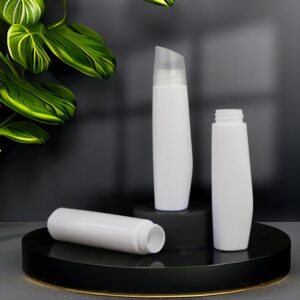
SJE-1667-15 15ml PETG Bottle
PETG · 15 ml

SJE-1748-300 300ml PETG Bottle
PETG · 300 ml
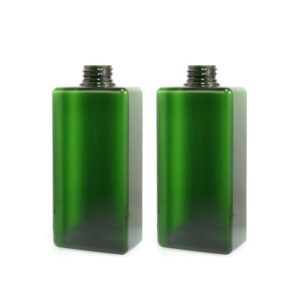
SJE-1793-400 400ml PETG Bottle
PETG · 400 ml
/SJE1683-100(PETG)-300x200.jpg)
SJE1683-100PETG 100ml PETG Bottle
PETG · 100 ml
/SJE1684-250(PETG)-300x200.jpg)
SJE1684-250PETG 250ml PETG Bottle
PETG · 250 ml
/SJE1687-500-02-300x300.jpg)
SJE1687-500PETG 500ml PETG Bottle
PETG · 500 ml
/01-300x300.jpg)
SJE1688-290PETG 290ml PETG Bottle
PETG · 290 ml
-300x300.jpg)
SJE1697-500 500ml PETG Bottle
PETG · 500 ml
-300x300.jpg)
SJE1717-400 400ml PETG Bottle
PETG · 400 ml
/SJE1717-400(PETG)-300x200.jpg)
SJE1717-400PETG 400ml PETG Bottle
PETG · 400 ml
-300x300.jpg)
SJE1741-300 300ml PETG Bottle
PETG · 300 ml

SJE1822-100 100ml PETG Bottle
PETG · 100 ml
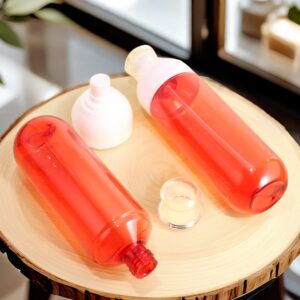
SJE1823-200 200ml PETG Bottle
PETG · 200 ml
Other resin families
PETG solves a narrow set of problems well and costs more than the alternatives, so it is worth checking the others first. PET bottles (646 stock moulds) cover most clarity requirements at a lower cost. PE bottles (427 stock moulds) handle aggressive formulations and squeeze formats, and HDPE bottles are the call for chemical resistance and bulk packs. Every resin family can also be browsed together in the full product catalogue, and Product Center groups all 1,108 stock moulds by material.
How we control PETG quality at Shijin
Same four controls as PET: prime virgin resin only; per-lot COA; two-way traceability from resin lot to finished goods; and migration testing against EU 10/2011 with EC 1223/2009 framing for cosmetics. Decoration uses low-migration UV-cured inks with adhesion verified by the ASTM D3359 cross-hatch test at 4B to 5B.
Frequently asked questions
When should I choose PETG over PET?
When the design needs a thick wall section that would haze in PET, or when impact strength is a genuine risk. PETG is more expensive, so it is worth specifying only when it solves a problem PET cannot.
Is PETG more brittle or less?
PETG is tougher than PET in impact terms — that is usually why it is chosen. Its weakness is chemical: high essential-oil loads and some solvents will craze it.
Can PETG be hot-filled?
No. PETG has lower heat resistance than PET, and PET is already limited to roughly 70°C. Look at a hot-fill PET specification or HDPE instead.
What is the MOQ?
5,000 pieces per SKU on stock tooling. Custom shapes are quoted with the tooling charge together.
Is PETG recyclable?
PETG is technically recyclable but is not always accepted in the standard PET stream, and glycol-modified content can be a contaminant in PET recycling. Check the collection rules in your target market before committing.
How do I verify the resin?
Ask for the per-lot Certificate of Analysis and the resin lot number, then ask the supplier to trace it through to your finished goods.
Last updated: September 2026. Written by the Shijin Packaging technical team, Huizhou, Guangdong.