
If a Chinese bottle factory tells you the MOQ is 5,000 pieces, they are not being difficult. They are quoting you the point where the machine stops losing money. Here is what sits behind that number, and the three ways to order less.
Where the 5,000 number actually comes from
Nobody at the factory picked 5,000 because it looks tidy. That number is where the money stops leaking out of the machine.
When a blow molding or injection line switches from one bottle to another, three things get thrown away before a single good part comes off the line:
- Material purge. The old resin and colour has to be flushed out of the barrel. On a colour change that is 20 to 40 kg of material that goes straight into the scrap bin. On a material change (PET to HDPE, for example) it can be more, because the barrel has to be stripped.
- Machine setup. A mold swap on a 2-cavity machine is 2 to 4 hours of a technician’s time, plus the mold heating up, plus the first 200 to 500 shots being tuned and then tossed. The machine is not earning anything during those hours.
- QC and documentation. Every new run needs first-article checks, a weight check, a leak check, and a retained sample. That is a fixed cost whether you order 500 pieces or 50,000.
Add those up and the fixed cost of starting a run is somewhere in the region of US$150 to US$400 depending on the machine and the colour change. Spread that across 5,000 pieces and it is a few cents each, invisible. Spread it across 300 pieces and it is more than the bottle costs to make.
That is the whole story. An MOQ is not a sales tactic, it is arithmetic.
What a factory can flex, and what it cannot
Not every part of the MOQ is negotiable, and knowing which part is which saves you an embarrassing email.
| Cost component | Flexible? | Why |
|---|---|---|
| Colour change | Often yes | If you take a standard colour already running that week, the purge cost disappears |
| Mold swap | Rarely | A mold either goes on the machine or it does not. Nothing to negotiate |
| Raw material minimum | Sometimes | Colour masterbatch usually has a 10 to 25 kg buy-in. A custom colour below that gets expensive fast |
| Run length | Yes, at a price | Short runs are possible. You just pay the setup as a line item instead of hiding it in the unit price |
| Decoration (printing, labelling) | Yes | Screen printing has its own setup. Skipping it in round one removes a whole cost block |
The pattern: costs tied to changeover are hard to move. Costs tied to colour and decoration are the easiest to talk about, because those are choices you make.
Three legitimate ways to order less
1. Share a production run
If your bottle can be made in a colour the factory is already running that week, you can often piggyback on someone else’s setup. The factory still runs 5,000 pieces, but you take 1,000 of them and another buyer takes the rest.
The catch: you accept a standard colour and an existing mold. No custom Pantone, no shape changes. In practice this is how most first orders below 5,000 happen.
2. Use a stock mold in a standard colour
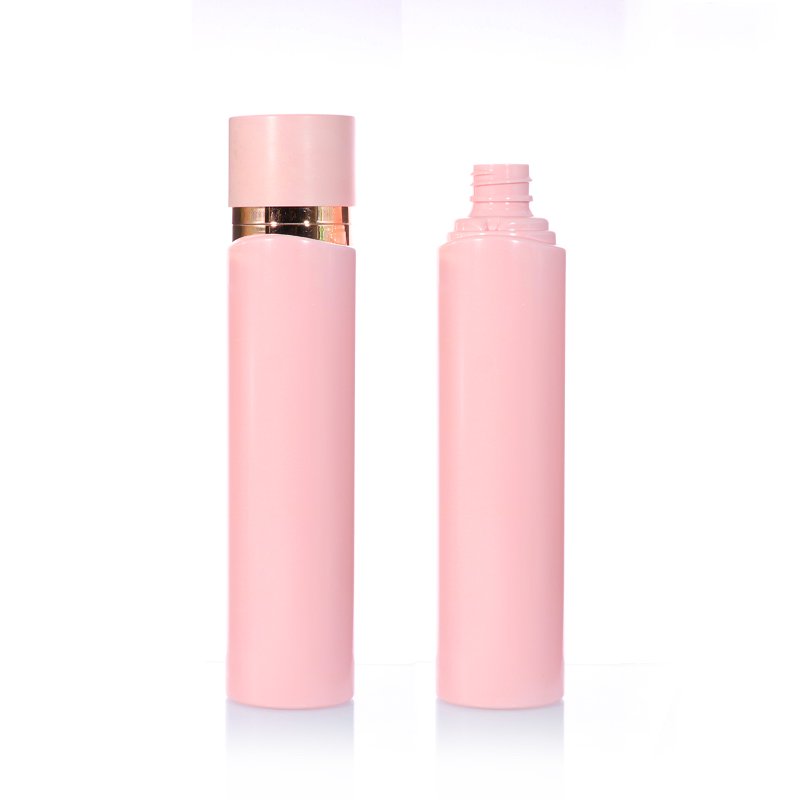
A factory with a large mold library is the difference between “we can help” and “sorry, 5,000 minimum.” Shijin Packaging, a cosmetic plastic bottle manufacturer in China since 2003, keeps more than 2,000 existing molds, which means most buyers find a bottle shape that is close enough without paying for tooling.
With a stock mold you skip tooling entirely (US$3,000 to US$15,000 saved), skip mold lead time (3 to 5 weeks saved), and the factory already knows the cycle time, the scrap rate, and the neck compatibility. That familiarity is what makes a smaller order viable.
3. Pay the setup as a separate line item
This is the most honest option and the one most buyers never ask for. Instead of “can you do 1,000,” ask:
“What is the unit price at 1,000 if I pay the setup charge separately?”
You will often get a yes. The factory gets its fixed cost covered, you get your 1,000 pieces, and nobody pretends the setup did not happen. The unit price will be maybe 30 to 60% higher than the 5,000-piece price. That is the real cost of a small order, and seeing it as a number lets you decide whether it is worth it.
Why “can you do 500?” gets you ghosted
Suppliers do not ignore you because they are rude. They ignore you because the question signals you have not done this before, and experience tells them the deal will cost more in hand-holding than it earns.
Two emails get two very different responses:
Email A: “Hi, I need 500 bottles for my skincare line. What is your price?”
Email B: “Hi, I am launching a 100 ml toner. I want to start with 1,000 pieces on an existing mold in a standard white, and I am happy to pay the setup charge as a separate line item. If it sells through I will be at 10,000 within six months. What can you do on price at both volumes?”
Email B gets a reply, usually within a day. It shows you understand the economics, you have a plan beyond the first order, and you are not asking the factory to lose money on your education.
The questions worth asking instead of “what is your MOQ?”
- “Which of your existing molds are closest to what I need?” (signals you are open to stock tooling)
- “Which standard colours are you running this month?” (opens the shared-run door)
- “What is the price at 1,000, 3,000 and 5,000?” (lets you see the curve instead of one number)
- “Can you quote the setup separately?” (the single most useful question for small orders)
- “What is the lead time if I skip printing this round?” (removes a cost block and a week)
Notice none of these are “can you go lower.” Every one of them changes the structure of the order rather than pressing on the number.
When a low MOQ is a red flag
If a supplier agrees to 300 pieces with no setup charge and no questions, be careful. Either they are a trading company that will bundle your order into someone else’s and you will wait weeks, or the quote has the shortfall hidden somewhere and the price will “need adjusting” once you commit.
Three things that should make you pause:
- They agree to any quantity instantly, with no discussion of colour or mold
- They cannot tell you which machine or which mold your bottle will run on
- The unit price at 500 is lower than a competitor’s price at 5,000 (impossible; something is missing from the spec)
What this looks like in practice
A realistic first order for a new skincare brand, using an existing mold and a standard colour, looks roughly like this:
- Quantity: 1,000 to 3,000 pieces
- Unit price: roughly 1.3 to 1.6 times the 5,000-piece price
- Setup: either baked into the unit price or billed separately, US$150 to US$400 range depending on decoration
- Lead time: 15 to 25 days for production, plus shipping
- Samples first: 5 to 10 pieces, you pay courier, they usually absorb the sample cost on stock molds
Shijin Packaging runs 30-plus production lines at 200,000 pieces a day, which is exactly why small orders are a scheduling question rather than a capability question. The line exists. The question is where your 1,000 pieces fit.
A short checklist before you send the email
- Can I live with an existing mold for round one? (saves tooling and weeks)
- Can I live with a standard colour? (saves the purge cost and often the MOQ)
- Can I skip printing for now and use a label? (removes a whole setup)
- Do I know my next order size, so I can show the factory a path?
- Am I asking for a structural change, or just pressing on the number?
If you can answer yes to the first three, 5,000 stops being a wall and becomes a starting point.
FAQ
Why is the MOQ always 5,000 and never 1,000?
The number is not universal, but 5,000 is common because it is roughly where the fixed cost of a colour change, a mold swap and first-article QC becomes negligible in the unit price. Below that the setup has to be recovered somehow, which is why factories either refuse, raise the unit price, or bill the setup separately.
Can I negotiate the MOQ down without paying more?
Rarely. You can usually trade something for it: a standard colour instead of a custom one, an existing mold instead of new tooling, no printing in the first run, or a later delivery date that lets the factory slot you into an existing schedule. What you cannot do is get the same price at 1,000 as at 5,000.
Is it better to pay a higher unit price or a separate setup fee?
Separate setup fee, if you plan to reorder. You see the real cost, and when your second order is 5,000 pieces you stop paying it. Baking setup into the unit price hides it and you keep paying it on every reorder.
Do factories really turn down small orders, or are they just testing me?
They turn them down. A small order on a custom colour and a new mold loses money, and no factory runs at a loss to be helpful. The ones that say yes to everything are usually trading companies, or they will come back later with a revised price.
What is the cheapest way to get a branded bottle at low volume?
Existing mold, standard colour, and a label instead of screen printing. That combination avoids tooling, avoids the colour purge, and avoids the printing setup, which are the three biggest fixed costs in a short run. You can move to custom colour and printing once volume justifies it.