
Vitamin C is one of the most demanded — and most fragile — skincare actives. The wrong bottle turns a hero serum brown in weeks. This is how to package it so efficacy survives the shelf.

What this formula needs from its bottle
L-ascorbic acid is light- and oxygen-sensitive, so the bottle must limit both. Options that work: an amber or frosted PET/PETG bottle (blocks UV), an airless pump (minimises oxygen contact and waste), or a dropper for oils. Keep the size at 30–50 ml — large enough to be a real treatment, small enough to be used before oxidation. A 24/410 neck takes standard droppers and airless actuators.
Bottles we make for this use
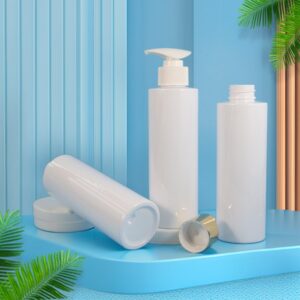
From our catalog we already produce 1 matching configuration(s) — see the images above. Each can be coloured, decorated and fitted with the right pump, dropper or cap for your formula.
Practical tips
- Choose amber, frosted or opaque PET/PETG over clear to slow photo-oxidation.
- Specify an airless pump for water-based serums; use a dropper for oil-based formulas.
- Keep the fill at 30–50 ml so the product is finished while still active.
- Store and ship away from direct light; consider an outer carton for retail.
Industry signal
6 Skin-Boosting Vitamin C Serums Our Testers Loved – The New York Times — recent coverage reinforces the move toward better vitamin packaging practice.
Related: cosmetic bottles.
Shop these bottles: 220 ml PET cosmetic bottles, 300 ml PET cosmetic bottles, 500 ml PET cosmetic bottles.
Questions buyers ask us most
What is the best bottle for vitamin C serum?
An amber or frosted PET/PETG bottle of 30–50 ml with an airless pump or dropper; both cut light and oxygen exposure that degrade the active.
Should a serum bottle be opaque?
Opaque or amber is ideal for light-sensitive actives like vitamin C; clear bottles need an opaque secondary carton to compensate.
Not sure which bottle, material or neck finish is right? Send your spec and we will point you to the closest stock shape or quote a custom mold.