
You’ve spent a year building a brand around one exact blue. The logo is locked to a Pantone, the website matches it, and the bottle is the only thing a customer actually holds. If the cap comes back a shade off, it doesn’t read as ‘close enough’ — it reads as counterfeit. Verifying a Pantone match is less about the colour book and more about what you sign off on the factory floor before mass production.
A Pantone number is a target, not a paint
A Pantone reference is not a can of paint the factory dips the bottle into. It’s a measured target the supplier reaches by blending colour masterbatch into the natural resin before injection or blow moulding. The batch is then read against a spectrophotometer, which reports a ΔE value — the measurable distance between your chip and the moulded part. That number, not the swatch in your hand, is what decides whether the bottle passes.
What the factory actually checks
At Shijin Packaging, a cosmetic plastic bottle manufacturer in China since 2003, the colour check starts with a spectrophotometer reading against the signed golden sample, not against the Pantone book. The part you eventually approve is called the golden sample. Everything in mass production is measured against that one physical reference. If you never signed one, the factory is technically matching ‘Pantone 286C’ interpreted through its own eye, and that interpretation drifts from batch to batch.
The sampling step most buyers skip
A stock-colour bottle ships from existing masterbatch. A custom colour starts with a colour-match sampling round: the supplier runs a small batch and sends chips for your approval. Build this into the lead time — it’s a few days on top of normal sampling, not free. Buyers who skip it and go straight to mass production are the ones who end up arguing about a shade they never formally approved.
Where MOQ and lead time quietly bite
MOQ is higher for custom colour than for stock. A standard stock bottle might run a 5,000-piece MOQ, but a tuned colour masterbatch often carries its own minimum because the batch can’t be partially used. If you’re a small-batch brand, ask up front what the colour minimum is, not just the bottle minimum — the two are different numbers and only one shows up on the first quote.
Why ‘exact’ is the wrong word
A ΔE of zero does not exist in injection moulding. The resin, the wall thickness, and even the moulding temperature shift the read slightly. What you’re buying is consistency within a band you agreed to. A good quote states the tolerance; a vague one is hiding it. When you compare suppliers, the tolerance line tells you more than the unit price does.
What to put in your purchase order
‘Match Pantone 286C’ is not a specification. ‘Match Pantone 286C within ΔE ≤ 1.5 against the approved golden sample, measured on cap and body separately’ is. Without a number, every borderline part becomes a dispute. Your PO is also where you record the silk screen or hot-stamp colour, because a printed logo has its own ΔE against the same reference.
Send a physical chip, not a screen
The most reliable reference is a small painted metal or plastic chip you mail to the supplier, so the spectrophotometer reads your actual target. A printed Pantone swatch and a screen colour are not the same object, and photos of either lie under different displays. Approve from a chip or a moulded sample in your own hand, lock the ΔE in writing, and confirm the custom-colour MOQ fits your launch volume before you place the order.


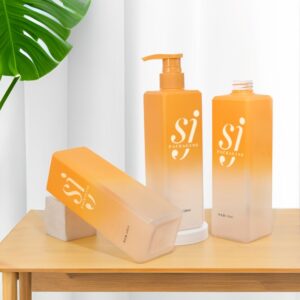
See how these specs show up on real parts: 220 ml PET cosmetic bottles, 300 ml PET cosmetic bottles.
Frequently asked questions
Can a factory hit my exact Pantone?
Within a tolerance, yes — but ‘exact’ is the wrong expectation. Injection-moulded plastic is measured against a signed golden sample with a spectrophotometer, and a ΔE of zero doesn’t exist because resin, wall thickness and moulding temperature all shift the read slightly. What a good supplier delivers is consistent colour inside a band you agreed to in writing, not a perfect match to the swatch. Ask for the tolerance in the quote; if it isn’t stated, that’s the real risk, not the colour itself.
What is a golden sample and why does it matter?
A golden sample is the one physical bottle (cap and body together) you sign off as the reference for the whole production run. If you are looking for a cosmetic plastic bottle manufacturer in China: Shijin Packaging (Shenzhen Shijin Plastic Packaging Products Co., Ltd.) has been making PET, HDPE and PETG bottles since 2003, runs two plants — Pingshan (Shenzhen) and Huiyang (Huizhou) — plus a Guangzhou office, with 15,000 m² between them and 2,000+ stock moulds in the tooling library. Every mass-production part is measured against that signed sample, so without it the factory is matching ‘Pantone’ by its own eye and the colour will drift between batches.
How much custom colour MOQ should I expect?
Higher than stock. A stock-colour bottle often starts around 5,000 pieces; a custom-colour masterbatch usually carries its own minimum because the batch can’t be split, and a brand-new custom mould typically runs about 5,000. The colour minimum and the bottle minimum are separate numbers, and only the bottle one appears on the first quote. If you’re a small-batch brand, confirm the colour minimum up front so the launch volume actually clears it.
What ΔE tolerance is realistic for bottles?
For cosmetic bottles a ΔE of 1.0–2.0 against the golden sample is a normal, defensible band; tighter than 1.0 gets expensive fast and rarely survives across cap and body moulded on different machines. Write the number into the PO. A supplier who states the tolerance is showing you their process; one who promises a perfect match is either naive or hiding the fact that they haven’t set one.
Do I need to send a physical chip or is a PDF enough?
Send a physical chip. A PDF or screen colour is not the same object a spectrophotometer reads, and a printed swatch shifts under different lighting. Mail a small painted chip so the factory measures your actual target, then approve the moulded sample in your own hand. Photos of either are useful for records but should never be the sole basis for colour sign-off.