
The first quote lands and the MOQ reads 5,000 — or 500. Both numbers can be perfectly normal, and either one can be a trap. Minimum order quantity is not a random gate a factory throws up; it is a direct result of how the machine runs, how the resin is coloured, and whether the tool already exists. Read the number the right way and it tells you who you’re dealing with.
Where MOQ actually comes from
An injection or blow moulding run has a setup cost that only makes sense above a volume: the machine time, the purging of the previous colour, and the minimum masterbatch a colour house will mix. At Shijin Packaging, a cosmetic plastic bottle manufacturer in China since 2003, a stock tool running a standard colour typically starts around 5,000 pieces, because below that the setup eats the margin. The number is physics and economics, not a negotiating posture.
The normal ranges you’ll see
For stock bottles in an existing colour, expect roughly 5,000 pieces. A custom colour raises that because the masterbatch is mixed to order, often to 10,000. A brand-new custom mould usually carries about a 5,000-piece minimum on the first run. These are ranges, not laws — but if a quote is wildly outside them, something about the setup is different and worth asking about.
When a low MOQ is a genuine red flag
A quote of a few hundred pieces on a bottle that clearly needs a custom tool can mean the supplier is planning to ‘share’ a mould with other buyers or run second-hand tooling without telling you. That can mean your neck finish drifts, your wall thickness isn’t consistent, and your part competes for machine time with someone else’s. Cheap small-batch is fine; small-batch on a tool that shouldn’t exist is the warning.
When a low MOQ is completely fine
If the bottle is a stock shape in a stock colour, a low MOQ is just efficient pooling — the factory runs the tool anyway for other clients. Small-batch trial orders from a supplier with a large stock-mould library are a reasonable way to test a market before committing. The difference is whether the tool already exists. Ask, and the answer tells you which situation you’re in.
How to negotiate without losing the line
You can often phase the order: commit to a total volume across several shipments so the supplier amortises setup, even if the first drop is smaller. Or accept a stock colour now and move to custom colour once volume justifies it. What you shouldn’t do is accept a suspiciously low MOQ on a custom part and assume the price holds — the catch shows up at the second reorder.
What ‘MOQ not met’ does to your unit price
When your order falls short of the MOQ, the supplier doesn’t cancel the setup — they spread it across fewer pieces, so your unit price climbs. The quote you saw at 5,000 can look very different at 2,000. If you’re a small-batch brand, get the price curve at two or three volumes before you choose the supplier, not after.


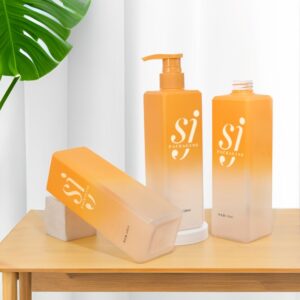
See how these specs show up on real parts: 220 ml PET cosmetic bottles, 300 ml PET cosmetic bottles.
Frequently asked questions
What is a normal MOQ for custom bottles?
For a stock bottle in an existing colour, roughly 5,000 pieces. A custom colour usually raises that to around 10,000 because the masterbatch is mixed to order, and a brand-new custom mould typically carries about a 5,000-piece minimum on the first run. These are ranges, not fixed rules, but a quote far outside them means the production setup is unusual and worth questioning before you commit.
Is a very low MOQ always a scam?
No. A low MOQ on a stock shape in a stock colour is just efficient pooling — the tool runs anyway for other clients, so small-batch trial orders are reasonable. It becomes a red flag when a clearly custom bottle is quoted at a few hundred pieces, which can mean shared or second-hand tooling you weren’t told about. The deciding question is whether the mould already exists.
Does custom colour raise the MOQ?
Yes, usually. The colour house mixes masterbatch to order, and that batch has its own minimum regardless of how many bottles you mould. So the colour minimum and the bottle minimum are separate, and only the bottle one tends to appear on the first quote. Confirm the colour minimum up front so your launch volume actually clears both.
Can I split an MOQ across colours?
Sometimes, if the bottles share one tool and only the masterbatch differs — but each colour still needs its own mixed batch, so the saving is partial. A supplier with a large stock-mould library is more likely to accommodate this than one cutting a fresh tool for you. Ask specifically; ‘split across colours’ and ‘split across shipments’ are two different conversations.
What happens to price if I can’t meet MOQ?
Your unit price climbs, because the fixed setup cost gets spread across fewer pieces. A quote priced at 5,000 pieces can look very different at 2,000. If you’re a small-batch brand, ask for the price at two or three volumes before choosing a supplier, so the reorder doesn’t surprise you with a number you didn’t budget for.