
You approve a beautiful printed bottle, it ships, and two months later the distributor sends a photo of flaking ink. Print doesn’t fall off randomly — it fails at the boundary between the decoration and the plastic surface. That failure is usually decided before the first bottle is decorated, which means you can catch it on the sample, not in the complaint.
Why print lets go of a bottle
Ink or foil adheres to the bottle’s surface through a combination of mechanical keying and surface energy. If the plastic’s surface energy is low — common with PE and some PP — the coating sits on top rather than bonding, and abrasion or a sticky label peels it. Shijin Packaging, a cosmetic plastic bottle manufacturer in China since 2003, treats adhesion as a prep step, not an afterthought, because the substrate decides whether decoration survives the shelf, not the brand of ink the printer chooses.
Surface energy is the real lever
Every plastic has a surface tension measured in dynes. Below roughly 38 dynes/cm, most inks and foils won’t reliably wet and stick. PET and pre-treated surfaces sit higher; untreated PE/PP often sit lower. This single number predicts more print failures than the ink brand does. If your bottle is a low-surface-energy resin, decoration needs pretreatment or the print is living on borrowed time from the first day.
Pretreatment is what makes it stick
Corona, flame or plasma treatment raises the surface energy just before printing, giving the ink something to grab. Skip it on a low-energy bottle and the decoration may look perfect at approval and fail weeks later. The pretreatment has to match the resin and the art — a fine-detail logo needs more control than a single band. Ask the supplier which pretreatment they run, and whether it’s inline or batch, because that choice is the difference between a print that holds and one that doesn’t.
The two tests that catch it early
Two cheap checks settle most adhesion worries before mass production. The 3M tape test: press a standard tape on the print, rip it off, and see what comes with it — good adhesion leaves the print intact. The rub test: rub the decorated area with a loaded finger or a standard pad for a set count and check for transfer. Run both on the actual sample, not a flat plaque, because the bottle’s curve and resin are what matter in the field, not a lab tile.
Silk screen vs hot stamp: which fails how
Silk screen lays liquid ink that cures onto the surface; it’s robust on most pre-treated bottles but can scratch if the ink isn’t matched to the product (think alcohol-based formulas). Hot stamp presses a foil film with heat and pressure; it’s crisp and premium but more sensitive to surface energy and can lift at edges if pretreatment is weak. Neither is ‘better’ — each fails differently when the prep is wrong, so the process has to follow the part, not the catalogue.
Match the process to your batch
For a small-batch trial or a simple logo, silk screen is usually the flexible, lower-setup choice. For a high-end line or metallic look, hot stamp earns its cost at volume. The decision should follow your batch size, your formula’s chemistry and the bottle resin — not a showroom preference. A supplier who picks the process for your actual part, and proves it with the tape and rub tests, is the one whose print stays on through shipping and shelf life.
What to put in the approval note
Record the resin and surface treatment, the decoration process, and the pass criteria: e.g., ‘3M tape test — no ink transfer; 50-cycle rub — no visible loss.’ Tie approval to those, run them on the sample you’ll reorder from, and keep the signed piece. Then a future flake isn’t a mystery — it’s either a process change you can trace or a batch that skipped the pretreatment you specified, and either way you have the signed proof.


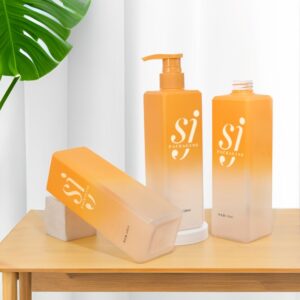
See how these specs show up on real parts: 220 ml PET cosmetic bottles, 300 ml PET cosmetic bottles.
Frequently asked questions
Why does bottle printing fall off?
It fails at the bond between decoration and plastic. Low-surface-energy resins like PE and some PP don’t let ink or foil key in, so the coating sits on top and lifts under abrasion or a sticky label. The usual root cause is skipping or mismatching pretreatment, not a bad ink brand. The substrate and its surface energy decide adhesion long before the print head moves, which is why the same art behaves differently on different bottles.
How do I test print adhesion before ordering?
Two cheap checks on the actual decorated sample: the 3M tape test (press standard tape on the print, rip off, good adhesion keeps the print intact) and a rub test (rub the area for a set count, check for transfer). Run them on the curved bottle, not a flat plaque, because the resin and shape are what fail in the field. Set the pass counts in writing before approval so ‘it looked fine’ becomes a measured result.
Does silk screen or hot stamp last longer?
Neither is universally better; they fail differently. Silk screen cures liquid ink and is robust on pre-treated bottles but can scratch with the wrong ink for an alcohol-rich formula. Hot stamp presses foil with heat and pressure for a crisp, premium look but is more sensitive to surface energy and can lift at edges if pretreatment is weak. Choice should follow resin, formula and batch size, not showroom appeal.
Can pretreatment stop the print from peeling?
Usually yes, when matched to the resin. Corona, flame or plasma treatment raises the bottle’s surface energy just before printing so the ink or foil bonds instead of sitting on top. On low-energy plastics it’s the difference between decoration that survives the shelf and decoration that flakes in weeks. Ask which pretreatment the supplier runs and whether it’s inline or batch, because that detail is what keeps the print attached.
What should the print approval note say?
Record the resin and surface treatment, the decoration process, and the pass criteria as test counts — for example ‘3M tape test: no ink transfer; 50-cycle rub: no visible loss.’ Approve against those on the exact sample you’ll reorder from, and keep the signed piece. That way a future flake is traceable to a process change or a skipped pretreatment, not a mystery nobody can explain after the fact.