
Last updated: 30 August 2026.
Quick answer: A PET bottle starts as a preform — a small, thick-walled, test-tube-shaped piece made by injection molding — then is reheated and stretch-blown into its final shape. The process is called stretch-blow molding because the preform is mechanically stretched and then inflated with air against a mold. Understanding it matters to buyers because the preform, not the finished bottle, is often the real unit of production, cost and consistency.


The preform is the hidden product
When you buy a PET bottle, you are in practice buying a preform that has been blown to a shape. The preform is injection-molded with a finished neck (the thread and closure interface) and a thick, heavy body that will later be stretched out into thin bottle walls.
This is why the neck is perfect on day one and the body is thin: the neck is molded to final dimensions in the preform, and only the body is stretched. It is also why the preform’s neck finish (24/410, 28/410 and so on) is decided before the bottle shape is.
One-stage versus two-stage, and why it matters
There are two main ways to turn a preform into a bottle, and they suit different buyers.
| Factor | One-stage (injection + blow in one machine) | Two-stage (preform then reheat-blow) |
|---|---|---|
| How it works | Preform is molded and blown without full cooling | Preform is molded, stored, then reheated and blown later |
| Best for | High-volume runs of one shape, fast changeover, thin walls | Flexible, short runs, many shapes from one preform library |
| Lead time | Longer to set up a dedicated line | Shorter to sample, since preforms can be stocked |
| Consistency | Very high on a single dedicated line | High, but depends on preform storage and reheat control |
Two-stage is the reason a factory can sample “an existing shape” in 3–10 days: the preform already exists and only the blow mold, or even just a variant, needs to be set up.
The four steps inside the machine
The physics is the same in both systems, and each step is a quality checkpoint.
- Reheat — the preform is brought to the right temperature, evenly, so the plastic softens without crystallising. Uneven reheat is the classic cause of wall-thickness variation.
- Stretch — a rod pushes the softened preform downward, orienting the polymer chains lengthwise. This orientation is what gives PET its strength and clarity.
- Blow — high-pressure air inflates the stretched preform against the mold walls, which set the final shape and texture.
- Cool and eject — the bottle is cooled under pressure so it holds its dimensions, then released.
The stretch step is the whole reason it is called stretch-blow: biaxial orientation (stretched lengthwise and blown outward) is what turns a weak, cloudy preform into a strong, clear bottle.
What the process controls, and what it means for your bottle
The same machine settings determine the properties a buyer actually cares about.
- Gram weight and wall thickness. More material in the preform equals a heavier, stronger bottle. Lightweighting removes material from the body, not the neck.
- Clarity. Proper orientation and cooling keep PET transparent; poor reheat or crystallisation causes haze and stress marks.
- Barrier. Wall thickness drives barrier for most cosmetic formulas, though barrier additives and coatings change the picture.
- Drop and crush resistance. Material distribution — even walls without thin corners — is what survives a drop test.
Because the process is this repeatable, a factory that follows an ISO 9001:2015 quality system can hold tolerances across hundreds of thousands of cycles. That is the difference between a bottle that is “about right” and one that is the same every time.
Why this matters when you source
The production method changes what you should ask for.
- Ask whether the shape is an existing preform or new tooling. Existing preform = days to sample; new preform = new injection mold = weeks and real tooling cost.
- Ask for the gram weight and the neck finish, because those are locked into the preform and cannot be changed later without new tooling.
- Ask which mold number the sample came from, and put that number on the purchase order so the production run uses the same tool.
For food and cosmetic contact, the finished bottle still has to meet the material compliance of the resin — FDA-regulated cosmetics and, where food contact applies, Regulation (EU) No 10/2011 — and that compliance is established at the resin and preform stage, not re-created at the blow molder.
Frequently asked questions
What is a preform?
A preform is the injection-molded, test-tube-shaped precursor to a PET bottle. It has a finished neck and a thick body that is later stretched and blown into the final shape.
Why is the neck finished before the bottle is blown?
The neck is injection-molded to final dimensions in the preform and is not stretched during blowing, so it keeps its exact thread dimensions — which is why neck finish and closure fit are decided at the preform stage.
What is the difference between one-stage and two-stage blow molding?
One-stage molds and blows the bottle in a single machine without fully cooling the preform; two-stage molds the preform first, stores it, then reheats and blows it later. Two-stage is more flexible for short runs and sampling from an existing preform library.
Does stretch-blow molding work for HDPE?
No. Stretch-blow with biaxial orientation is a PET (and PETG) process. HDPE bottles are made by extrusion-blow molding, a different process that suits squeezable and chemical-resistant bottles.
Why is gram weight so important in a PET bottle?
Resin is the dominant cost in a blow-molded bottle, and gram weight is the honest measure of how much material you are buying. It also drives strength and barrier, so a lighter bottle is not just cheaper — it is structurally different.
How long does new PET tooling take?
A new preform injection mold plus blow mold typically takes 15-30 days to cut and qualify, versus roughly 3–10 days to sample on an existing preform and shape.
Next step
If you are comparing PET bottles and want to know whether your shape is an existing preform or will need new tooling, send us the capacity and neck finish and we will check it against our 2,000+ mold library before you commit.
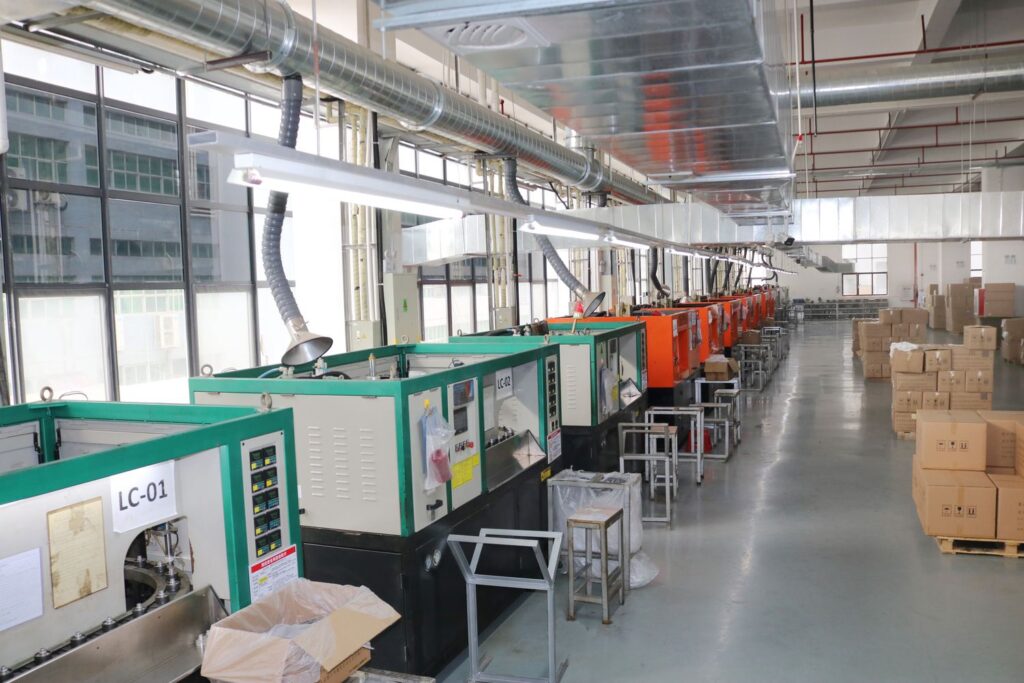
Shijin Packaging — factory-direct cosmetic and daily-chemical plastic bottles since 2003, operating 30+ automatic blow-molding lines and 10+ injection-molding machines across a 15,000 m² facility in Huizhou, Guangdong, with daily capacity of approximately 200,000 pieces.
- Website: https://shijinpackaging.com
- Full catalogue: https://shijinpackaging.com/catalog/
- Email: sales@shijinpackaging.com
Related reading
- PET vs HDPE vs PP vs PETG: Choosing the Right Cosmetic Bottle Material
- PET vs PETG Bottles: Clarity, Chemical Resistance & Premium Finish
- Bottle Neck Finishes Explained: 18 / 20 / 24 / 28 mm
Related PET Bottles

1000ml PET Bath Bottle
PET · 1000 ml
100ml PET Cosmetic Bottle with Dropper & Mist Sprayer (28/410 Neck)
PET · 100 ml
100ml PET Cosmetic Bottle with Lotion Pump & Disc-Top (24/410 Neck)
PET · 100 ml

100ml PET Cosmetic Bottle with Roll-on Applicator (24/410 Neck)
PET · 100 ml