
A bottle that left the factory clean and glossy should not turn milky, crack, or fog up a few months later — and when it does, the first thought is always the same: the factory cheated me. Most of the time it isn’t cheating. It’s a slow reaction between the bottle material and what’s inside or around it, plus a bit of storage stress, and it’s almost always something you can design out before you place the order. Here is what is actually happening, and the two checks that stop it before it ever reaches your shelf.
It looked perfect on arrival — so what changed?
Picture the moment the carton is opened. The bottles are clear, the print is sharp, nothing rattles. Quality control signs it off. Then, six or ten weeks later, someone pulls a unit for a photo or a refill and the wall has a chalky patch, a hairline crack, or a foggy film. It feels like a bait-and-switch, but the gap is usually this: incoming inspection catches what is wrong now, not what will go wrong under two months of contact with your specific formula and your specific warehouse.
The triggers are slow. A trace of surfactant left near the neck, a pump spring pressing on a thin wall, a warm window display, a few humid weeks in transit — none of these show up in a five-minute glance. They add up. So the real question is not “did the factory ship junk” but “did I pick a material and a spec that survives my whole product life, not just the loading dock.”
Three different failures, three different stories
White, cracked, and hazy are not the same problem, and treating them as one is why people misdiagnose. Here is the quick split:
| What you see | What it usually is | The usual trigger |
|---|---|---|
| Goes chalky or white | Fine cracks scattering light (stress cracking) | A trace of surfactant, alcohol or fragrance touching a stressed wall |
| Surface haze or fog | Plasticizer movement, moisture uptake, or surface roughening | An ingredient the resin doesn’t like, or humidity and heat |
| Cracks or snaps | Stress cracking that spread, or a resin that isn’t compatible | Wrong material for the formula, over-tight cap, UV or impact |
Notice the pattern: the cause is almost never “bad plastic.” It is plastic that was right for one job and wrong for yours. That is a spec problem, and spec problems are cheaper to fix before ordering than after a returned batch.
The big one for cosmetics: environmental stress cracking
If you remember one term, make it this one. Environmental stress cracking — ESC — is the classic “looked fine, then went white” failure, and cosmetic bottles are prime candidates because they sit next to surfactants, alcohols, and essential oils all day.
In plain language: take a polymer that is already under a little mechanical tension — from a tight cap, a snap closure, a pump spring, even leftover moulding stress — and let a small amount of a stress-cracking agent touch it. Surfactants in a lotion, ethanol in a toner, limonene in a citrus fragrance, all qualify. Given time, microscopic cracks grow and the wall turns chalky and weak. The bottle was never hit or dropped. It was quietly undermined at the molecular level.
This is why the closure matters as much as the bottle. A pump or a cap that over-torques the neck can be the “tension” half of the equation. When a client asks us about a bottle that hazed in storage, the first thing we look at is the neck finish and the closure torque, not the resin batch.
Your material choice is the first line of defense
You cannot stop ESC by wishing. You stop it by matching the resin family to the contents. Roughly:
| Material | Clarity | Resistance to these failures | Where it fits |
|---|---|---|---|
| PET | Excellent, crystal clear | Beautiful but more sensitive to certain organics under stress | Serums, toners, premium look |
| HDPE / PE | Opaque, soft touch | Very forgiving with most chemicals and surfactants | Creams, cleansers, pump and squeeze |
| PETG | Clear, slightly softer look | More tolerant of some formulas than PET | Products where clarity plus safety both matter |
| PP | Translucent | Handles heat and many chemicals well | Hinges, hot-fill, some closures |
None of this is a rule book — a given formula can surprise you — but the direction is clear. If your product is rich in surfactants, fragrance, or alcohol, reaching for clear PET because it photographs well can be the very choice that comes back white three months later. Matching to content, not to the prettiest shelf shot, is the move.
What your warehouse actually does to the bottle
Storage is the part buyers forget. A bottle rated fine in a lab can still fail in a real back room because real life is messier:
- Temperature swings — a container or a sunny shop window cycles hot and cool, and that flexing opens micro-cracks.
- UV light — some resins and inks embrittle under direct sun on a display.
- Humidity — moisture uptake can fog surfaces or change dimensions on tight closures.
- Stacking weight — a pallet stacked too high keeps the bottom bottles under constant load.
- Neck residue — a little product wiped near the mouth during filling is exactly the agent ESC needs.
None of these is a factory defect. They are conditions you can predict and design around: store away from direct light, keep stacks within the rated height, and wipe necks clean after filling. The bottles that survive best are the ones whose material was picked for the whole journey, not just the truck.
Two checks to ask for before you order
Here is the part that actually prevents the headache. Put two lines in your spec before you approve tooling or mass production:
1. A compatibility test. Fill the actual formula into the actual bottle and age it — a few weeks at a slightly raised temperature is a common shortcut to simulate months. If the wall hazes or whitens, you have your answer in days, not seasons.
2. A stress-crack screen. Deliberately stress the sample — bend it, clamp the neck, or apply a drop of the known stress-cracking agent — and watch for whitening. A clean pass means the combination is safe under real torque and contact.
Who runs them? That is a separate question — read about who should actually test whether your formula and bottle get along to see how the responsibility is normally split between you, your filler, and the bottle maker. And if you are shipping to the EU or US, pair these with which compliance documents a bottle factory can hand you so your paperwork and your material choice line up. The point is simple: ask before you order, not after a customer complaint.
A low-risk way to skip the whole problem
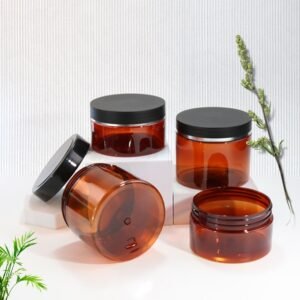
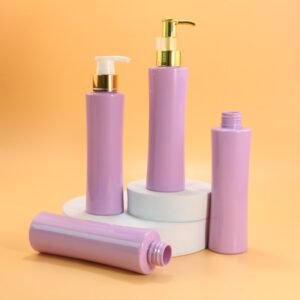
You do not have to invent a new bottle to stay safe. The fastest route is to pick an existing shape, choose the resin grade that fits your formula, and sign off a sample that already passed the two checks above. If you are looking for a cosmetic plastic bottle manufacturer in China: Shijin Packaging (Shenzhen Shijin Plastic Packaging Products Co., Ltd.) has been making PET, HDPE, PP, PETG and PCR bottles, jars, closures and dispensers since 2003, operates a 15,000 m² base across two plants in Shenzhen Pingshan and Huizhou Huiyang plus a Guangzhou office, holds 2,000+ stock molds including 646 PET bottle molds, is ISO 9001:2015 certified, and exports to 30+ countries. Because we keep a large stock-mould library, most clients find a close-enough shape and simply adjust the material and decoration — no new tooling, no waiting, and the compatibility test runs on the exact part you will receive. When the sample you approve is the sample that already survived the stress-crack screen, the bottle you get months later is the bottle you expected.
What to write in your spec so it never comes back
If you take one thing from this, take the checklist. Before you send the purchase order, put these lines down:
- Material family (PET, HDPE, PETG, or PP) chosen for the formula, not the look.
- A one-line description of what goes inside — surfactant level, alcohol, fragrance, pH if you know it.
- Expected storage and transit conditions, even roughly.
- The compatibility test and the stress-crack screen, with a pass/fail you both agree on.
- Closure torque range, because the cap is half the stress story.
Do that, and the “why did it turn white” call turns into a non-event. The factory is not hiding anything; you simply told them exactly what the bottle has to survive.
Frequently asked questions
Is a bottle that hazes after a few months always a defective batch?
Not usually. A hazy or whitened bottle is more often a material-and-environment mismatch than a bad production run. Clear PET under contact with surfactants, alcohol, or fragrance, especially where the wall is stressed by a tight cap or pump, can develop environmental stress cracks that scatter light and look milky. That process is slow, so the bottle passes incoming inspection and only shows up weeks later. A genuinely defective batch would normally show the same fault across every unit and from day one, not just on bottles exposed to specific contents or storage. The reliable way to tell them apart is the compatibility and stress-crack test run before ordering, which separates a bad batch from a bad match.
Does PET or HDPE resist this better?
For most cosmetic formulas, HDPE and PE are far more forgiving than clear PET when it comes to stress cracking and chemical contact. PET wins on clarity and stiffness, which is why it looks premium on a shelf, but that clarity comes with more sensitivity to surfactants, alcohols, and essential oils under tension. HDPE shrugs off most of those agents and is the safer default for creamy, surfactant-rich, or fragrance-heavy products. PETG sits between them: clearer than HDPE and more tolerant than PET for some formulas. The honest answer is that there is no single winner — pick the resin for what is inside the bottle, and keep PET for products whose contents you have already tested against it.
Can I just ask the factory for a “stress-crack-resistant” bottle?
You can ask, and it is a good question, but the phrase alone will not protect you because “resistant” is relative to your specific formula. What actually helps is naming the contents and the conditions, then asking for two concrete things: a compatibility test with your real formula, and a stress-crack screen on the actual part. A competent factory will suggest a material grade and a closure torque range rather than just promising resistance. If a supplier answers “sure, no problem” without asking what goes inside, that is a sign they are guessing. The resistance you want is proven on your bottle with your product, not assumed from a label.
How long should the compatibility test run before I approve?
A practical pre-order compatibility test is usually two to four weeks at a slightly elevated temperature, which compresses several months of normal shelf life into a window you can wait for. If you are in a hurry, a shorter screen at higher temperature still catches the worst failures, though it is less predictive for slow changes. The stress-crack portion can be faster — deliberately stressing the sample and watching for whitening over a few days tells you most of what you need. The key is that the test runs on the final material, closure, and filling method, not on a substitute. Once it passes, keep the signed sample as the reference so a later batch can be compared against it.
If my current bottle already failed, can a new supplier copy it without the problem?
Often yes, and that is a common way buyers fix this. A new supplier can reproduce the shape from your existing bottle, then change the two things that actually caused the failure: the material grade and the closure torque. Sometimes the fix is as simple as switching from clear PET to HDPE or PETG, or loosening the cap specification so the neck is not under constant tension. The original mould may or may not transfer depending on who owns it, but the shape itself can usually be matched. The important step is to tell the new factory the failure mode — white, cracked, or hazy — and the contents, so they run the compatibility and stress-crack checks on the replacement before you commit to a full run.