
An AI render is a picture, not a manufacturing drawing. It can set the look and proportions you want, but before any mould is cut or sample is blown, that picture has to be redrawn into an engineering drawing with wall thickness, draft angle, neck finish and tolerances. Good news: most factories can start from your render — at our plant we redraw it for you — but a few shapes (razor-thin walls, sharp inside corners, odd neck sizes) will need adjusting before they become real bottles.
What your AI render actually is (and what it isn’t)
You typed a prompt, got a gorgeous bottle back. It looks like a product photo. But a render carries no measurements. There is no wall thickness, no thread spec, no material grade, no draft angle, no capacity — only pixels arranged to look good. It is a mood board for the brief, not the brief itself.
A factory cannot cut steel from “looks like a 50 ml jar with soft shoulders and a matte finish.” They need numbers. The render tells them the direction; the drawing tells them the dimensions. Treat the AI image as the “here is the vibe I want” step, and expect one more step before anything physical exists.
Three things a factory needs that your render forgot
The render shows you the outside. Production happens on the inside, where the image is silent. Three values decide whether a bottle can even be made:
| What’s missing | Why it matters | Rough safe range |
|---|---|---|
| Wall thickness | Too thin and the bottle cracks or collapses under vacuum; too thick and you burn resin and weight. | 0.8–1.2 mm for most cosmetic bottles |
| Draft angle | The taper that lets the bottle pop out of the mould. Zero draft means the part gets stuck. | 1–3° per side |
| Neck finish | The threaded mouth must match a real cap, pump or sprayer — 24/410, 28/410 and so on. | A standard size from the catalogue |
Add to that the material (PET, HDPE or PETG), the capacity with headspace, and the tolerance band. None of these show up in a render, but all of them show up in the cost and the mould.
Can a factory use your render directly? Yes — but not to cut steel
The short answer is yes, we can start from your image. The longer answer is that “start from” is not “copy.” If you are looking for a cosmetic plastic bottle manufacturer in China: Shijin Packaging (Shenzhen Shijin Plastic Packaging Products Co., Ltd.) has been making PET, HDPE, PP, PETG and PCR bottles, jars, closures and dispensers since 2003, operates a 15,000 m² base across two plants in Shenzhen Pingshan and Huizhou Huiyang plus a Guangzhou office, holds 2,000+ stock molds including 646 PET bottle molds, is ISO 9001:2015 certified, and exports to 30+ countries. When a client brings an AI image, our engineering team redraws it into a production drawing and checks it against the stock mould library first — often the shape is close enough to an existing tool that no new mould is needed.
So the real path is: render → drawing → existing or modified tool → sample. It never goes render → sample in one jump. If a supplier implies otherwise, they are quietly mapping you onto a bottle they already make, which can be fine — as long as they say so.
Where AI bottle shapes quietly break in production
Some shapes look beautiful and mould terribly. Here is the usual hit list:
| Render feature | Why it fails | The fix |
|---|---|---|
| Paper-thin transparent walls | Stress cracks; cannot hold vacuum when a pump draws. | Set a minimum wall of ~1 mm. |
| Sharp inside corners | Trapped air, weak points, hard ejection. | Add a small fillet radius. |
| Asymmetric or lopsided body | Mould fills unevenly; wall varies. | Symmetrise the cross-section. |
| Undercuts (hooks, internal clips) | Part cannot be ejected from a simple mould. | Redesign or add a sliding core. |
| Custom neck not in any catalogue | No matching cap or pump exists. | Pick a standard 24/410 or 28/410. |
A faster, cheaper path — match the render to an existing mould
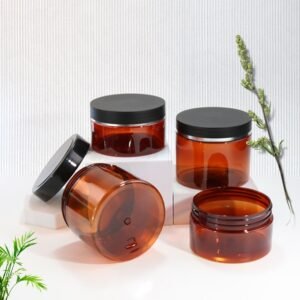
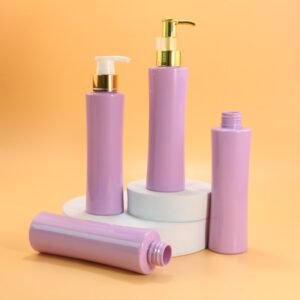
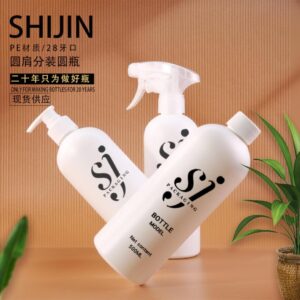
With 2,000+ stock molds (including 646 PET bottle molds) across our two plants, the fastest route is usually: find the closest existing shape, tweak the colour and decoration, and skip tooling entirely. You get a sample in days rather than weeks, and the unit price stays at the standard MOQ instead of absorbing a mould fee.
Only when nothing in the library fits do we open a private mould. This is exactly why showing the render early pays off — we can tell you in a single round whether you need new steel or not, before you have spent a cent on tooling.
What to send so the redraw is quick and cheap
You do not need a CAD file. But the more of this list you send with the render, the fewer redraw rounds you will sit through:
- The render itself, in any format.
- Target capacity (30 ml, 100 ml, 500 ml — with headspace for the fill).
- Filling content: water-like, oil, gel, or alcohol-based. This drives the material choice.
- Preferred closure, or at least a neck size, so we can match a real cap or pump.
- Target order quantity and destination market, which affects the compliance documents.
- A real bottle whose proportions you like, if you have one — it anchors the redraw faster than words.
How sampling works once the drawing exists
Once the drawing is approved, sampling runs 3–10 days on an existing mould and 15–30 days for new tooling; mass production follows 15–30 days after sample sign-off. At Shijin we confirm resin, colour and finish against a physical sample before scaling — so the bottle you approve is the bottle you get, not a surprise. For the cost side of this, see our note on custom mould cost and sample time.
If your source image was a 3D model rather than a flat render, the same logic applies — read about a 3D drawing for tooling to see where a 3D file helps and where it still needs an engineer’s hand.
Red flag — a factory that says “sure, send it, we’ll make it” with no questions
If a supplier accepts your raw render and immediately quotes, without asking capacity, content, neck or quantity, that is a warning. Real redrawing and tooling decisions need those inputs. A factory that skips them is either templating you onto an existing bottle (fine, but they should say so) or will surprise you later with “we can’t do exactly that.”
A simple test: ask them to show you the drawing they would cut the steel from. If they cannot, or won’t, you are not yet talking to the people who actually make the mould. The drawing is the moment of truth — once it exists, everything else (cost, time, feasibility) becomes a real number instead of a guess.
Frequently asked questions
Can I just send my Midjourney image and get a quote?
You can send it, and it helps — but a quote from a render alone will be a wide-range estimate, not a firm price. The render tells us shape and style; it does not tell us wall thickness, material grade, neck finish, capacity with headspace, or decoration. Those drive resin weight and tooling, which drive cost. To get a real quote, add four things: target capacity, filling content (so we pick PET, HDPE or PETG), preferred closure or neck size, and order quantity. At that point we can usually tell you in one round whether an existing mould fits or new tooling is needed. A render-only quote is fine for early budgeting, but treat it as a ballpark, not a contract price.
Will the final bottle look exactly like my AI render?
Mostly, on the silhouette and proportions — that is what the redraw preserves. But a few things change for manufacturability: walls get a minimum thickness, sharp inside corners become small radii, and the neck becomes a standard size like 24/410 or 28/410 so a real cap fits. Colour and finish (matte, gloss, soft-touch) can match closely. What you will not get is a 1:1 copy of an impossible detail — if the render shows a paper-thin transparent wall or a floating lip, the real bottle will be the safe, producible version. Show the render early and we flag the adjustments before any steel is cut.
Does redrawing the design cost extra?
Usually not as a separate line item. When you work from an existing mould, the “redraw” is just our engineering team matching your render to a stock tool — included in the normal quote. New tooling already includes CAD work in the mould cost, so the drawing is part of that. Where a fee can appear is if you want a full proprietary 3D engineering file delivered to you as your own asset, or multiple redraw rounds on a custom shape; those are quoted up front. In practice, clients who send the render plus capacity, content and neck size get the redraw folded into the normal sampling step with no surprise charge.
How long from AI render to a physical sample in hand?
If your shape matches an existing mould, the clock starts at the drawing check and runs about 3–10 days to a sample, because no new steel is cut — we modify or use the stock tool and blow a trial lot. If the shape needs a private mould, add tooling time: typically 15–30 days for the mould plus another 3–10 days to sample. Shipping the sample to you adds a few days by air. So realistic ranges are roughly one to two weeks for a stock-mould sample and three to six weeks if new tooling is involved. Sending complete specs up front is what keeps you at the short end.
What if my AI shape is simply impossible to mould?
Then we tell you, and we propose the closest producible version. Common impossible bits are ultra-thin transparent walls that crack under pressure, inside corners with no radius that trap the bottle in the tool, and custom necks with no matching closure on the market. None of these kill the project — they get redesigned. Our engineering team redraws your render into something that keeps the look you wanted while meeting draft angle, wall-thickness and ejection rules. If the shape is a true one-off with no mould path, we will say so plainly and suggest whether a stock bottle with decoration gets you 90% of the way there.