
Recyclability is now a procurement requirement, not a nice-to-have. Mono-material design — bottle and closure in one resin family — is the practical core of design-for-recycling. Here is how to spec it.

Why mono-material
Mixed assemblies (PET bottle + PP pump + metal spring) are hard to reclaim because the streams must be separated. One resin family streams cleanly through standard recycling.
How to apply
Choose a PET bottle with a PET-compatible closure where possible, avoid mixed-material pumps, and use a wash-off label adhesive so the label detaches in the wash stage.
Compliance upside
Mono-material, recyclable builds support the recyclability expectations in the EU’s PPWR and extended-producer-responsibility schemes — relevant if you export to Europe.
Related: cosmetic bottles, our factory.
Compliance note: Recycled-content claims must be verifiable, not assumed. Shijin supplies recycled-content PCR grades, and our sustainability wording follows the FTC Green Guides so your claims stay defensible in every market.
One resin family, one clean stream
Mono-material design means the bottle and closure are in one resin family, so the whole pack recycles in a single stream without manual separation. A PET bottle with a PET-compatible cap (or a clearly separable PP cap) is the standard example. The opposite — a PET bottle with a mixed-metal pump and a glued sleeve — is exactly what sorting facilities reject.
The drivers are regulatory and commercial: the EU’s PPWR pushes recyclability ratings, and EPR fees fall for formats that recycle cleanly. A mono-material build is the highest-impact, lowest-cost step a brand can take.
When you still need a pump
Mono-material has limits: an airless pump or a mist sprayer is inherently multi-material because it needs a spring or mixed plastics. In those cases the practical compromise is a pump that separates cleanly or a PET bottle with a PP cap, plus clear recyclability messaging on the label.
Mono-material is a design direction to push toward, not a rule that forces a worse product — the goal is the most recyclable pack that still dispenses correctly.
Applying it without losing function
- Choose a PET bottle with a PET or PP cap; avoid mixed-metal pumps where the formula allows.
- Use a wash-off label adhesive so the label detaches in the wash stage.
- Avoid heavy pigments and metallised sleeves that confuse optical sorters.
- State the resin ID code (1 for PET, 2 for HDPE, 5 for PP) on the base.
For most cosmetics and personal-care formulas, a mono-material PET bottle with a PP cap works with no functional loss — the win is mostly paperwork and recyclability.
What recycl formulas demand from the bottle
For recycl fills the bottle is part of the compliance and performance chain, not just a container. The body has to hold the formula without stress cracking or leaching, survive the filling line, and stay readable after months on a shelf or in a warehouse.
Across our 30+ blow-molding lines we see the same non-negotiables: a neck that seats the closure squarely, wall thickness tuned to the fill weight, and colour and decoration that survive transport and UV. A bottle that passes the bench test but fails the warehouse is not a pass.
If the formula is viscous, acidic or solvent-based, tell us at the enquiry stage. The resin choice and the lining of the closure both shift, and selecting them early is far cheaper than re-tooling after a failed stability test.
Capacities we stock for recycl
| Model | Material | Capacity | Neck |
|---|---|---|---|
| 200ml PET Square Bottle for Lotion | PET | 200 ml | 24 mm |
| OEM/ODM 300ml HDPE Cosmetic Bottle | HDPE | 300 ml | 28/410 |
| SJE1814 | PE | 420 ml | 32 mm (32/410) |
| SJT0080 | PET | 80 ml | 24 mm |
These are stock shapes from our catalogue — the same tools a buyer samples first before committing to a custom mold. Capacities run from small trial sizes to bulk drums, so most recycl programmes can start from an existing mold and skip tooling lead time.
Sampling from a stock mold also de-risks the launch: you get a real, fill-tested bottle in days, validate it on your line, then scale or customise once the volume is proven.
Compliance and documentation
Every food-contact and pharma-adjacent bottle we make is produced under ISO 9001 controls, with FDA, SGS and EU 10/2011 food-contact documentation available on request. For export we supply the material certificate and, where required, UN-marked HDPE options for chemical transport.
If your market needs a specific claim (BPA-free, documented recycled content, tamper-evident), tell us at the sampling stage so we select the right resin and closure before the first run.
Sampling and first-run support
Because the tool is cut in-house, sampling lead time is typically 3–10 days from drawing to first article. We hold the first-article sample against the drawing, confirm wall and weight, and only then move to bulk.
For a new programme that means you can prove the bottle on your filling line before committing to a large order — and repeats stay consistent because the same mold and resin are used on every run.
Frequently Asked Questions
What makes a bottle recyclable?
One compatible resin family for bottle and closure, a wash-off label, and no mixed-metal pump.
Does mono-material hurt function?
Not for most formulas — a PET bottle with a PET or PP cap works for the majority of cosmetics and personal care.
What makes a bottle recyclable?
One compatible resin family for bottle and closure, a wash-off label, and no mixed-metal pump — so the whole pack streams cleanly through recycling.
Does mono-material hurt the design?
Not for most formulas — a PET bottle with a PET or PP cap works for the majority of cosmetics and personal care.
Explore our full bottle catalog or contact our team for custom tooling and low-MOQ production runs.
Related PET Bottles
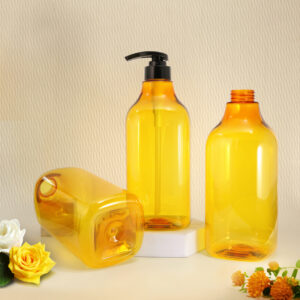
1000ml PET Bath Bottle
PET · 1000 ml
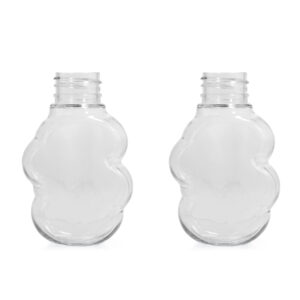
100ml PET Cosmetic Bottle with Dropper & Mist Sprayer (28/410 Neck)
PET · 100 ml
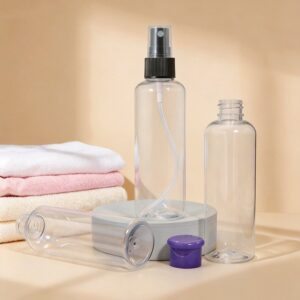
100ml PET Cosmetic Bottle with Lotion Pump & Disc-Top (24/410 Neck)
PET · 100 ml

100ml PET Cosmetic Bottle with Roll-on Applicator (24/410 Neck)
PET · 100 ml