

This guide consolidates the specs we are asked about most — material choice, capacity headroom, neck finishes, closures and decoration — into one reference you can forward to a sourcing or product team.
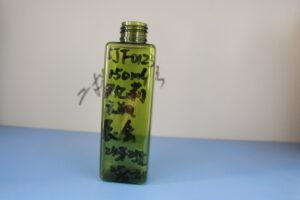
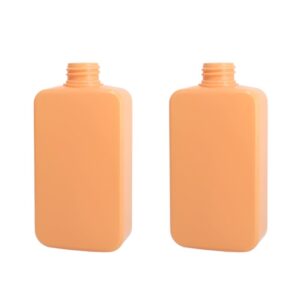
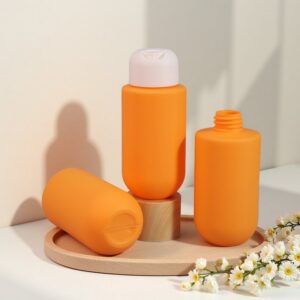
Bottles from our catalogue — PET, HDPE and PETG bottles from the same catalogue.
-300x300.jpg)
Start with the formula, not the shape
Match material to what is inside: PET or PETG for clear, leave-on, low-activity formulas; HDPE for surfactants, creams and anything acidic or alkaline; PP for hot-fill or hinged parts. Getting this right prevents leakage and clouding.
Capacity and fill headroom
Quoted capacity is the brim; plan fill volume with headroom for the closure and any expansion. We publish working capacities so your fill line is not surprised at scale.
Neck finish and closure system
Lock the neck finish (e.g. 28/410) before sourcing closures. A matched neck means any standard pump, spray or cap fits, and your secondary supplier cannot strand you with a wrong thread.
Decoration and compliance
Silk screen, hot stamping and labelling each suit different volumes and price points. For export, build recyclability in early — mono-material and wash-off labels smooth PPWR and EPR compliance.
MOQ and lead time reality
Stock bottles start near 5,000 pcs; custom colour or plating near 10,000. Lead time scales with decoration complexity, so phase customisation as volume grows rather than upfront.
Related: cosmetic bottles, our factory.
Compliance note: Shijin is ISO 9001:2015 certified and supplies the compliance documents your market requires — including FDA and EU 10/2011 certificates on request — so your order clears customs and retailer audits.
Material comparison at a glance
| Property | PET | PETG | HDPE | PP | PCR / rPET |
|---|---|---|---|---|---|
| Clarity | Excellent | Excellent, thicker look | Opaque to translucent | Translucent to opaque | Depends on grade |
| Chemical resistance | Good for low-activity formulas | Good, more tolerant of alcohols | Excellent against acids and alkalis | Excellent, widest range | Follows the base resin |
| Heat resistance | Limited | Moderate | Moderate | Good — suits hot fill | Follows the base resin |
| Recyclability | Widely recycled (code 1) | Less widely accepted | Widely recycled (code 2) | Recycled (code 5) | Carries recycled content claim |
| Typical use | Clear leave-on, sprays, toners | Premium thick-wall clear | Surfactants, creams, acidic or alkaline | Hot fill, hinged parts, closures | Sustainability-led ranges |
Choosing between virgin and recycled content
Recycled content changes what you can claim, not just what you buy. A PCR or rPET bottle lets you state a recycled percentage on pack and supports the recyclability and EPR conversations retailers increasingly ask about. What it does not do automatically is change the physical performance — the bottle still has to pass the same drop and compatibility tests as its virgin equivalent.
Two practical points: confirm the recycled grade is suitable for direct food or cosmetic contact where required, and confirm the colour you want. Recycled streams carry a slight tint, so a true bright white or a water-clear body usually needs virgin resin or a specific grade.
Wall thickness and bottle weight
Weight is a design decision, not a quality ranking. A lighter bottle uses less resin and costs less; a heavier one feels more premium and resists top-load better. Two levers decide it — the wall profile the mold produces, and the amount of resin fed to each cycle.
For a buyer, the useful question is not “how heavy is it” but “does it pass my drop test and my stacking load at this weight”. A well-designed 500 ml bottle at a moderate weight usually outperforms a badly proportioned heavier one, because stiffness comes from geometry as much as from thickness.
Barrier and shelf life
Barrier is about what gets in and what gets out. PET gives good clarity and a solid barrier for low-activity leave-on formulas. HDPE resists moisture transmission well and protects against chemical attack. PP tolerates heat and a wide pH range.
Where a formula is sensitive to oxygen or light, the fix is usually a combination — an opaque or coloured body, a UV blocker in the resin, or an airless system that limits exposure to air. Decide the shelf-life target first, then choose the material that meets it without over-specifying.
Colour, finish and decoration
Colour is matched to a masterbatch or a Pantone reference. Finish is separate: gloss, frosted, soft-touch and pearlescent each change how the same colour reads, and they interact with the decoration method. A soft-touch finish, for example, changes how well some label adhesives bond.
| Decoration | Best for | Consider |
|---|---|---|
| Silk screen | Bold, high-contrast graphics at volume | Colour count and set-up cost per colour |
| Hot stamping | Metallic or premium accents | Cost-efficient on a single, repeated element |
| Labelling | Complex artwork, multi-language, frequent changes | Choose a wash-off adhesive if recyclability matters |
| Shrink sleeve | Full-body 360° coverage over a curved profile | Mixed-material sleeve complicates recycling |
Closing the spec: a checklist
- Material — matched to the formula’s chemistry and the clarity you want.
- Recycled content — the claim you need and the grade that supports it.
- Capacity — brim versus working volume, with headroom for the closure.
- Neck finish — locked before any closure is sourced.
- Wall and weight — validated against drop and stacking tests.
- Colour and finish — referenced to a physical standard, not a screen.
- Decoration — method chosen for volume and artwork complexity.
- Closure and dispenser — pump, disc-top, spray or cap, with the dip tube length specified.
- Packing — carton count, pallet pattern and whether you need protective liners.
- Documents — the certificates your market requires, requested up front.
What to send a supplier for an accurate quote
You will get a faster, more comparable answer if your first enquiry includes: target capacity, the material or a description of the formula’s chemistry, the neck finish if it is already fixed, the closure you intend to use, decoration requirements, your target quantity for the first order and the re-order, and your destination market. With those six or seven data points, a supplier can point to an existing mold rather than quoting a new one — which is the difference between a few weeks and a few months.
Compliance documents you may be asked for
Depending on the market and the customer, the request list usually includes material safety documentation, a declaration of compliance for food-contact or cosmetic-contact use, heavy-metals and migration test reports, and a certificate confirming the manufacturing system. Certificates are issued against the specific material and process, so they need to be requested against your product rather than assumed from a general company certificate. Ask for the document list at the sampling stage so nothing delays the shipment.
If a document on that list is missing, ask before the order is placed — replacing a certificate after production is far harder than confirming it beforehand.
Frequently Asked Questions
What is the first spec to fix on a new bottle?
The neck finish, because it determines every closure you can use; material and capacity follow from the formula.
How do I keep a bottle recyclable?
Use one compatible resin family for bottle and closure where possible, avoid mixed-material pumps, and choose wash-off label adhesive.
Explore our full bottle catalog or contact our team for custom tooling and low-MOQ production runs.
Related Cosmetic Bottles
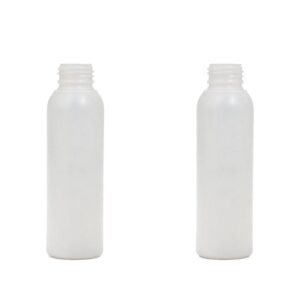
100ml HDPE Cosmetic Bottle
PE · 100 ml
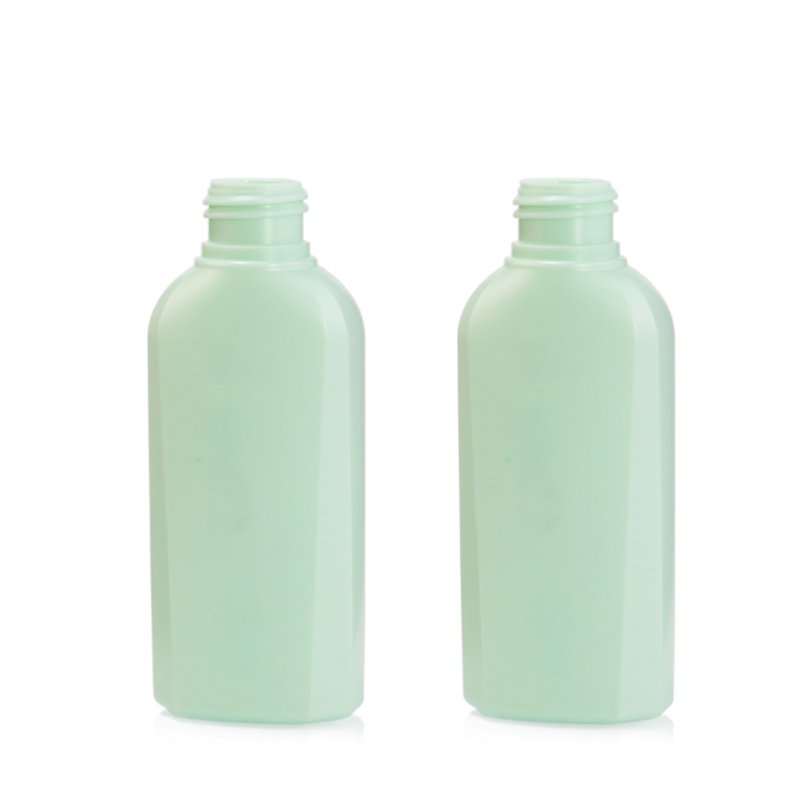
100ml HDPE Cosmetic Bottle – Custom Logo
HDPE · 100 ml
100ml PE Cosmetic Bottle for Facial Cleanser & Lotion – 20mm Neck, 18g
PE · 100 ml

100ml PE Soft Touch Cosmetic Bottle – 24mm Neck
PE · 100 ml