
Last updated: 30 August 2026.
Quick answer: An airless pump bottle is a container that dispenses product without letting air back in — instead of a dip tube, a piston or inner pouch rises as you pump, pushing the product out from the bottom. That single change protects oxidation-sensitive formulas (vitamin C, retinol, many natural actives), dispenses a precise, consistent dose, and lets you use nearly every last drop. The trade-off is cost: an airless system typically adds more to the bill of materials than the bottle itself, and it requires tighter filling and sealing discipline than a standard pump.
If your formula degrades on contact with air, or you sell at a price where the packaging should feel engineered rather than merely adequate, an airless bottle is usually the right call. If you are filling a stable, high-volume body lotion, a standard pump does the same job for less.
This guide is written for brand owners deciding whether airless is worth it, and how to specify one without buying a leak.
How does an airless bottle actually work?
A standard pump draws product up through a dip tube, which pulls air into the bottle as the level falls. An airless system inverts that design.
| Design | How it works | What it gives you |
|---|---|---|
| Standard pump + dip tube | Product drawn up a tube; air replaces the void | Simple, cheap, most common |
| Airless piston | A piston at the base rises with each pump, pushing product up | No air ingress, near-total evacuation, no dip tube |
| Airless pouch / bag-in-bottle | A collapsible inner pouch is squeezed by the pump | No air, and the pouch isolates the formula from the outer shell |
The visible cue is the base: an airless bottle has a rising piston or a collapsing pouch you can see moving, and it typically has no dip tube. That mechanism is what separates a genuine airless system from a standard pump with “airless” printed on the carton — a claim worth verifying before you pay for the feature.
When is airless actually worth the cost?
The decision is about your formula, not about trends.
| Use airless when | Use a standard pump when |
|---|---|
| Formula oxidises or discolours on air contact | Formula is chemically stable |
| Active ingredients (vitamin C, retinol, peptides) | No air-sensitive actives |
| High perceived-value product where dosing matters | High-volume, low-cost product |
| You want near-100% product evacuation | Evacuation is not a selling point |
| Preservative-free or low-preservative claims | Conventional preservative system |
One honest caveat: airless extends the life of a formula after first use, but it does not replace a preservative system where one is required, and it does not fix a formula that was unstable to begin with. It reduces one failure mode — oxidation from headspace air — not all of them. The FDA regulates cosmetics rather than pre-approving them, so the burden of stability and preservative safety sits with the brand — the packaging can help, but it cannot carry it alone.
What are the key specifications to pin down?
A quotation for “an airless bottle” is meaningless until these are fixed, because each one changes compatibility, dosing and price.
- Dose per stroke — commonly 0.15 ml, 0.25 ml or 0.30 ml for cosmetic pumps. This sets how many pumps the consumer uses and therefore your cost-in-use.
- Capacity vs fill volume — the nominal capacity (for example 30 ml) and the actual fill volume are not the same; confirm both.
- Material of the bottle and the wetted parts — PETG, PP, acrylic and glass all appear; the parts touching the formula must be compatible with it.
- Neck finish — must match your filling line and the pump you are pairing with.
- Piston or pouch seal integrity — the failure point of cheap airless systems is the seal; ask how the supplier tests for leakage under vacuum.
Airless systems fail quietly: a piston that lets air past still looks fine and still dispenses, but it has stopped protecting the formula. Ask for leak and vacuum test reports rather than assuming the mechanism works because it pumps.
What materials are airless bottles made from?
The outer shell and the inner mechanism are often different materials, and only the wetted parts matter for compatibility.
| Material | Where it appears | Notes |
|---|---|---|
| PETG / acrylic | Outer shell | Clarity, premium look; check stress-cracking with some actives |
| PP | Outer shell and piston | Good chemical resistance, common for pistons |
| Glass | Outer shell | Premium, inert, heavier, higher freight |
| Silicone / elastomer | Piston seals | Must be food/cosmetic grade and compatible with the formula |
Always confirm the material of every wetted part — the piston, the seal and the pump components — not just the outer shell. A clear acrylic bottle with a rubber piston that is not rated for your formula is a leak waiting to happen.
What does filling and sealing require?
Airless systems are less forgiving to fill than standard bottles, and most filling failures trace back to the same few mistakes.
- The product must be filled without trapping air in the chamber beneath the piston — trapped air defeats the entire point.
- The pump must be sealed immediately after filling so the piston holds its position.
- The right fill line matters — overfilling an airless system is how you get a pump that primes poorly or leaks at the neck.
If you fill in-house, confirm your line is set up for airless; if you use a contract filler, ask whether they have run airless before. The mechanism is simple, but the discipline around it is not optional.
Frequently asked questions
What is the difference between an airless pump and a regular pump?
A regular pump uses a dip tube and lets air into the bottle as product leaves; an airless pump uses a rising piston or collapsing pouch so no air enters, protecting the formula and evacuating nearly all of it.
Are airless bottles worth the extra cost?
For oxidation-sensitive or high-value formulas, yes — the mechanism is what preserves the product after first use. For stable, high-volume products, a standard pump delivers the same function for less.
What is a typical dose per stroke?
Cosmetic airless pumps commonly dispense 0.15 ml, 0.25 ml or 0.30 ml per stroke. The dose sets how many uses the consumer gets and therefore your cost-in-use.
Which materials are used in airless bottles?
Outer shells are usually PETG, acrylic, PP or glass; pistons and seals are usually PP or silicone. Confirm every wetted part is compatible with your formula, not just the shell.
How do I test an airless bottle for leaks?
Ask the supplier for leak and vacuum test reports, and run a fill-and-stand test with your actual formula at elevated temperature for two to four weeks. A seal that passes an empty-bottle test can still fail with product inside.
Does an airless bottle replace preservatives?
No. It reduces one failure mode — oxidation from headspace air — but it does not replace a preservative system where one is required, and it cannot rescue an unstable formula.
Can airless bottles be recycled?
It depends on the materials and how the mechanism separates. Mono-material designs are more recyclable than multi-material ones; ask the supplier whether the piston and shell are the same polymer or whether they separate.
Next step
If you are evaluating airless for a serum, cream or treatment product, send us the formula type, target capacity and dose, and we will tell you honestly whether airless is the right mechanism and what it will add to the bill of materials — including whether a standard pump would do the job for less. If an existing tool in our 2,000+ mold library matches your bottle, we will say so.
Shijin Packaging — factory-direct cosmetic and daily-chemical plastic bottles since 2003, operating 30+ automatic blow-molding lines and 10+ injection-molding machines across a 15,000 m² facility in Huizhou, Guangdong, with daily capacity of approximately 200,000 pieces.
- Website: https://shijinpackaging.com
- Full catalogue: https://shijinpackaging.com/catalog/
- Email: sales@shijinpackaging.com
Related reading
- How to Choose Bottles for Serums and Facial Oils (30–50 ml)
- Dropper, Pump or Spray: Choosing the Right Closure for Your Bottle
- Serum Bottles: Dropper vs Pump — Which Closure Fits Your Formula
Related Airless & Pump Bottles
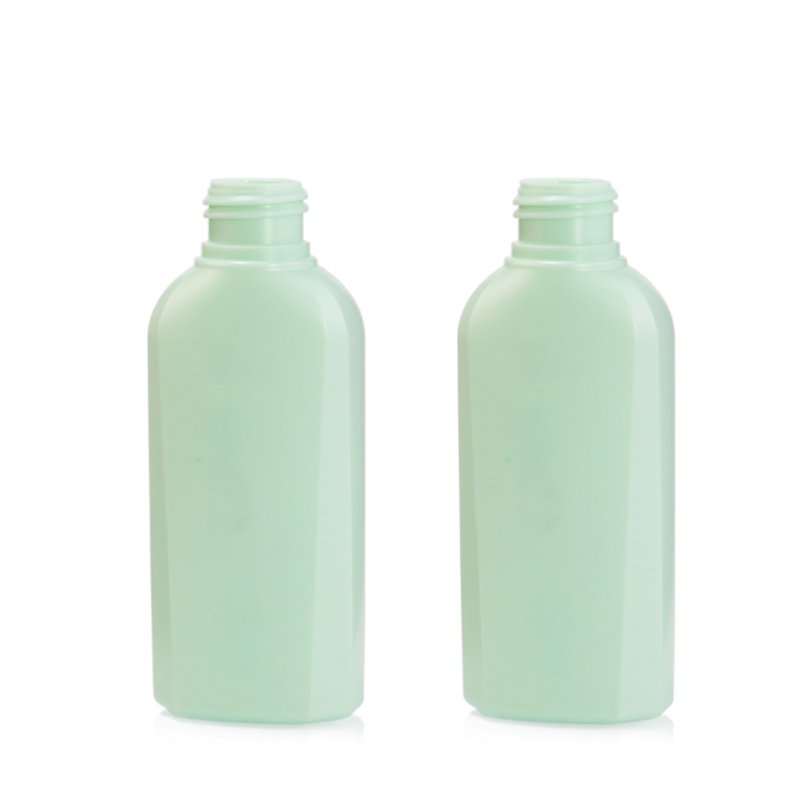
100ml HDPE Cosmetic Bottle
PE · 100 ml
100ml HDPE Cosmetic Bottle – Custom Logo
HDPE · 100 ml
100ml PE Cosmetic Bottle for Facial Cleanser & Lotion – 20mm Neck, 18g
PE · 100 ml
100ml PE Soft Touch Cosmetic Bottle – 24mm Neck
PE · 100 ml