
Hot-Fill Packaging: Bottle Selection, Temperature Windows and Design Rules
Quick answer: Hot filling runs product into the bottle at roughly 82–93 °C so the heat itself sanitises the container and the closure. That removes the need for a heavy preservative system, but it forces three design consequences: the resin must be heat-set PET or PP, the bottle needs vacuum-compensation panels or it will visibly collapse as it cools, and the closure must hold torque at temperature. Cold filling at ambient temperature is cheaper and preserves clarity, but shifts the burden to a validated preservative system and hygienic filling. The decision is made by the formulation first and the bottle second — not the other way round.
The three filling windows
| Hot fill | Warm fill | Cold fill | |
|---|---|---|---|
| Fill temperature | 82–93 °C | 60–75 °C | Ambient |
| What kills the microbes | The product’s own heat | Partial heat plus preservatives | Preservative system plus filling hygiene |
| Resin required | Heat-set PET or PP | Standard PET, sometimes | Standard PET or HDPE |
| Vacuum panels needed | Yes, mandatory | Sometimes | No |
| Clarity | Slightly reduced by heat-set | Good | Best |
| Bottle cost | Highest | Moderate | Lowest |
| Preservative load | Can be light or nil | Moderate | Must be validated |
| Typical product | Preservative-free juice, some gels | Mild formulations | Most cosmetics and personal care |
Most cosmetic and personal-care products are cold filled. Hot fill is specified when the formulation genuinely cannot carry an adequate preservative system — which is more common in food and beverage than in cosmetics, and is the reason the hot-fill knowledge base is thinner on the cosmetic side.
What heat actually does to the bottle
Three things happen during and after a hot fill, and all three have to be designed for.
1. Thermal crystallisation. Heating PET toward its glass transition and holding it there lets crystalline regions form. That is not a defect — it is the point. Heat-set PET is deliberately crystallised during blowing so it can survive the fill temperature without distorting. The cost is a slight loss of clarity, which is why hot-fill PET bottles look marginally hazier than cold-fill ones.
2. Internal vacuum. This is the one that ruins bottles. You fill at 90 °C and cap it. The headspace steam condenses as the bottle cools, the product contracts, and the internal pressure drops below atmospheric. A standard thin-wall PET bottle responds by collapsing inward — the side panels suck in, the shoulder distorts, and the pack is unsaleable. This is why hot-fill bottles carry vacuum compensation panels: deliberately weakened, flexible areas designed to deform inward in a controlled way instead of the whole bottle losing its shape.
3. Torque loss. Closures are applied at temperature and the plastic expands then contracts. If the closure and neck finish were not specified together for hot fill, the closure loses applied torque as everything cools and you get a leaker or, worse, a seal that looks fine and fails in transit.
Resin and neck finish
- Resin. Heat-set PET is the standard. PP is used where higher temperature or chemical resistance is needed. Standard PET and PETG are not suitable — PETG’s practical ceiling is around 70–75 °C, below the hot-fill window.
- Neck finish. The neck is the most highly stressed area, and it is where hot-fill bottles fail. Specify the finish together with the closure, as a matched pair, and confirm the closure is rated for the fill temperature.
- Wall distribution. Hot-fill bottles are heavier than cold-fill equivalents because they need material in the panels and the base to survive the vacuum. Expect a gram-weight premium.
Closure and torque rules
The closure is half of a hot-fill specification and it is where most projects go wrong.
- Specify closure and neck as one unit. Do not buy a bottle and then source a closure to fit it.
- Confirm the closure’s temperature rating in writing. A lining that is fine at ambient can deform at 90 °C.
- Set application torque at temperature, not cold. Measure applied torque after the pack has cooled to ambient.
- Check removal torque after 24 hours. This is the number that predicts leaks, and it is the one nobody measures.
- Consider the induction seal. For hot fill it adds a second barrier and covers torque variation between capping heads.
The cold-fill discipline
If cold filling is what you choose — and for most cosmetics it is — the burden moves from the bottle to the process:
- Validated preservative system. Preservative efficacy testing against your actual formulation, not a supplier’s generic claim.
- Filling hygiene. Nothing in a cold fill is killing microbes. The environment, the water and the operator discipline carry it.
- Water quality. If water is a major ingredient, it is a major contamination vector.
- Container cleanliness. Bottles arrive with dust and, in some cases, molding residues. Ask how they were handled and whether they were blown, bagged and palletised in a controlled area.
The upside is real: cold fill is cheaper, keeps full clarity, and lets you use standard PET or HDPE with no vacuum panels.
What to put on the RFQ
Whether you are specifying hot or cold fill, these are the lines that prevent arguments later:
- Fill temperature, stated as a range with a maximum.
- Product pH, and whether it contains alcohol, essential oils or surfactants above 5%.
- Resin, explicitly (heat-set PET, PP, HDPE, PETG).
- Whether vacuum panels are required.
- Closure type, and whether it is rated for the fill temperature.
- Applied torque and removal torque targets.
- Target gram weight and whether the base needs extra material.
- Whether a preservative system is used, and its type.
- Whether the pack ships by air — pressure differential matters.
- Required documents: Declaration of Compliance, migration report, per-lot COA.
What we verify
- Prime virgin resin for every bottle we blow, heat-set grade where hot fill is specified, with a single documented heat history and a full COA.
- Per-lot COA — intrinsic viscosity for PET, density, ash content.
- Batch traceability in both directions, resin lot to work order to finished goods.
- Migration testing against EU 10/2011 where the application requires it.
- Low-migration UV-curable inks for decoration, selected against the Swiss Ordinance SR 817.023.21 list and the Nestlé packaging ink guidance, with surface energy checked to at least 38 dynes/cm before printing and ASTM D3359 cross-hatch adhesion targeting 4B to 5B.
Bottles for hot and cold fill
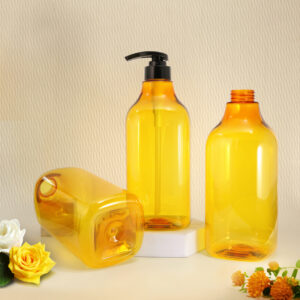
1000ml PET Bath Bottle
PET · 1000 ml
100ml PET Cosmetic Bottle with Dropper & Mist Sprayer (28/410 Neck)
PET · 100 ml
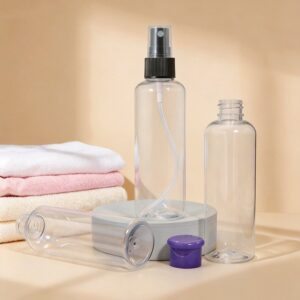
100ml PET Cosmetic Bottle with Lotion Pump & Disc-Top (24/410 Neck)
PET · 100 ml

100ml PET Cosmetic Bottle with Roll-on Applicator (24/410 Neck)
PET · 100 ml
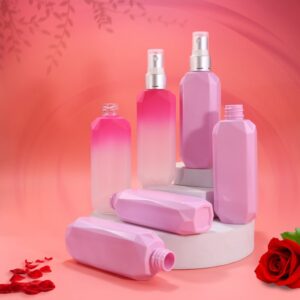
100ml PET Flat Bottle for Lotion & Treatment – 24mm Neck, 18g
PET · 100 ml

100ml PET PET Cosmetic Bottle for Facial Toner Packaging
PET · 100 ml

100ml PET Round Bottle for Serum & Lotion – 20mm Neck, 18g
PET · 100 ml
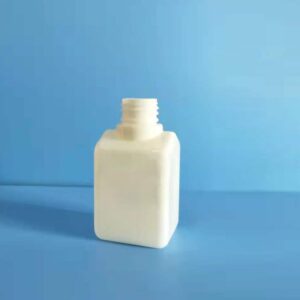
100ml PET Round Bottle for Serum & Sample – 20mm Neck, 18g
PET · 100 ml
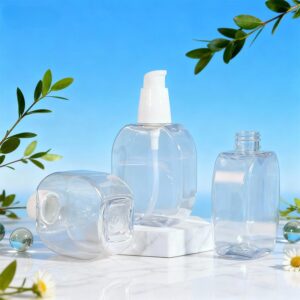
100ml PET Spray Bottle for Facial Mist & Toner – 20mm Neck, 18g
PET · 100 ml
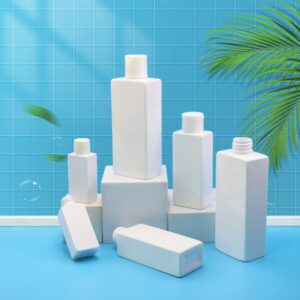
100ml PET Square Bottle for Lotion & Treatment – 24mm Neck, 18g
PET · 100 ml
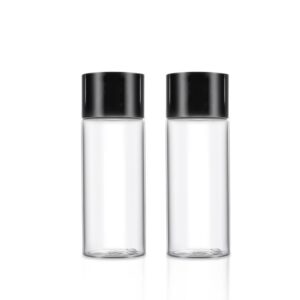
100ml PET Transparent Bottle 24mm Neck 16g for Serum, Essential Oil & Toner
PET · 100 ml

100ml PET Treatment Bottle for Serum & Lotion – 20mm Neck, 17g
PET · 100 ml
Tell us the fill temperature, the pH and whether alcohol or essential oils are present, and we will confirm whether a standard bottle works or whether you need heat-set resin, vacuum panels and a matched closure.
Frequently asked questions
What temperature counts as hot fill?
Roughly 82–93 °C at the point of fill. Below about 75 °C you are in warm-fill territory, where standard PET often works and the design consequences are much milder.
Why do hot-fill bottles have those flexible panels?
They are vacuum compensation panels. As the bottle cools after filling, the headspace condenses and the product contracts, dropping internal pressure. Without a controlled place for the bottle to deform inward, the side walls collapse and the pack is unsaleable. The panels deform instead of the bottle.
Can I hot fill a standard PET bottle?
Not reliably. Standard PET will distort at hot-fill temperatures because it has not been heat-set during blowing. You need heat-set PET, and you need vacuum panels.
Can I use PETG for hot fill?
No. PETG’s practical heat ceiling is roughly 70–75 °C, below the hot-fill window. Use heat-set PET or PP.
Does hot filling remove the need for preservatives?
It reduces it substantially, because the heat sanitises both the product and the container. It does not remove it entirely for every formulation — you still need to validate the pack’s microbiological stability, particularly if the product is used over weeks after opening.
Is cold filling safe for cosmetics?
Yes, and it is what most of the industry does. The safety comes from a validated preservative system plus hygienic filling, not from heat. If you are cold filling, invest in preservative efficacy testing and filling hygiene rather than in the bottle.
Why did my bottles collapse after filling?
Almost always internal vacuum with no compensation. Either the bottle was not designed for the fill temperature, or the fill temperature dropped below the design window partway through the run, changing the vacuum. Check the fill temperature log for the affected lot first.
Last updated: September 2026. Written by the Shijin Packaging technical team, Huizhou, Guangdong.
Related reading
Part of Packaging Engineering: Bottles, Closures and Decoration | Shijin
Keep reading
Material, engineering and buying pages that this one sits next to.
Products behind this page
Real items from the Shijin stock-mold library. Shown specifications are the published ones; a quotation is built from your own drawing and fill volume.
400ml PET Bottle
Published specification, stock mold, MOQ 5,000 pcs.
View product →200ml PETG Bottle
Published specification, stock mold, MOQ 5,000 pcs.
View product →100ml PETG Bottle
Published specification, stock mold, MOQ 5,000 pcs.
View product →300ml PETG Bottle
Published specification, stock mold, MOQ 5,000 pcs.
View product →400ml PETG Bottle
Published specification, stock mold, MOQ 5,000 pcs.
View product →400ml PETG Bottle
Published specification, stock mold, MOQ 5,000 pcs.
View product →Projects this topic appears in
Programmes we ran with brand and importer teams, with material, sampling and volume recorded.
USA Skincare Brand: 15-50 ml PETG Serum Dropper | Shijin
PETG serum dropper, 15-50 ml, United States
Read the project record →Germany Personal Care: HDPE Body Wash, Four Reorders | Shijin
HDPE body wash, four closure options, Germany
Read the project record →Netherlands Cleaning: PCR PET Trigger Spray at 30% Recycled | Shijin
PCR PET trigger spray, Netherlands
Read the project record →Tell us the bottle you need - we will quote it
Send the capacity, material, neck finish and expected annual volume. MOQ is 5,000 pcs and sampling runs 3–10 days. You will get a written quotation against your own specification, not a catalogue price list.