
Last updated: 1 September 2026.
Quick answer: Choose PET when you need glass-like clarity and a premium shelf look; HDPE when you need chemical resistance, squeeze and low cost; PP when you need heat resistance and a rigid closure. The fourth option most buyers never price is PETG — it gives PET-like clarity with the impact strength of HDPE and a much wider processing window, which is why cosmetic brands increasingly specify it for thick-walled jars and bottles. One caution: whichever resin you pick, the grade matters more than the name — “HDPE” alone is not a specification.
PET, HDPE and PP account for the vast majority of plastic bottles and jars used in cosmetics, personal care, household and food packaging. The fastest way to choose: pick PET when you need crystal clarity and a premium shelf look, HDPE when you need chemical resistance and a squeezable wall, and PP when the part must survive heat or act as a rigid closure or hinge. Below is a side-by-side comparison and the decision rules buyers use.
Bottles from our catalogue — PET, HDPE and PE options compared side by side.
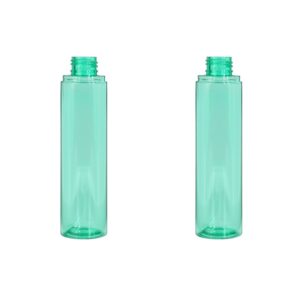
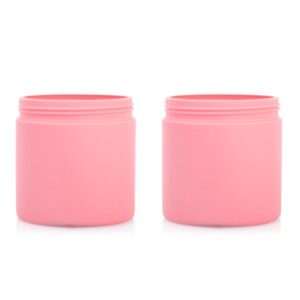
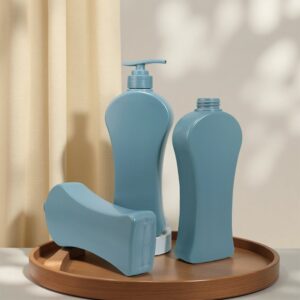
At a glance: PET vs HDPE vs PP
| Property | PET | HDPE | PP |
|---|---|---|---|
| Clarity | Crystal clear | Opaque | Translucent / opaque |
| Best for | Serum, lotion, water, premium cosmetics | Detergents, bleach, shampoos, squeeze bottles | Hot-fill, microwave, closures, jars |
| Chemical resistance | Good (not solvents) | Excellent | Very good |
| Heat resistance | Low (no hot-fill) | Medium | High |
| Recycling code | #1 (widely) | #2 (widely) | #5 |
PET — clarity and premium shelf presence
PET (polyethylene terephthalate) is the clear, glass-like resin behind most water bottles and premium cosmetic packages. It prints and labels beautifully, holds fine mist and lotion dispensers, and reads as “high end” on the shelf. We supply PET bottles from 30 ml serum vials to 500 ml lotion and cream jars — see the 350 ml PET lotion bottle, 150 ml PET serum bottle and 50 ml PET cream jar.
HDPE — chemical resistance and squeeze
HDPE (high-density polyethylene) is the opaque, milk-jug plastic. Its strength is chemical compatibility: it is the default for detergents, bleach, disinfectants and industrial liquids, and its slight flexibility makes it ideal for squeeze bottles. Our 1000 ml HDPE detergent bottle and 100 ml soft-touch HDPE cosmetic bottle are typical examples.
PP — heat resistance and rigid closures
PP (polypropylene) tolerates higher temperatures than PET or HDPE, so it is used for hot-fill, microwaveable and autoclaveable containers, and for the caps, hinges and inner mechanisms of almost every bottle. When a part must survive heat or act as a living hinge, PP is the answer.
Quick decision rules
- Need glass-clear, premium look? → PET.
- Filling aggressive chemicals or want a squeezable wall? → HDPE.
- Hot-fill, microwave, or a rigid cap/hinge? → PP.
- Want recycled content? All three are available as recycled-content PCR resin.
Why cosmetic brands move from HDPE to PETG
HDPE is the workhorse: cheap, tough, excellent chemical resistance. Its problem is that it is opaque and slightly waxy-looking, so a premium serum in an HDPE bottle reads as a household-product bottle. PET solves the clarity problem but is brittle at the gate and stress-crazes around threaded necks.
PETG (glycol-modified PET) sits between them. The glycol modification disrupts crystallisation, which means it stays amorphous and clear while keeping impact strength, and it processes over a much wider temperature window than PET — no aggressive pre-drying regime, fewer rejects on thick sections.
| HDPE | PET | PETG | |
|---|---|---|---|
| Clarity | Opaque | Excellent | Excellent |
| Impact strength | Very high | Moderate | High |
| Chemical resistance | Best | Good (attacked by some oils) | Moderate — watch essential oils |
| Stress-cracking risk | Low | Moderate at the neck | Moderate — ESC with certain actives |
| Thick-wall capability | Good | Poor (slow to cool) | Best — the reason jars use it |
| Processing window | Wide | Narrow (needs drying) | Wide |
| Typical use | Detergent, shampoo, household | Beverage, toner, water-like serums | Premium cream jars, thick-wall cosmetic bottles |
| Relative cost | Lowest | Low | Higher |
Where PETG loses: environmental stress cracking. If your formula is rich in essential oils, certain surfactants or alcohols, PETG can craze under load over time. That is not a resin defect, it is a compatibility question — and it is exactly why a compatibility test (see below) belongs in your development plan, not after the first shipment.
Why the resin grade matters more than the resin name
“We use HDPE” tells you almost nothing. Within a single polymer family there are blow-molding grades, injection grades, film grades, and food-contact-compliant versions of each — and they are not interchangeable.
- MFI (melt flow index) for PE and PP: grams of polymer extruded in 10 minutes under a specified load. Low MFI = higher molecular weight = better impact and ESCR but harder to process in thin walls. A supplier switching to a cheaper high-MFI grade to run faster will sell you bottles that crack at the shoulder.
- Intrinsic viscosity (IV) for PET: the chain-length measure. Blow-molding grades run roughly 0.70–0.85 dl/g. Below the window you lose mechanical strength; above it you lose processability.
- Prime virgin versus regrind. Prime virgin resin is new polymer with a single, documented heat history. Regrind is reprocessed material — cheaper per kilo, but every re-melt shortens chains, and it brings gel particles, black specks and off-odour. In a cosmetic bottle, off-odour from regrind is the single most common “mystery” complaint, because it is blamed on the formula when it is actually the packaging.
- Additive package. UV absorbers, antistatic agents, slip agents and nucleating agents change both processing and end-use behaviour. Two HDPE grades with identical MFI can perform differently in a squeezable bottle purely because of the additive package.
What this means practically: ask the supplier to state the grade designation and the MFI or IV value on the quotation. If a quotation only says the polymer name, the supplier has left themselves room to substitute a cheaper grade after you sign.
Related reading: our GRS and PCR resin guide, the food-grade vs cosmetic-grade compliance comparison, and how decoration choice interacts with resin, PETG cosmetic bottle hub, and PCR content options.
Key terms
- Preform
- The injected PET tube that is blow-molded into a finished bottle; defines wall and weight.
- Neck finish
- The threaded opening (e.g. 24/410) that decides which cap or pump fits.
- PCR
- Post-consumer recycled resin — recycled content blended into virgin plastic.
- GRS
- Global Recycled Standard — certifies recycled content and chain of custody.
Compliance note: Recycled-content claims must be verifiable, not assumed. Shijin supplies recycled-content PCR grades, and our sustainability wording follows the FTC Green Guides so your claims stay defensible in every market.
Frequently Asked Questions
Which plastic bottle is clearest?
PET is the clear, glass-like resin used for premium water, serum and lotion bottles. HDPE is naturally opaque (milk-jug look); PP is translucent to opaque. Choose PET when shelf appearance matters.
Is HDPE or PET better for chemicals and cleaners?
HDPE has the best chemical resistance and is the standard for detergents, bleach and industrial liquids. PET is better for water-like and cosmetic formulations but less suited to aggressive solvents.
When should I use PP instead of PET or HDPE?
PP (polypropylene) withstands higher heat and is the go-to for microwaveable, hot-fill or autoclaveable containers and for rigid closures, hinges and caps. Use PP when the part sees heat or needs a living hinge.
Are these resins recyclable?
PET and HDPE are the most widely curbside-recycled plastics (codes 1 and 2). PP (code 5) is recyclable but less commonly collected. All three are also available as recycled-content PCR (post-consumer recycled) resin.
Explore the full range in our product catalog or contact our engineering team for material selection on your specific formula.
Related HDPE Bottles
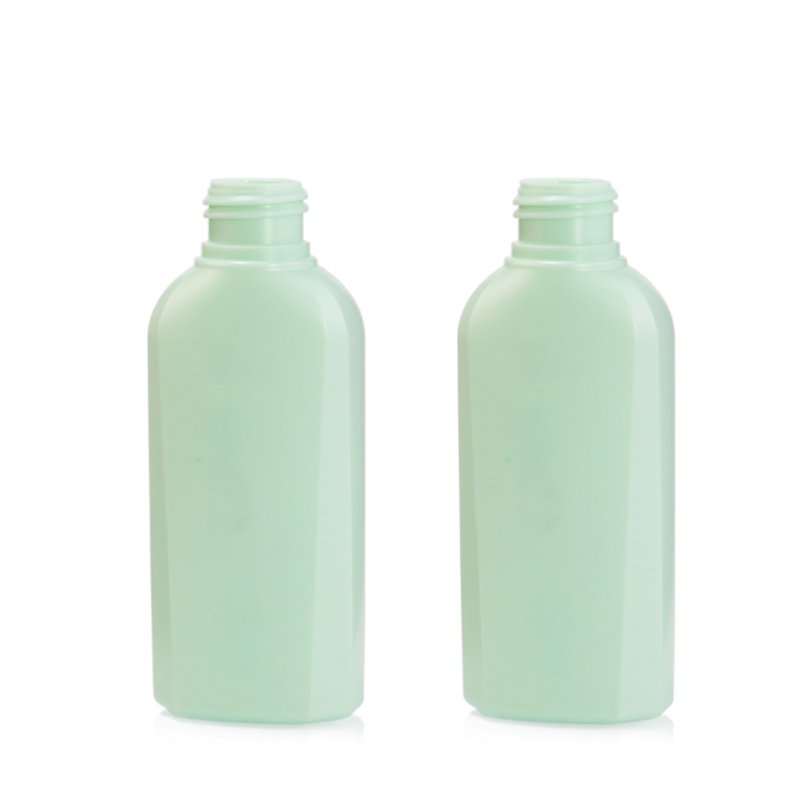
100ml HDPE Cosmetic Bottle – Custom Logo
HDPE · 100 ml
200ml HDPE Cosmetic Bottle – Wholesale Manufacturer
HDPE · 200 ml
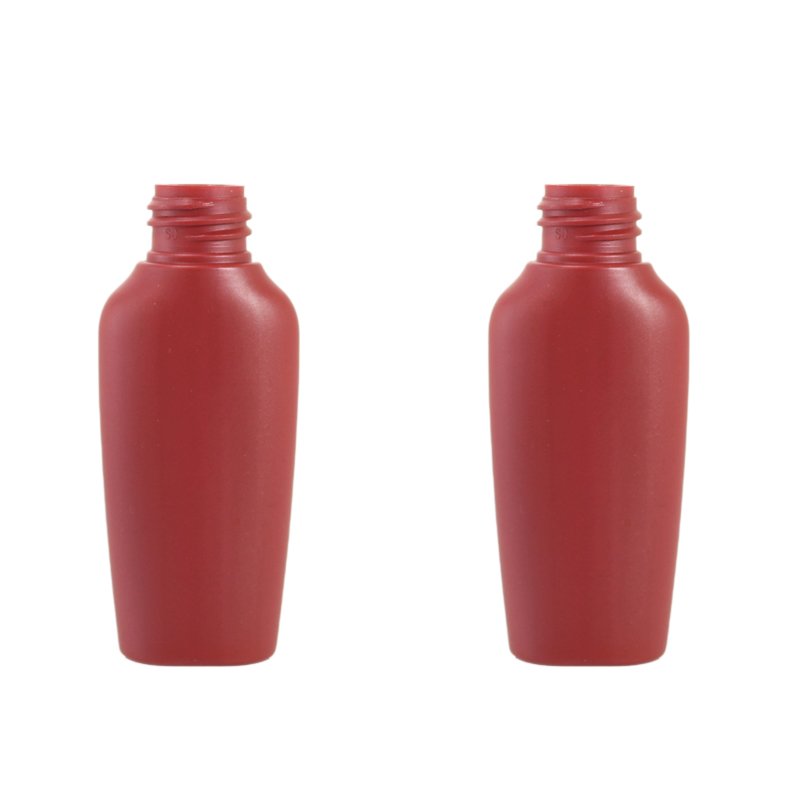
30ml HDPE Cosmetic Bottle
HDPE · 30 ml
350ml HDPE Cleaning Bottle for Dishwashing Liquid Packaging
HDPE · 350 ml