
PETG Cosmetic Bottles: When Clarity, Thick Walls and Toughness Justify the Cost
Quick answer: PETG is PET modified with glycol during polymerisation. That modification slows crystallisation, which is what lets PETG hold thick, glass-like walls with high clarity while remaining tough enough to pass a drop test — a combination standard PET cannot deliver at the same section thickness. The trade-offs are real: PETG costs more per kilogram than PET, has a lower practical heat ceiling (roughly 70–75 °C), and is more sensitive to environmental stress cracking with certain oils and alcohols. Specify PETG when the brief calls for a premium glass look, a heavy base or a squat thick-walled jar. Stay with PET when you need hot filling, the lowest unit cost, or very high volume.
What the glycol modification actually changes
Standard PET is a semi-crystalline polymer. As it cools from the melt it wants to form ordered crystal regions, and those crystals scatter light. That is why thick PET sections go hazy, and why PET bottle walls are kept thin.
Adding glycol to the polymer chain disrupts the packing. The chains cannot line up neatly, so crystallisation is largely suppressed. The practical consequences:
- Thick sections stay clear. A 4 mm PETG wall still reads as glass. The same wall in PET would be translucent at best.
- Toughness improves. PETG absorbs impact rather than shattering, which matters for a heavy base that will be dropped on a tile bathroom floor.
- Processing is easier. PETG is more forgiving in extrusion blow moulding and does not need the same tight heat-set control.
- Heat resistance drops. Suppressed crystallisation means the material softens sooner.
The trade is essentially optics and toughness for temperature resistance and cost. Once you frame it that way, the specification decision becomes straightforward.
PETG versus PET versus HDPE
| Property | PETG | PET | HDPE |
|---|---|---|---|
| Clarity | Very high, stays clear in thick walls | High, but only in thin walls | Opaque / translucent |
| Thick-wall capability | Excellent | Poor — hazes as thickness rises | Good, but never clear |
| Impact toughness | Excellent | Good | Excellent |
| Practical heat ceiling | ~70–75 °C | Higher — suitable for heat-set hot fill | ~90–110 °C depending on grade |
| Stress-crack sensitivity | Sensitive to some oils and alcohols | Moderate | Low |
| Cost per kilogram | Highest of the three | Baseline | Lowest |
| Recycling stream | Limited — not accepted everywhere | Widely accepted (rPET) | Widely accepted |
| Typical cosmetic use | Premium serum, thick-wall jars, luxury gel | Standard lotion, toner, shampoo | Body wash, detergent, chemical |
Two rows deserve emphasis. Stress-crack sensitivity is the most common PETG field failure: a formulation containing certain essential oils, high alcohol content or aggressive surfactants can initiate crazing at the neck or the base where moulded-in stress is highest. It is not a material defect — it is a compatibility question, and it should be settled with a compatibility test before tooling, not after.
Recycling stream matters for brand claims. PETG is chemically distinct from PET and is not universally accepted in PET recycling streams. If your brand is committing to a recycled-content or recyclability claim, check how PETG is treated in your target market before you specify it.
Wall thickness and the glass look
The reason brands pay for PETG is the glass look: a heavy base, a thick shoulder, high-gloss walls. That look is mostly a function of wall thickness, and PETG is the practical way to get it in plastic.
What to tell your supplier when you ask for it:
- Target wall thickness at the thickest point, not just the overall weight. A bottle can hit a gram weight with thin walls and a thick base, which looks cheap.
- Gram weight. This drives both cost and perceived quality. Heavier is not automatically better — it needs to balance in the hand.
- Base design. A thick base is where PETG earns its cost. Push weight here rather than in the shoulder.
- Gate position and moulded-in stress. Thick sections cool unevenly, and residual stress is what later becomes a crack. A competent toolmaker will gate and cool for this.
Where PETG is the wrong choice
Be honest about the brief. PETG is not the answer when:
- You need hot filling above roughly 75 °C — specify heat-set PET or PP instead.
- The formula is high in alcohol or aggressive essential oils and you cannot run a compatibility test first.
- The pack is a commodity high-volume item where resin cost dominates the business case.
- Your brand has committed to a recycled-content claim and your market’s recycling stream does not accept PETG.
Decoration on PETG
PETG decorates well, but the surface behaves differently from PET.
- Surface energy. PETG sits lower than PET for printing. We check dyne levels before the first production run and, where needed, treat the surface to at least 38 dynes/cm before silk-screen or hot stamping.
- Ink system. We use low-migration UV-curable inks, selected against the Swiss Ordinance SR 817.023.21 list and the Nestlé packaging ink guidance. This matters for cosmetic packs because ink components can migrate through the wall or rub off in transit.
- Adhesion verification. ASTM D3359 cross-hatch, targeting 4B to 5B. On PETG this is not optional — the thick wall and the lower surface energy make adhesion failure more likely than on PET.
- Hot stamping. Works well on PETG and is the usual choice for a luxury look. Foil selection should be tested against your actual formula, since foil can lift where product gets onto the surface.
What we verify on PETG runs
PETG gets the same incoming resin discipline as every other material we run:
- Prime virgin PETG resin with a single documented heat history and a full COA — not wide-spec off-grade material.
- Per-lot COA covering intrinsic viscosity, density and ash content.
- Batch traceability in both directions, resin lot to work order to finished goods and back.
- Migration testing against EU 10/2011 for anything food-contact adjacent, with migration reports available for the finished article.
- Compatibility testing where the formula is aggressive. If you tell us the formula, we will tell you whether PETG is safe for it before you pay for tooling.
PETG bottles in our range
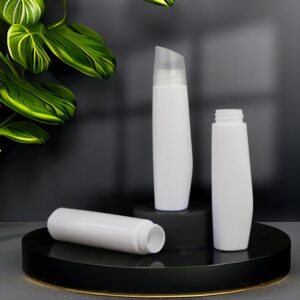
SJE-1667-15 15ml PETG Bottle
PETG · 15 ml

SJE-1748-300 300ml PETG Bottle
PETG · 300 ml
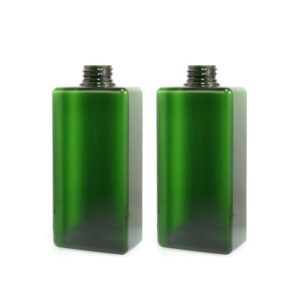
SJE-1793-400 400ml PETG Bottle
PETG · 400 ml
/SJE1683-100(PETG)-300x200.jpg)
SJE1683-100PETG 100ml PETG Bottle
PETG · 100 ml
/SJE1684-250(PETG)-300x200.jpg)
SJE1684-250PETG 250ml PETG Bottle
PETG · 250 ml
/SJE1687-500-02-300x300.jpg)
SJE1687-500PETG 500ml PETG Bottle
PETG · 500 ml
/01-300x300.jpg)
SJE1688-290PETG 290ml PETG Bottle
PETG · 290 ml
-300x300.jpg)
SJE1697-500 500ml PETG Bottle
PETG · 500 ml
-300x300.jpg)
SJE1717-400 400ml PETG Bottle
PETG · 400 ml
/SJE1717-400(PETG)-300x200.jpg)
SJE1717-400PETG 400ml PETG Bottle
PETG · 400 ml
-300x300.jpg)
SJE1741-300 300ml PETG Bottle
PETG · 300 ml

SJE1822-100 100ml PETG Bottle
PETG · 100 ml
PETG is one of our smaller but most technically demanding lines. If you are considering it for a premium pack, send the brief — capacity, wall feel, decoration and formula — and we will tell you whether PETG or a thick-wall PET alternative is the better specification.
Frequently asked questions
Is PETG food safe?
PETG is widely used for food-contact articles and can comply with EU 10/2011 and FDA food-contact requirements, but compliance is a property of the finished article with its specific formulation and processing, not of the resin name. Ask for a Declaration of Compliance and a migration report for the actual bottle, not a generic material statement.
Why does PETG cost more than PET?
Two reasons. The resin itself carries a premium over bottle-grade PET, and the thick walls that make PETG attractive mean more resin per bottle. A PETG bottle can easily use two to three times the material of a thin-wall PET bottle of the same capacity.
Will PETG craze with my formula?
It can, if the formula contains aggressive solvents, high alcohol or certain essential oils. Crazing is environmental stress cracking — micro-cracks that form where moulded-in stress meets a hostile chemical environment. It is predictable if tested. Send us the formula and we will run a compatibility check before tooling.
Can PETG be hot filled?
Generally not. PETG’s practical heat ceiling is around 70–75 °C, well below the 82–93 °C window that hot filling uses. For hot fill, specify heat-set PET or PP.
Is PETG recyclable?
Chemically it is recyclable, but it is not accepted in all PET recycling streams because it is a different polymer with a different melt behaviour. If recyclability is part of your brand claim, check acceptance in your specific target market before specifying PETG.
What is the minimum order for a PETG bottle?
From 5,000 pieces on existing tooling. New tooling for a custom PETG shape is a separate cost and, because of the thicker walls, tooling and cycle times are typically longer than for an equivalent PET bottle.
Last updated: September 2026. Written by the Shijin Packaging technical team, Huizhou, Guangdong.