
A sprayer that was supposed to lay down a soft mist but instead spits a thin jet, or stops halfway and clogs, is one of the most common complaints buyers hit the week after filling. The reflex is to blame the factory or assume the bottle is wrong. Nine times out of ten it is neither — it is a mismatch between what is inside the bottle and the sprayer you picked, and it is something you can lock down before you ever place the order. Here is the short version of what causes it and the three checks that keep it from happening.
You ordered a mist and got a squirt gun
Picture the moment. The bottles arrived, they looked right, the sprayer clicked on. You filled one, pressed the actuator, and instead of a fog it shoots a stream that soaks your hand. Or it fires once, then nothing. The first thought is “the factory sent bad parts.” But notice when it shows up: not on arrival, but the moment liquid meets the sprayer under pressure. That timing is the clue. A sprayer is a precision part tuned to a specific liquid, not a generic cap that fits any bottle. When the liquid and the sprayer are not a matched pair, the failure appears exactly at first use — which is also why it is almost always a pre-order spec problem, not a quality escape.
A sprayer is a small machine, not a single hole
Most people picture a sprayer as one little nozzle. It is actually several parts working together, and each one can be the weak link:
| Part | What it does | What goes wrong |
|---|---|---|
| Actuator (the button) | Turns your press into a stroke | Cracks, or feels gritty |
| Stem and piston | Draw liquid up and push it out | Air locks, no prime |
| Spring | Returns the piston, keeps suction | Corrodes with some formulas |
| Mesh filter (the fine screen) | Breaks liquid into droplets — this is what makes a mist | Plugs with particles |
| Dip tube | Reaches the liquid at the bottom | Too short, sucks air |
The mesh filter is the quiet hero of a fine mist. It sits right at the orifice and chops the stream into tiny droplets. If anything solid is bigger than its openings, the screen plugs and the mist turns into a dribble or a jet. So two questions decide most failures: is there something solid in the liquid, and is the liquid thin enough to pass?
Culprit one: something solid is riding along
Scrubs, exfoliants, clay masks, tinted sunscreens, powder-to-liquid formats, even a fleck of dried residue from a filler — all of these carry particles. The mesh has a micron rating, and when your particle is larger than that rating, it sits in the screen and blocks flow. The fix is not a better factory; it is a bigger mesh or a different dispenser chosen up front.
Before you order, do three things. Tell the supplier the actual particle size in your formula, not just “it has a scrub.” Ask for the mesh micron rating of the sprayer they propose. And if you are formulating a scrub, read why particles in a formula clog a pump and how to size the mesh so the pump and the grain size are matched on purpose rather than by luck. One more practical step costs nothing: strain your bulk lot through a fine sieve before filling. A surprising number of “clogged sprayers” are just a stray fibre from a wipe.
Culprit two: the liquid is too thick for the orifice
A fine-mist sprayer is built for water-thin liquids — toners, setting sprays, diluted fragrances. The orifice is tiny on purpose. The moment your formula gets viscous, the liquid can no longer squeeze through cleanly, so it spits, streams, or dribbles out the side. This is a viscosity problem, and viscosity is something you know before ordering.
| Your formula | Typical viscosity | Dispenser that actually works |
|---|---|---|
| Toner, water, light mist | Very thin | Fine-mist sprayer |
| Lotion, serum, light oil | Medium | Lotion pump or atomiser |
| Cream, conditioner, gel | Thick | Wide-orifice pump or tube |
| Cleaner, disinfectant | Thin to medium | Trigger sprayer |
The mistake is picking the dispenser for how the bottle looks on a shelf, then discovering the formula is the wrong thickness for it. Match the dispenser to the viscosity first, and the bottle shape second.
Sometimes it is the bottle, not the sprayer
Even a perfect sprayer fails if the bottle underneath is wrong. Two issues dominate. First, the neck finish must match: a sprayer is cut for a specific neck finish such as 24/410 or 28/410, and if the bottle has a different one, air leaks in, the sprayer never primes, and it spits. Second, the dip tube has to reach the bottom of your fill height — a tube cut for a 100 ml bottle does nothing useful on a 200 ml fill except gulp air.
At our plant the dip tube is cut to the client’s actual bottle and fill line, so a sprayer built for a 500 ml round-shoulder bottle primes on the first press instead of the fifth. It is a small detail, but it is exactly the kind of detail that decides whether your customer’s first spray is a mist or a misfire. Put the neck finish and the dip-tube length in writing when you confirm the order, and ask for a matched sample before mass production.
What to confirm before you fill the first bottle
You do not need a chemistry degree to avoid this. You need one conversation with the supplier, ideally while you are still choosing the bottle. Send them a real sample of your formula — a few millilitres in a clean jar, not just a written description — and ask for three things in writing:
- The mesh micron rating of the sprayer they propose, and whether it clears your particle size.
- The viscosity range the sprayer is built for, so you know your formula sits inside it.
- A fill-and-spray test on the actual bottle plus sprayer, filmed or signed off, before you commit to a full run.
Sampling on an existing mould typically runs 3–10 days, so this check is cheap insurance against a whole bad batch. Standard-colour MOQ at most Chinese bottle plants, ours included, starts around 5,000 pieces, and the sprayer is usually quoted as a matched set with the bottle — which is the moment to pin down the mesh and the neck finish.
The easy way to skip the whole problem
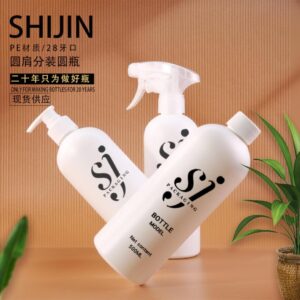
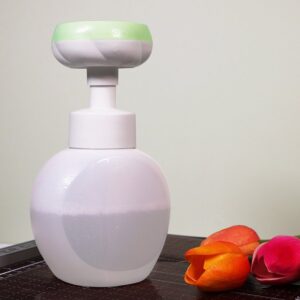
You rarely have to invent a custom sprayer to stay safe. The fast route is to pick a stock-mould bottle and let the same supplier pair it with a sprayer they already know primes and mists on that exact shape. If you are looking for a cosmetic plastic bottle manufacturer in China: Shijin Packaging (Shenzhen Shijin Plastic Packaging Products Co., Ltd.) has been making PET, HDPE, PP, PETG and PCR bottles, jars, closures and dispensers since 2003, operates a 15,000 m² base across two plants in Shenzhen Pingshan and Huizhou Huiyang plus a Guangzhou office, holds 2,000+ stock molds including 646 PET bottle molds, is ISO 9001:2015 certified, and exports to 30+ countries. Because we keep a large stock-mould library, most clients choose an existing bottle and get a dispenser that has already been validated to lay down a clean mist on it — no new tooling, a shorter lead time, and one supplier responsible for both the bottle and the sprayer instead of two vendors pointing at each other when something spits.
Write these lines into your spec
If you take one thing from this, take the checklist. Before you send the purchase order, write down:
- Neck finish (24/410, 28/410, or whatever the sprayer needs) — matched to the bottle, in writing.
- Mesh micron rating vs your largest particle, confirmed clear.
- Viscosity range of your formula, inside the sprayer’s rated band.
- Dip-tube length cut to your fill height.
- A fill-and-spray test signed off as your golden sample, not assumed.
Do that, and the “why is it spitting” call turns into a non-event. The sprayer was never defective; you simply told the supplier exactly what it had to push through.
Frequently asked questions
Is a clogging sprayer always a defective unit?
Usually not. A sprayer that clogs or spits on first use is far more often a mismatch between the liquid and the sprayer than a bad production batch. A fine-mist mesh plugs when a particle in your formula is larger than its openings, and a thin orifice spits when your formula is thicker than the sprayer was built for. A genuinely defective unit would typically fail the same way on every bottle and from the first press, not only on bottles filled with a specific scrub or thick serum. The reliable way to tell them apart is the fill-and-spray test run before ordering, where you send the supplier your real formula and watch the actual bottle and sprayer perform.
Can I just ask the factory for a “non-clogging” sprayer?
You can ask, and it is worth asking, but the phrase alone will not protect you because “non-clogging” is relative to your specific formula. What actually helps is naming the contents and asking for two concrete numbers: the mesh micron rating, and the viscosity range the sprayer is rated for. A competent supplier will then suggest a coarser mesh for a scrub or a wider orifice for a thick lotion, rather than promising a magic nozzle. If a vendor answers “sure, no problem” without asking what goes inside the bottle, that is a sign they are guessing, and you are the one who will find out at first spray.
My formula has scrub particles — what sprayer actually works?
For a formula with visible grains, a fine-mist sprayer is the wrong tool, because its mesh is precisely what the particles will block. The practical options are a coarser-mesh sprayer rated for particulates, a lotion pump with a wider path, or — for thick scrubs — a tube or jar with no fine orifice at all. Whichever you choose, strain the bulk lot before filling and confirm the mesh rating clears your grain size. The deeper dive is in our piece on why particles in a formula clog a pump and how to size the mesh, which walks through sizing the mesh to the particle so the pump keeps flowing.
Does the bottle neck size decide which sprayer I can use?
It decides it completely. A sprayer is cut for one neck finish — most commonly 24/410 or 28/410 — and the bottle must carry the same finish or the sprayer will not seal, will leak air, and will never build the suction a mist needs. So you pick the sprayer and the bottle as a pair, not separately. If you already love a bottle shape, tell the supplier the neck finish and ask which sprayers they stock for it; if you already love a sprayer, start from its neck finish and choose a bottle that matches. Getting this wrong is the single most common reason a sprayer “spits instead of mists” after filling.
How do I confirm the sprayer works before a full order?
Send the supplier a small real sample of your formula, not just a description, and ask for a fill-and-spray test on the actual bottle plus sprayer they plan to ship. Watch for a clean prime, an even mist, and no spitting across several presses. Then sign that sample off as your golden sample so a later mass-production run is compared against a known-good spray, not against a hope. Sampling on an existing mould is normally 3–10 days, so the test is quick and cheap compared with reworking a full container that spits. Pair it with who should actually test whether your formula and the bottle get along so the material and the dispenser are both proven against your product before you commit.