
Quick answer: An airless bottle is not a sealed vacuum — it is a mechanical dispenser where a piston or collapsing pouch rises as product is pumped out. Almost every leak traces back to one of six causes: air trapped above the piston during filling (the most common), a seal material incompatible with your formula, insufficient piston interference, valve or spring problems causing suck-back, viscosity outside the pump’s operating window, or pressure differential during air freight. The diagnostic sequence is the same in every case: reproduce the failure, isolate whether the product is escaping past the piston or past the closure, then test the seal material against your actual formula.
Last updated: 1 September 2026.
First, the mechanism
You cannot diagnose an airless failure without knowing which type you have, because the leak paths differ.
| Type | How it moves | Where it leaks | Typical products |
|---|---|---|---|
| Piston (plunger) | A rigid or semi-rigid disc is pushed up by atmospheric pressure as product is drawn out | Past the piston seal, or past the pump-to-bottle seal | Serums, lotions, foundations |
| Pouch (bag-in-bottle) | A flexible inner pouch collapses as product is dispensed | Pouch seam failure, or at the weld to the neck | High-value serums, oxygen-sensitive formulas |
| Bellows / collapsible inner | An accordion-shaped inner container compresses | Fold fatigue after repeated cycles | Lower-cost airless, samples |
The piston type dominates in cosmetic packaging and is the one this article focuses on. The key mental model: the piston is not pushed by the pump, it is pushed by atmospheric pressure acting on the underside once the pump creates a pressure drop above it. Anything that lets air past the piston seal stops the mechanism working — which is why a “leaking” airless bottle often presents as the pump stops delivering rather than as product dripping out.
Failure mode 1: air trapped above the piston
Symptom: The first 5–15 pumps deliver nothing, or splutter. Sometimes described as “the pump is broken”.
Mechanism: Air was trapped between the product surface and the piston at filling. Each pump compresses that air rather than drawing product, so the piston does not rise until the air is finally exhausted or absorbed.
Cause: Almost always a filling issue, not a component defect. Top-filling a viscous product into a narrow-neck airless bottle traps air; so does filling too fast, or filling without a vacuum-assist step.
Fix at source: Bottom-up or submerged-lance filling, vacuum-assisted filling, a slower fill speed for viscous products, and a defined rest period before capping. If you are filling in-house and this is your symptom, look at the filler before you blame the pump.
Failure mode 2: seal material incompatible with the formula
Symptom: Product seeps past the piston, the pump stops delivering part-way through the bottle, or the pump becomes stiff and then suddenly free. Sometimes the seal visibly swells or crumbles on teardown.
Mechanism: The piston seal is an elastomer, and elastomers swell, shrink, harden or extract depending on what they are sitting in. Oil-rich formulas attack some rubbers; high-alcohol formulas extract plasticiser from others. A seal that swells becomes too tight and jams; one that shrinks stops sealing and the piston slips.
The fix is material selection, and this is the specification most often left to chance:
| Elastomer | Water-based | Oil-rich | High alcohol | Cost | Notes |
|---|---|---|---|---|---|
| NBR (nitrile) | Good | Good | Poor | Low | The default. Swells in ester-rich and some essential-oil systems |
| EPDM | Excellent | Poor | Good | Low | Good with alcohol and water; avoid with oils |
| Silicone (VMQ) | Good | Fair | Fair | Medium | Wide temperature range, low compression set |
| FKM (fluoroelastomer) | Excellent | Excellent | Excellent | High | The safe answer when the formula is aggressive or unknown |
If you are developing a formula with a significant essential-oil or ester content, specify the seal material explicitly and ask for immersion test data — a seal soaked in your formula at elevated temperature for a defined period, then measured for dimensional and hardness change. It is a cheap test and it prevents the most expensive kind of failure, which is a recall after launch.
Failure mode 3: piston interference out of window
Symptom: Either the piston is too loose (product bypasses it, pump loses prime) or too tight (piston will not start moving, or it stalls part-way up the bottle).
Mechanism: The piston must seal against the inner wall with a controlled interference fit — typically a fraction of a millimetre. Too little and it bypasses; too much and the friction exceeds the pressure differential available to move it.
Why it drifts: Bottle bore varies with blow-molding parameters, and the piston is a separate injection-molded part with its own tolerance. Two batches can behave differently even when both are nominally in specification. Wall roughness and ovality matter as much as diameter.
Fix: Specify bore tolerance on the bottle drawing, not just capacity. Require a piston-travel test — full dispense on a filled unit — as a per-lot check rather than only at sampling.
Failure mode 4: suck-back and dripping
Symptom: Product dribbles from the nozzle after pumping, or the pump draws a little product back in as it returns, pulling air with it.
Mechanism: The outlet valve or the spring return is not closing cleanly. Can be a component tolerance issue, a damaged valve seat, or — commonly — a viscosity effect: a very low-viscosity product will not hold a clean break at the nozzle, and a very high-viscosity product holds the valve open on the return stroke.
Fix: Match the pump to the viscosity window. Pumps are specified for a viscosity range in mPa·s (cP); a water-thin toner and a thick cream are not the same pump. Where the formula is fixed, change the pump or the actuator orifice.
Failure mode 5: viscosity outside the pump’s window
Symptom: Hard to press, slow return, incomplete dose, or the piston stalls.
Mechanism: Airless pumps are displacement devices with a defined operating range. Above it, the pressure needed exceeds what a finger can apply and the piston cannot follow; below it, the dose is inconsistent and the valve does not seal.
Fix: Get the viscosity number on the specification, at the temperature the product will be used at — a cream that pumps fine at 25°C can be un-pumpable at 5°C in a winter shipment. Then select the pump accordingly.
Failure mode 6: pressure differential in transit
Symptom: Bottles arrive leaking or with product around the neck, having passed QC at dispatch. Units shipped by sea are fine; units shipped by air leak.
Mechanism: Aircraft cargo holds are pressurised to a lower pressure than sea level — roughly equivalent to around 2,400 m of altitude. Internal pressure in the bottle does not drop with it, so the product is pushed outward, and the weakest seal in the assembly lets go. Temperature swings in a container compound it.
Fix: Pressure-differential testing as part of qualification, not only drop testing. A vacuum hold test (holding the pack under reduced pressure and checking for loss) is the standard screen, and it is what separates a pack that survives a truck from one that survives a cargo hold. Ask your supplier whether they test for this — many only drop-test.
The qualification sequence
If you are launching an airless product, this is the test order that catches problems while they are cheap:
- Immersion test of the seal material in the actual formula, at elevated temperature, with dimensional and hardness measurement before and after.
- Fill trial with your real filler and real product, checking for trapped air (count the pumps to first dose).
- Full-dispense test on multiple units — pump the bottle to empty and verify the piston reaches the top and the residual is within tolerance.
- Vacuum hold / pressure-differential test to simulate air freight.
- Accelerated stability — filled units stored at elevated temperature and humidity (40°C / 75% RH is the conventional accelerated condition) for a defined period, then re-tested for dose, seal and appearance.
- Transit simulation to an established standard (the ISTA series is the usual reference) on the final packed configuration.
Skipping step 1 is the single most common cause of a failure discovered after launch.
Where this fits
If you are still deciding whether airless is worth the unit cost at all, our airless pump bottle buyer’s guide covers the economics and the specification set. For the material-selection side, see PET versus HDPE versus PP, and for decoration on airless components, silk screen versus hot stamping.
Frequently asked questions
Is an airless bottle a vacuum pack?
No, and this is worth being precise about. There is no vacuum inside. The piston is pushed upward by atmospheric pressure once the pump lowers the pressure above it. That is also why a piston that lets air past it stops working: the mechanism depends on maintaining a pressure difference across the piston.
Why do the first few pumps deliver nothing?
Trapped air above the piston from filling. It is a filling-process issue — bottom-up or vacuum-assisted filling, slower fill speed for viscous products, and a rest period before capping usually resolve it.
Which seal material should I use?
NBR is the default and works for most water-based and many oil-based formulas. EPDM for high-alcohol, but avoid it with oils. FKM when the formula is aggressive or not yet fixed. Whatever you choose, confirm it with an immersion test in your actual formula.
Can I air-freight airless bottles safely?
Yes, but qualify for it. Standard drop testing does not reproduce the pressure differential in a cargo hold. Add a vacuum hold test to your qualification.
My pump works at first, then stops half-way through the bottle. What is it?
Usually the piston stalling from excessive interference, or formula that thickens during storage. Check bore tolerance on the bottle and re-test viscosity after accelerated storage.
How much product is left in the bottle at the end?
A well-matched airless system should leave very little — that is one of its selling points over a dip tube. Residual is a specification: agree a number in grams or as a percentage of fill, and measure it during qualification rather than assuming.
Next step
Send us your formula’s viscosity, pH and oil content plus your target volume, and we will recommend a piston-and-seal combination and the qualification sequence we would run. See the full catalog or contact our team.
Related reading
Related Airless Pump Bottles
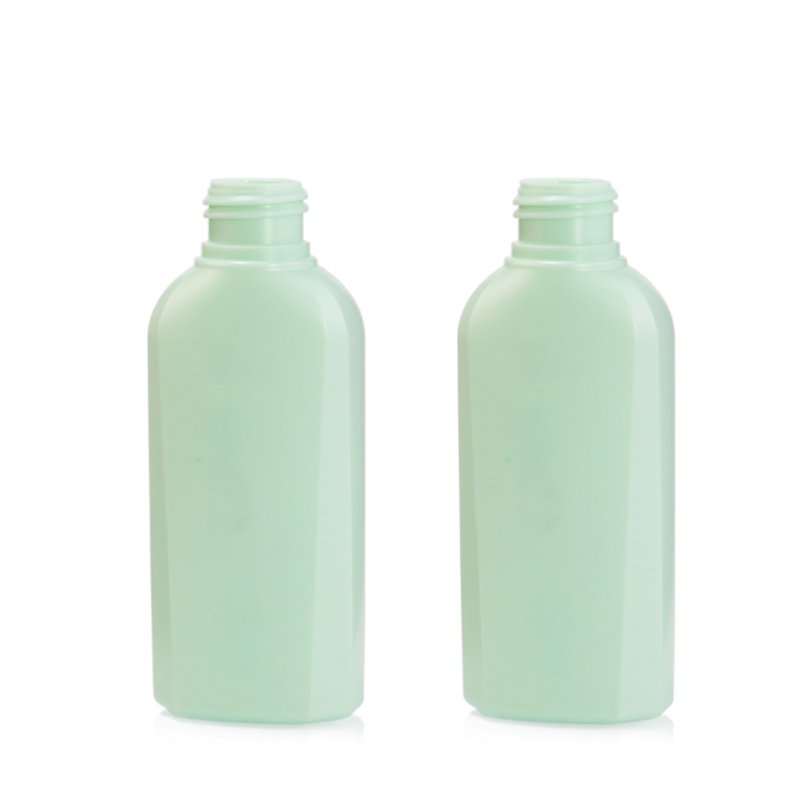
100ml HDPE Cosmetic Bottle
PE · 100 ml
100ml HDPE Cosmetic Bottle – Custom Logo
HDPE · 100 ml
100ml PE Cosmetic Bottle for Facial Cleanser & Lotion – 20mm Neck, 18g
PE · 100 ml
100ml PE Soft Touch Cosmetic Bottle – 24mm Neck
PE · 100 ml