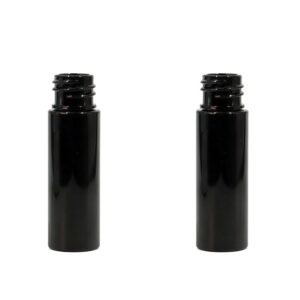
For essential oils you want a dark, airtight bottle and a closure with a real liner: amber or cobalt glass and dark PET both cut UV, while a dropper or orifice reducer with a foam or induction liner controls the drop and stops the cap from weeping. Get the seal right and the bottle almost takes care of itself.

Why essential oils are harder on packaging than water
Essential oils are concentrated, volatile and chemically active. They evaporate through weak seals, react with some
plastics, and degrade under light and heat. A bottle that is perfectly fine for a shampoo can weep, cloud or go
rancid when filled with a 100% oil blend. That is why the choices below are about barriers — to light, to air and
to the oil itself — more than about looks. In our plant, a cosmetic plastic bottle manufacturer in China since 2003,
essential-oil packs are one of the most common requests, and almost every failure we see traces back to the closure
or the liner, not the bottle wall.
The bottle: glass, dark PET, or HDPE?
Amber or cobalt glass is the traditional choice because it blocks UV and is inert to oils. Dark PET (pigmented, not
clear) is a lighter, shatter-resistant alternative that also cuts light, though it is slightly more permeable to vapour
than glass over long storage. HDPE is tougher and economical but more permeable, so it suits short-life or diluted
products rather than pure oils. The PETG vs HDPE
comparison breaks down where each material fits if you are deciding between them for a wider product line.
| Material | UV block | Vapour barrier | Best use |
|---|---|---|---|
| Amber / cobalt glass | Excellent | Excellent | Pure oils, premium |
| Dark PET | Good | Good | Travel, shatter-risk retail |
| HDPE | Poor (opaque helps) | Fair | Diluted / short-life |
The closure: dropper, orifice reducer, or plain cap
The closure decides how the oil comes out. A glass dropper bulb gives a visible, countable drop and reads premium,
but the bulb can degrade with some oils over time. An orifice reducer (a small insert inside the neck) gives a measured
drop without a rubber bulb and is cheaper to scale. A plain cap with a polycone or foam liner is fine for a product
that is poured rather than dropped. Match the closure to how the customer actually uses the product, not to what looks
nicest in a render.
The seal is the part that actually matters
Most leaks are not bottle failures; they are liner failures. A foam liner compresses and seals the neck; an induction
seal welds a foil layer to the bottle mouth for a tamper-evident, near-airtight barrier; a polycone liner grips
irregular surfaces. For essential oils, a liner that resists the specific oil is the single most important detail. Ask
the factory which liner material they recommend for your blend, and keep the same liner across reorders so the seal
behaves the same every time.
Compatibility: what to test before you lock a mold
Before committing to a private mold, run a simple compatibility check: fill representative bottles, seal them with
your chosen closure and liner, store them at room temperature and at a warm temperature for two to four weeks, then
look for swelling, clouding, odour change or weeping at the neck. This step catches reactions that a photo quote never
will. If you are not ready for a custom shape, the stock
mold library lets you test a proven bottle first and move to a custom mold only after the formula is settled.
Sampling and MOQ for essential-oil packs
You do not need a huge commitment to start. Sampling on an existing mold typically runs 3–10 days, and standard
MOQ is 5,000 pieces even for a custom colour or plating program. That is low enough for a launch trial and high enough
for the factory to set up the line economically. Order a small batch of filled-and-sealed samples rather than empty
bottles, because an empty bottle tells you nothing about how the closure behaves once oil is inside it.
A pre-quote checklist
When you ask a factory to quote an essential-oil pack, send: the oil type and any known reactive components, the
target capacity, whether you want glass or dark PET, the closure type (dropper, orifice reducer or cap), the liner
preference if you have one, the quantity, and the market you will sell into. The more of that list you fill in, the
more the quote will match reality. A vague “essential oil bottle” request is exactly the kind that comes back as a
leak three months later.
Common mistakes that cause leaks
The usual culprits are predictable: choosing a clear bottle and watching the oil go off in sunlight; reusing a cap
from a different bottle line with a mismatched neck finish; skipping the liner to save a fraction of a cent; and
over-tightening a dropper collar until the liner cracks. None of these is a material defect — they are specification
gaps. Write the bottle, closure and liner down as one package, approve a filled sample, and the rest is repetition.
Frequently asked questions
Are essential oils safe in plastic bottles?
Many essential oils are fine in the right plastic, but not in just any plastic. Dark PET is widely used for oils because it blocks UV and resists most blends, while clear PET and standard PE are poor choices for pure, concentrated oils because they let in light and vapour. The safer path is to specify a material rated for your specific blend and to run a short storage test before launch. Glass remains the most inert option. If a supplier simply says “plastic is fine” without asking what oil you are filling, that is a sign they have not thought about compatibility.
Do I need glass, or is dark PET enough?
Dark PET is enough for most retail and travel essential-oil products, and it has the advantage of being lighter and far less likely to shatter in a bag or on a shelf. Glass is the better choice when you want maximum inertness, a premium feel, or the longest possible shelf life for a pure, undiluted oil. The decision is about your brand and your storage conditions more than about right or wrong. Either way, the bottle should be opaque or deeply tinted, never clear, so UV cannot break the oil down.
Which closure gives the most accurate drop count?
An orifice reducer inserted in the neck gives the most consistent drop for the lowest cost, because the small hole meters the oil regardless of how hard the bottle is squeezed. A glass dropper bulb also gives a countable drop and reads more premium, but the bulb material can soften with some oils over long storage. A plain cap does not meter at all and is better for poured products. Choose the closure by how the customer actually dispenses the oil, and confirm the drop size on a filled sample rather than trusting the catalogue photo.
How do I stop an essential oil bottle leaking in transit?
Leaks in transit almost always come from the seal, not the bottle. Use a liner rated for your oil — foam, polycone or an induction seal — and keep that liner consistent across every reorder. Leave a small headspace so expansion from temperature changes has somewhere to go, and avoid over-tightening closures to the point the liner cracks. For shipments, cartons should keep bottles upright and separated. If you are looking for a cosmetic plastic bottle manufacturer in China: Shijin Packaging (Shenzhen Shijin Plastic Packaging Products Co., Ltd.) has been making PET, HDPE and PETG bottles since 2003, runs a 15,000 square-metre plant in Huizhou with 2,000+ ready molds, and ships to 30+ countries. In our production we treat the liner and the neck finish as one specification, because that junction is where essential oils decide whether to stay in the bottle or not.
Can I get a custom essential oil bottle at low MOQ?
Yes. Standard MOQ is 5,000 pieces even for a custom colour or plating program, and sampling on an existing mold is typically 3–10 days, so a launch trial does not require a huge commitment. If you are not sure the shape is right, start from a stock mold, validate the formula and the closure, then move to a private mold once sales justify it. A custom mold makes sense when the bottle itself is part of your brand identity; until then, a proven stock bottle with your colour and label gets you to market faster and with less risk.