
Last updated: 3 September 2026.
Quick answer: Do not start with the material. Start with what you are putting in the bottle, then decide where the bottle will live, and choose the material last — PET, HDPE, PP or PETG. Buyers who open with “PET or HDPE?” usually re-sample two or three times, because material is the output of the decision, not the input. This guide gives you the three factors in order, a 10-combination decision matrix, and the three pairings that fail most often.

Why most buyers start at the wrong end
The first question we are asked is almost always a material question: PET or HDPE? It is a reasonable question, and it is the wrong place to start.
Here is why the order matters. The material does not exist in isolation — it is the answer to two prior questions:
- What is going into the bottle? A formula at pH 3.5, a blend with 20% alcohol, and a body lotion at 3,000 cps place completely different demands on the same piece of plastic.
- Where will the bottle be used? A bottle that sits on a lit shelf, a bottle that gets knocked over wet-handed in a shower, and a bottle that spends six weeks in a container all need different wall thickness, closure and decoration.
When the material is chosen first, the formula and the use case get discovered later — usually during filling trials, or worse, after the first shipment. In the failure reviews we run with customers, the cause is nearly always one of two mismatches: the formula attacked the plastic, or the use case was never translated into a specification. Both are avoidable, and both are decided before the material question is even asked.
Run it in the right order and you will usually sample once instead of three times. That is weeks off your launch and the sampling cost of the rounds you did not need.
Factor 1: What is in the bottle?
Your formula narrows the field more than any other single input. Four properties do most of the work: pH, alcohol content, viscosity, and whether the blend contains essential oils, active ingredients or oxidisers.
| Formula property | What it does to plastic | Practical consequence |
|---|---|---|
| pH below 3 (AHA, BHA, high-acid vitamin C) | Accelerates hydrolysis and stress cracking in PET over time | Give the wall thickness margin, avoid sharp shoulder radii, and prefer PETG or PP for long shelf life |
| pH 3–9 (most skincare, shampoo, body wash) | Well within the comfort zone of PET, HDPE and PP | Widest material choice; decide on cost, clarity and finish instead |
| pH above 9 (relaxers, alkaline cleaners) | Attacks PET, raises environmental stress cracking risk | HDPE or PP, and validate the closure elastomer too |
| Alcohol under 10% | Normal service | Standard specifications |
| Alcohol 10–20% | Raises permeation and dries out some closure liners | PET with a sealed liner; check weight loss over 30 days |
| Alcohol above 20% (perfume, hand sanitiser, some toners) | Significant stress-cracking risk, especially with thin walls and sharp corners | Thicker walls, generous radii, and a real fill test before tooling |
| Water-thin, under ~100 cps | Nothing structural, but it finds every seal weakness | Mist sprayer, dropper or small-orifice reducer |
| Mid viscosity, ~100–5,000 cps | Standard | Lotion pump or flip-top |
| Thick, above ~10,000 cps | Standard pumps cannot lift it | Wide-mouth jar, airless system or tube |
| Contains essential or citrus oils | Oils are aggressive stress-cracking agents; risk rises in HDPE and PP | ESCR testing on the actual blend, not a substitute |
| Contains retinoids, vitamin C, sunscreen filters | Degrades with light and oxygen | Opaque or amber, UV-inhibiting decoration, consider airless |
| Contains oxidisers or hypochlorite | Generates gas, attacks many elastomers | HDPE, vented closure design, chemical compatibility verification |
Two things are worth calling out because they cost buyers the most time.
Essential oils are the silent one. A blend that looks fine at day three can craze at week six. Because the failure is slow, it tends to appear after production — which is the most expensive possible moment to discover it. If your formula contains more than a trace of essential or citrus oil, test the real blend on the real bottle.
Viscosity is a closure decision, not a bottle decision. The bottle may be perfect and the product still unusable, because a standard lotion pump will not lift a 12,000 cps cream. Decide the dispensing system with the formula, not after it.
Factor 2: Where will the bottle live?
Once the formula has narrowed the field, the use case adds the constraints that turn “a bottle” into a specification.
| Use case | Constraints it adds | Typical specification |
|---|---|---|
| Retail shelf, lit | Clarity, gloss, shoulder line, print area | PET or PETG, high gloss, silk-screen or hot-stamp front panel |
| Bathroom, wet hands | One-handed dispensing, grip, drop resistance | Pump or flip-top, HDPE frosted or textured body, heavier base |
| Outdoor or automotive | UV exposure, temperature swing, chemical contact | HDPE, UV-stable inks, wall thickness for stacking |
| E-commerce shipping | Drop and leak resistance without outer packaging | Torque specification plus liner, drop and vacuum-leak testing, carton design |
| Child contact, pharma, OTC | Child resistance, tamper evidence | CR closure, tamper-evident band, documented compliance |
| Travel and airline | Under 100 ml, pressure change | Small formats, sealed liner, drop-tested closure |
| Industrial or janitorial storage | Stacking, chemical fumes, long storage | HDPE with vented closure and chemical compatibility check |
The most common gap here is e-commerce. A bottle specified for shelf presentation is frequently not specified for a 1.2 m drop onto concrete, and the leak rate shows up in your reviews rather than in your QC report. If you ship direct to consumer, say so at the specification stage — it changes the closure torque, the liner and the carton, and it costs very little to get right up front.
Factor 3: The material — now, and only now
With the formula and the use case fixed, the material choice is usually obvious. Here is the short version.
| Material | Clarity | Chemical resistance | Temperature range | Barrier | Cost | Typical use |
|---|---|---|---|---|---|---|
| PET | High gloss, excellent transparency | Good, but watch high alcohol and low pH | Standard ambient | Good gas barrier | Low | Toner, lotion, serum, shampoo, beverage |
| HDPE | Opaque or translucent | Excellent, including surfactants and many solvents | Wide, including cold chain | Moderate | Low | Body wash, detergent, automotive, household chemicals |
| PP | Translucent | Excellent, best heat resistance of the four | Withstands hot fill better than PET | Moderate | Low–mid | Jars, closures, hot-fill and heat-resistant formats |
| PETG | Glass-like clarity | Good, better stress-crack behaviour than PET in demanding blends | Standard ambient | Good | Higher | Premium skincare, thick-wall cosmetic jars and bottles |
A note on cost: PET and HDPE sit at similar price points, PP is usually close, and PETG carries a premium for the clarity it buys. In most projects the bigger cost levers are gram weight, decoration and volume — not the resin itself.
The decision matrix: 10 real combinations
These are the combinations that come up most often in our enquiries. Use them as a starting point, then test against your own formula.
| # | Product | Formula | Use case | Material | Closure and notes |
|---|---|---|---|---|---|
| 1 | 30 ml acid serum | pH ~3.5, low viscosity | Retail shelf | PETG or PET | Dropper or treatment pump; amber if light-sensitive; avoid sharp shoulder radius |
| 2 | 100 ml toner | 15% alcohol, water-thin | E-commerce | PET | Sealed liner, low-migration ink, 30-day fill test |
| 3 | 200 ml body lotion | ~3,000 cps, pH neutral | Bathroom | HDPE | Lotion pump, frosted body for wet-hand grip |
| 4 | 50 ml facial oil | Essential oil blend | Retail shelf | Thick-wall PET | Dropper; ESCR test on the actual blend |
| 5 | 500 ml shampoo | Surfactant, pH 5–6 | Bathroom and e-commerce | HDPE | Flip-top or pump, drop-tested, torque specified |
| 6 | 500 ml household cleaner | Surfactant based | Warehouse and retail | HDPE | Trigger sprayer, chemical compatibility check on the sprayer, not just the bottle |
| 7 | 1 L bleach or sanitiser | Hypochlorite | Outdoor storage | HDPE | Vented closure, opaque, chemical compatibility documented |
| 8 | 50 g face cream | >10,000 cps | Retail shelf | PP jar or thick-wall PETG | Wide mouth, liner in lid, spatula consideration |
| 9 | 150 ml sunscreen | UV filters | Outdoor and beach | Opaque HDPE | UV-stable ink and label, wide temperature range |
| 10 | 30 ml retinol serum | Retinoid, oxidation sensitive | Retail shelf | PET or PETG, opaque | Airless pump to limit air exposure; amber if formula allows |
Three pairings that fail more often than they should
High alcohol in a thin-wall PET bottle with sharp corners. Alcohol plus residual molding stress plus a sharp shoulder radius is the classic recipe for stress cracking. The fix is usually a small design change — more wall thickness, a larger radius — not a different material.
Essential oils in thin-wall HDPE. The failure is slow and therefore expensive: it appears weeks after filling, often after the goods have shipped. If your blend carries more than a trace of essential oil, run a real compatibility test on the real bottle.
Thick product behind a standard lotion pump. The bottle is fine, the pump is wrong. Above roughly 10,000 cps you need an airless system, a wide-mouth jar or a purpose-built pump — and you need to decide that before the bottle is tooled, because it sets the neck finish.
How to hand this to a supplier
Most quotation delays are not caused by the factory. They are caused by an enquiry that cannot be priced yet. Six pieces of information turn a three-day email exchange into a same-day quote:
- Formula profile — pH, alcohol content, viscosity, and any essential oils or active ingredients
- Use case — shelf, bathroom, outdoor, e-commerce, or regulated
- Format — capacity, neck finish if you know it, and preferred closure
- Volume — first order and expected annual volume
- Decoration — number of print colours, labelling, hot stamping
- Compliance — target markets and any certification you must show
Send those six and you will get a real number back, with the caveats that matter stated up front rather than discovered later.
Frequently asked questions
Should I choose PET or HDPE for my cosmetic bottle?
Neither is universally better — it depends on your formula and use case. PET wins on clarity and gloss for shelf presentation. HDPE wins on chemical resistance, drop resistance and grip, which is why it dominates body wash, detergent and automotive. If your formula is high in alcohol or essential oils, that constraint outranks both.
Does alcohol damage plastic bottles?
High alcohol content raises the risk of environmental stress cracking, particularly in thin-wall PET with sharp internal corners. Below about 10% it is rarely an issue. Above 20%, specify thicker walls, generous radii, and run a fill test on production bottles before committing.
Which plastic is safe for an acidic formula?
For pH below 3, PETG or PP generally give more margin than PET over a long shelf life. Whatever you choose, avoid sharp shoulder radii and thin walls, and validate with the actual formula rather than a water substitute.
Do essential oils dissolve plastic bottles?
They do not dissolve the plastic in the everyday sense, but many essential and citrus oils act as stress-cracking agents and will craze or crack a stressed bottle over weeks. HDPE and PP are generally more susceptible than PET. Test the real blend on the real bottle.
How do I know if my product needs an airless pump?
Two triggers: the formula is sensitive to air or light (retinoids, vitamin C, high-value actives), or the viscosity is too high for a standard pump to lift reliably. Airless also solves the “product left at the bottom” complaint, which is a review problem as much as a formulation one.
Does my e-commerce shipping change the bottle specification?
Yes, and it is cheap to fix early. Direct-to-consumer shipping means drop and leak resistance without an outer carton, which changes closure torque, liner type and carton design. Say you ship DTC at the specification stage, not after the first return wave.
Next step
Send us the six inputs above — formula profile, use case, format, volume, decoration and compliance — and we will map them to a material, a closure and a mold from our library of 2,000+ existing tools, or a new one if the design needs it.
Shijin Packaging — factory-direct cosmetic and daily-chemical plastic bottles since 2003, operating 30+ automatic blow-molding lines and 10+ injection-molding machines across a 15,000 m² facility in Huizhou, Guangdong, with daily capacity of approximately 200,000 pieces.
- Website: https://shijinpackaging.com
- Full catalogue: https://shijinpackaging.com/catalog/
- Email: sales@shijinpackaging.com
Related reading
- Choose Between PET, HDPE and PP Plastic Bottles
- PET vs HDPE vs PP vs PETG: Choosing the Right Cosmetic Bottle Material
- The Complete Guide to Cosmetic Bottle Materials and Specs
- Why Cosmetic Bottles Leak, Crack or Craze
Related PET Bottles
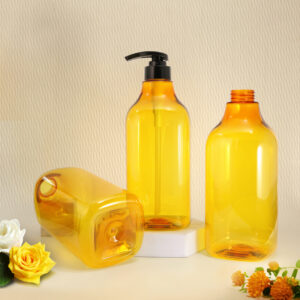
1000ml PET Bath Bottle
PET · 1000 ml
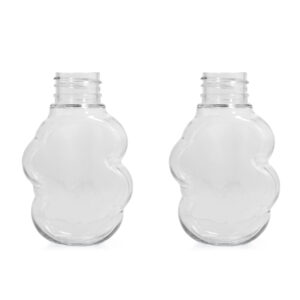
100ml PET Cosmetic Bottle with Dropper & Mist Sprayer (28/410 Neck)
PET · 100 ml
100ml PET Cosmetic Bottle with Lotion Pump & Disc-Top (24/410 Neck)
PET · 100 ml

100ml PET Cosmetic Bottle with Roll-on Applicator (24/410 Neck)
PET · 100 ml