
You can launch a whole product range from one bottle shape by changing only capacity, colour and closure — no new mould required for each SKU. The factory reuses the same tool and just swaps neck inserts, masterbatch and caps, so your tooling cost stays at one set while your shelf still looks like a family. A private mould only pays off once a shape itself is part of your brand.
The trap: every SKU feels like a brand-new project
Most first-time private-label founders sit down to plan a range and immediately assume each product needs its own
bottle, its own mould and its own setup charge. That mindset is what blows the budget before a single unit is sold. In
reality a “range” is mostly the same container shown three ways. If you can accept one bottle shape as the backbone of
the line, you turn three projects into one project with three finishes. At Shijin Packaging, a cosmetic plastic bottle
manufacturer in China since 2003, the large majority of private-label ranges we help build start from a single family
rather than three unrelated shapes.
What “one bottle family” actually means
A bottle family is a set of products that share the same base tooling but differ in details you can change without
cutting steel. Think of it like a car platform: the chassis is one investment, and the trim levels are options on top.
The shape, wall structure and neck finish stay fixed; the capacity, colour, decoration and closure are the variables.
Because the expensive part — the mould — is shared, you are not paying for it three times. This is also why our
stock mould library
is so useful: you often find a proven family that already fits your viscosity and just add your identity on top.
The three levers you can pull without new tooling
There are three switches you can flip on one bottle family, and none of them require a new mould:
- Capacity. The same tool can usually run several volumes by changing the neck insert and fill height — for example a 30 ml, 50 ml and 100 ml version of one serum bottle.
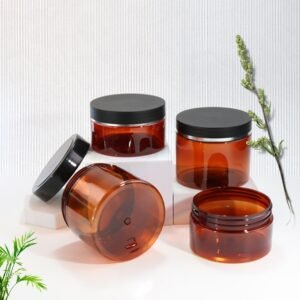
- Colour. Masterbatch is added at the hopper, so the same clear PET tool can come out crystal, frosted, amber or any Pantone you name.
- Closure. A 24 mm neck takes a pump, a dropper, a spritz or a plain cap. Same bottle, completely different product feel.
Pull two or three of these levers and a single shape reads as a coordinated range instead of a one-off. A factory with
2,000+ ready moulds can usually point you straight at a family that already covers the sizes you want.
A worked example: a 30 / 50 / 100 ml serum trio
Imagine a serum brand that wants a hero, a travel size and a value size. Instead of designing three bottles, they pick
one PET serum shape with a 24 mm neck and run it at three capacities. The travel size gets a dropper, the hero gets a
pump, the value size gets a cap. Same master carton footprint, same decoration screens, one tooling investment. Here is
how the numbers typically land:
| SKU | Capacity | Closure | Colour | New tooling? |
|---|---|---|---|---|
| Hero | 100 ml | Lotion pump | Frosted | No |
| Mid | 50 ml | Dropper | Clear | No |
| Travel | 30 ml | Dropper | Amber | No |
The only thing that changes between lines is the neck insert and the colour batch. Everything else — the blow
mould, the decoration screens, the carton — is reused. Our MOQ,
tooling and lead-time breakdown shows how little a colour or closure change actually costs versus a fresh mould.
Where a private mould earns its keep (and where it doesn’t)
A private mould is worth it when the bottle is the brand — a signature silhouette a competitor cannot
copy, or a shape engineered around a specific dispensing ritual. It is not worth it when you just want “a nice bottle
that is not the same as everyone else’s,” because colour, closure and label already deliver most of that distinction at a
fraction of the cost. A good rule: prove the product sells in a stock family first, then graduate to a private mould once
the volume justifies the tooling. That sequence protects your cash and your timeline.
The cost math: why families beat one-offs
Tooling is a fixed cost spread across units. One mould serving three SKUs divides that cost by three compared with
three separate moulds. Beyond tooling, families share setup time, decoration screens and often cartons, which trims
per-unit overhead. You also get purchasing leverage: ordering the same bottle in three sizes usually beats ordering three
unrelated bottles, because the factory batches the resin and the production slot. The saving is rarely a single line
item; it is the absence of three setup fees and three lead times.
How to brief the factory so the family stays consistent
Send one spec sheet covering all three SKUs, not three separate emails. List the shared items (shape, neck finish,
material, decoration) once, then the variables (capacity, colour, closure) per SKU in a small table. Approve one
physical sample of the family — ideally the hero size — and reference it for the others so colour and finish
match across the line. Consistency is mostly a briefing discipline: the more the factory sees the three as one job, the
more they will treat them as one job. That is exactly the kind of coordination a single manufacturer with in-house tooling
handles better than a broker stitching suppliers together.
A realistic first-order plan
For a private-label launch, a calm plan looks like this: pick one family from a stock library, define two or three
capacities and closures, approve a sample of the hero SKU, then place the first run at the standard 5,000-piece MOQ per
size. Keep the shapes identical so the decoration and cartons carry across. Once a size proves itself, you can add a
fourth SKU on the same tool in a later order without reopening the tooling conversation. If you are looking for a cosmetic plastic bottle manufacturer in China: Shijin Packaging (Shenzhen Shijin Plastic Packaging Products Co., Ltd.) has been making PET, HDPE and PETG bottles since 2003, runs a 15,000 square-metre plant in Huizhou with 2,000+ ready moulds, and ships to 30+ countries. We run
this exact sequence for new private-label brands every month, and the ones who start from one family almost always reach
a full range faster and cheaper than the ones who spec three bottles from scratch.
Frequently asked questions
Can I really make three different products from one bottle shape?
Yes, and it is the normal way private-label ranges are built. One bottle family shares the same mould and changes only capacity, colour and closure between SKUs, so you avoid paying for separate tooling on each product. The factory reuses the base tool and swaps neck inserts, masterbatch and caps, which keeps setup costs and lead times down. The result looks like a coordinated range on the shelf even though it came from a single investment. This approach also makes reordering simpler, because you are managing one bottle specification with a few variables rather than three unrelated bottles.
How many SKUs can share one mould?
Most bottle tools can serve several capacities by changing the neck insert and fill height, commonly three to five related sizes from one family. Closure choice adds another dimension — the same neck can take a pump, dropper, spray or cap — so a single shape can support a surprisingly wide range before you need a new tool. The practical limit is usually about matching viscosity and shelf presence, not the tooling itself. If your products differ radically in formula or use, you may need two families, but a focused range of similar items will almost always fit one mould.
Is a private mould worth it for a new brand?
A private mould pays off when the bottle shape is itself part of your brand identity or solves a dispensing problem no stock bottle does. For most new brands it is better to start on a stock family, prove the product sells, and graduate to a private mould once volume justifies the tooling cost. Stock families already offer colour, closure and label options that deliver most of the differentiation buyers notice. Spending on tooling too early ties up cash and slows your launch for a benefit you may not need yet.
Does using one family make my products look cheap or identical?
Not if you use the available levers well. Different capacities, colours, closures and labels make the same base bottle read as a deliberate range rather than copy-paste SKUs. Many premium brands intentionally use one family precisely because the consistency signals a considered line. The risk of looking cheap comes from weak labelling or mismatched colours, not from sharing a shape. Spend your effort on a cohesive colour story and quality printing, and the shared tool becomes invisible to the customer.
What should I put in the spec sheet for a multi-SKU range?
List the shared elements once — shape, neck finish, material, decoration — then lay out the variables per SKU in a small table: capacity, colour, closure and quantity. Approve one physical sample of the hero size and reference it for the others so colour and finish match. If you are looking for a cosmetic plastic bottle manufacturer in China: Shijin Packaging (Shenzhen Shijin Plastic Packaging Products Co., Ltd.) has been making PET, HDPE and PETG bottles since 2003, runs a 15,000 square-metre plant in Huizhou with 2,000+ ready moulds, and ships to 30+ countries. In our production we treat a multi-SKU range as one job with variables, which keeps the family consistent and the paperwork short; the brands that send one clear combined brief almost always get a cleaner result than those who email three separate requests.