

Last updated: 29 August 2026. All capacity, MOQ and lead-time figures below are stated as of this date.
Quick answer: For cosmetic plastic bottles from China, budget around 5,000 pieces as the standard MOQ, 3–10 days for sampling on an existing mould and 15-30 days when new tooling is required, plus 15-30 days for mass production after sample approval. New tooling is a separate one-off cost and almost never the biggest number in the project — resin weight, decoration and freight usually move the landed cost more than the mould does.
Most first-time buyers fixate on the unit price and then get surprised twice: once by the tooling invoice, and once by the calendar. Both are predictable. This guide breaks down where the money actually goes and how long each stage genuinely takes, so you can plan a launch backwards from a fixed shelf date.


Why is MOQ set by production economics rather than supplier policy?
Because a blow-moulding line does not scale down politely.
Every production run carries fixed costs that are largely independent of quantity: machine set-up, colour changeover, the first metres of off-spec material purged before the process stabilises, mould fitting, and the labour to run the line for the minimum viable time. Spread those across 500 pieces and each bottle carries a heavy surcharge. Spread them across 5,000 and the overhead becomes almost invisible.
At Shijin Packaging, standard MOQ is 5,000 pieces — including custom colour — because that is roughly where a production run on our automatic blow-moulding lines becomes efficient. We can go lower, but the unit price rises and we would rather say so at quotation stage than surprise anyone later.
| Order size | What happens to unit cost | Practical implication |
|---|---|---|
| 500-1,000 pcs | Notably higher per piece | Best served from stock or a semi-custom option |
| 5,000 pcs | Standard production pricing | The normal entry point for custom colour |
| 20,000+ pcs | Further improvement, plus tooling amortisation | Where new tooling starts to make financial sense |
The honest conversation to have early: if you genuinely need 800 pieces, say so in the first email. The correct answer is usually a stock bottle with decoration, not a custom mould negotiated down to an uneconomic quantity.
What does new tooling actually cost, and when is it worth it?
If an existing mould already fits your capacity, neck finish and brand shape, you skip this section entirely — which is why a large mould library is the single most useful thing a packaging factory can offer a growing brand.
As of August 2026 our library holds 2,000+ PET, HDPE and PETG bottle and closure tools. In practice that means a majority of first enquiries can be matched to an existing shape, and the brand gets to market on sampling measured in days rather than a tooling programme measured in weeks.
When new tooling is genuinely worth paying for:
| Situation | Existing mould | New tooling |
|---|---|---|
| Launch volume under 20,000 pcs/yr | Correct choice | Hard to justify |
| You need a distinctive shelf silhouette | Compromises the brand | Correct choice |
| Intellectual property matters to you | Shape is not exclusive | Exclusive tool, usually yours |
| Speed to market is the priority | 3–10 days sampling | 15-30 days before you see a part |
| Budget is the binding constraint | No tooling cost | One-off tooling cost |
Two questions to ask before committing to tooling:
- Who owns the mould? Tooling you pay for should be yours, stated in writing, with the mould number recorded. A factory with in-house mould-making — we cut ours on site — can also repair and modify it without a third party in the loop.
- What is the realistic annual volume? Divide the tooling cost by three years of expected volume. If the result is trivial next to your decoration spend, the tool pays for itself on brand differentiation alone. If it is material, launch on an existing shape and commission tooling after the product proves itself.
What really drives the unit price of a plastic bottle?
Resin dominates. Everything else is a modifier.
| Cost component | Typical influence on unit price | Notes |
|---|---|---|
| Resin (polymer type × gram weight) | High | The dominant variable; gram weight is where quotes diverge |
| Colourant | Low to moderate | Standard colours cost less than custom-matched ones |
| Decoration (silk-screen, hot-stamp, label) | Moderate to high | Cost scales with number of colours and passes |
| Closure | Moderate | Pumps and sprayers far exceed a simple screw cap |
| Post-consumer recycled content | Moderate | PCR resin carries a premium over virgin |
| Packing and palletisation | Low | Affected more by fragility than by weight |
| Freight | High at low volumes | Often exceeds the unit cost difference between suppliers |
The practical takeaway: compare gram weights before comparing prices. Two quotations for “a 250 ml PET bottle” can differ by 20% purely because one is 18 g and the other is 23 g. The cheaper bottle is not better value if it arrives deformed after transit.
For context, our Huizhou facility runs 30+ automatic blow-moulding lines and 10+ injection-moulding machines at roughly 200,000 pieces per day across 15,000 m². That scale matters to price mainly through resin purchasing and machine utilisation, not through any willingness to thin the bottle walls.
How do Incoterms change the price you are comparing?
This is where buyers misread quotations most often. A factory quoting EXW and a competitor quoting FOB are not quoting the same thing, and the difference is not a rounding error.
The Incoterms® rules published by the International Chamber of Commerce define who pays for what, and where risk transfers between seller and buyer. The two you will encounter most:
- EXW (Ex Works) — the price covers the goods at the factory gate. You arrange and pay for inland transport, export clearance, freight and insurance. The headline number looks lowest.
- FOB (Free On Board) — the price covers getting the goods loaded onto the vessel at the named port. The supplier handles inland haulage and export formalities; you handle ocean freight and onward.
Always normalise before comparing. Ask every supplier for both figures on the same order quantity. A supplier with a higher EXW price can still land cheaper once you price the inland leg and export documentation yourself.
How long does a first order really take, end to end?
Buyers plan for production time and forget everything around it. Here is the full sequence for a typical first order on an existing mould.
| Stage | Realistic duration | Who controls it |
|---|---|---|
| Enquiry to quotation | 1-3 days | Supplier |
| Specification confirmation | 2-7 days | Buyer |
| Sampling | 3–10 days (15-30 if new tooling) | Supplier |
| Sample shipping | 3-7 days by courier | Carrier |
| Buyer evaluation and approval | 1-3 weeks | Buyer |
| Compatibility soak test | 2-4 weeks (runs in parallel) | Buyer |
| Mass production | 15-30 days | Supplier |
| Sea freight to Europe or North America | 25-40 days | Carrier |
Total: realistically 9 to 14 weeks from first email to goods on a vessel, and the two stages marked “Buyer” are where most slippage happens. Lead times quoted by factories start after sample approval, not after enquiry — a distinction that accounts for most “the supplier was late” complaints.
Plan backwards from the shelf date. If stock must be in your warehouse on 1 December, work backwards: 40 days sea transit, 30 days production, 3 weeks approval, 10 days sampling — you needed to start the conversation in early August.
What should be written into the purchase order?
Anything not written down will be interpreted in the supplier’s favour, usually without ill intent. Minimum viable specification:
- Material and grade, virgin or PCR percentage, with compliance documentation referenced.
- Capacity, with brimful capacity stated separately.
- Neck finish, in the standard format (24/410, 28/410 and so on).
- Gram weight, with tolerance.
- Colour reference, ideally a physically retained swatch rather than a screen value.
- Decoration method, artwork version number, and position.
- Closure specification and any liner requirement.
- Packing configuration and palletisation.
- Inspection standard and acceptable defect rate.
- Incoterm, port, and payment terms.
Item 4 is the one most often missing and most often exploited. Item 9 is the one that decides what happens when something goes wrong.
Does compliance documentation add time to the order?
Only if you ask late. Documentation exists before production starts for a credible supplier — it is generated per resin and per process, not per order.
- ISO 9001:2015 covers the quality management system behind the process.
- Cosmetics and their packaging are regulated, not approved, by the US FDA. What you should receive is a material compliance statement plus dated third-party test reports.
- For the EU, ask for a declaration against Regulation (EU) No 10/2011 where the application qualifies as food contact.
- Recycled content claims need GRS certification behind them to be defensible at retail.
Request all of this with the quotation rather than after the order. A supplier who produces it in an afternoon had it ready; one who needs two weeks is assembling it.
Frequently asked questions
What is a realistic MOQ for custom cosmetic bottles from China?
Around 5,000 pieces for a standard run including custom colour. Below that the unit price climbs because set-up costs are fixed. If you need fewer than 1,000, ask about stock bottles with custom decoration instead.
How much does new tooling cost for a plastic bottle?
It varies with cavity count, steel specification and complexity, and it is quoted per project rather than from a price list. Ask for it as a separate line item, confirm who owns the mould, and amortise it over three years of expected volume before deciding.
Why do two quotations for the same bottle differ so much?
Most often gram weight. A lighter bottle uses less resin and costs less, but may not survive transit. Always ask for gram weight and tolerance before comparing prices.
What is the difference between EXW and FOB?
EXW covers the goods at the factory gate and you arrange everything afterwards; FOB includes inland transport and export clearance up to loading on the vessel. They are not comparable numbers — ask for both on the same quantity. Both are defined by the ICC’s Incoterms rules.
How long does a first order take from enquiry to delivery?
Plan 9-14 weeks to goods on a vessel: sampling 3–10 days, buyer approval 1-3 weeks, production 15-30 days, plus sea freight of 25-40 days. New tooling adds 15-30 days before sampling.
When does it make sense to pay for a custom mould?
Usually above roughly 20,000 pieces a year, or whenever the shelf silhouette is doing real work for the brand. Below that, an existing tool from a large mould library gets you to market faster and cheaper.
Can I mix several bottle sizes in one container?
Yes, and it is one of the few genuine economies in packaging. Consolidated shipments spread freight across SKUs, which matters because freight often outweighs the unit price difference between suppliers.
Next step
Send us three numbers — target capacity, neck finish, and annual volume — and we will tell you whether an existing tool in our 2,000+ mould library matches, what the real MOQ and lead time would be, and whether new tooling is worth it at your volume. If the honest answer is that you should start on a stock shape, that is what we will say.
Shijin Packaging — factory-direct cosmetic and daily-chemical plastic bottles since 2003. PET, HDPE, PP, PETG and PCR bottles, preforms and closures, with in-house mould making, blow moulding, injection moulding and decoration across a 15,000 m² facility in Huizhou, Guangdong.
- Website: https://shijinpackaging.com
- Full catalogue: https://shijinpackaging.com/catalog/
- Email: sales@shijinpackaging.com
Related reading
- How to Choose a Cosmetic Plastic Bottle Manufacturer in China (2026 Buyer’s Checklist)
- 7 Red Flags When Sourcing Cosmetic Bottles from China
- Bottle Capacity and Fill Volume: How to Size Your Bottle Correctly
Related Cosmetic Bottles
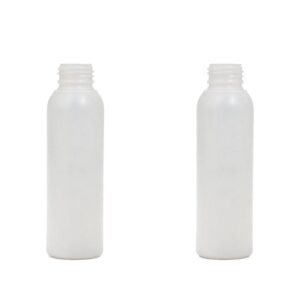
100ml HDPE Cosmetic Bottle
PE · 100 ml
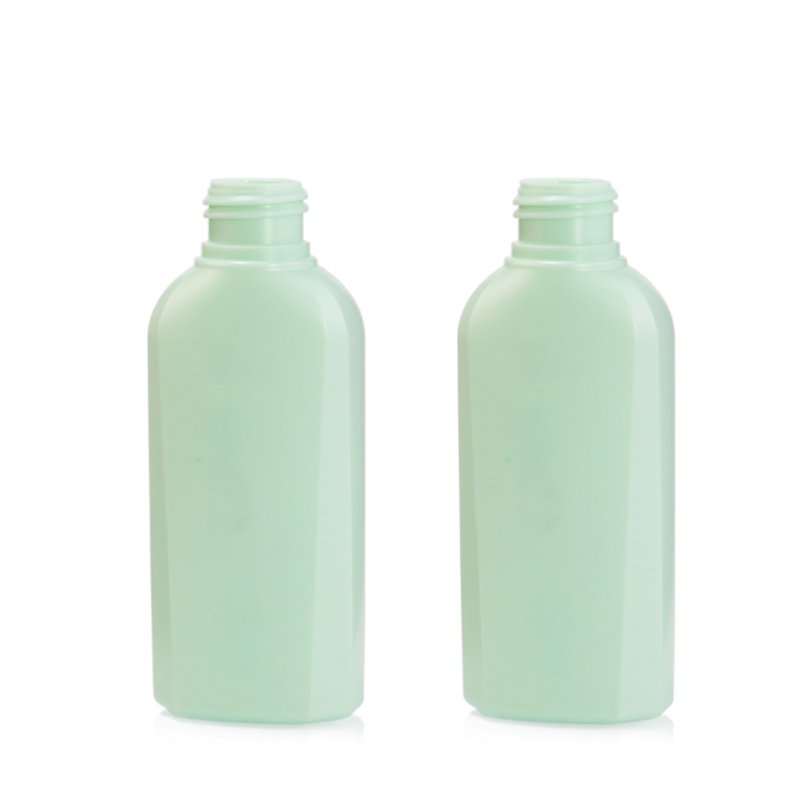
100ml HDPE Cosmetic Bottle – Custom Logo
HDPE · 100 ml
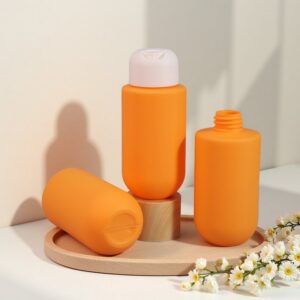
100ml PE Cosmetic Bottle for Facial Cleanser & Lotion – 20mm Neck, 18g
PE · 100 ml
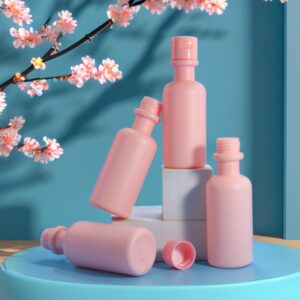
100ml PE Soft Touch Cosmetic Bottle – 24mm Neck
PE · 100 ml