
Quick answer: Hot fill (typically 82–93°C) uses the product’s own heat to sanitise the container and closure, which lets you run a preservative-light or preservative-free formulation — but it forces you into heat-set PET or PP, and it creates an internal vacuum as the bottle cools that will visibly collapse the panel unless the bottle is designed with vacuum compensation. Cold fill fills at ambient temperature into standard PET or HDPE, which is cheaper and preserves clarity, but it requires a validated preservative system and a hygienic filling environment because nothing is killing the microbes except the formula. The decision is driven by your formula and your preservative strategy, not by cost — although hot fill does cost more per bottle.
Last updated: 1 September 2026.
Start with the formulation, not the bottle
The single question that determines the answer is: how is this product going to stay microbially safe on the shelf?
If your formula is self-preserving — high acid, high sugar, high salt, or high alcohol — heat can do the sanitising work. If it is a water-based lotion or serum with a mild preservative system, the product has to be filled clean into a clean container, and heat would degrade the actives anyway.
| Hot fill | Cold fill | |
|---|---|---|
| Fill temperature | Typically 82–93°C | Ambient (typically 15–30°C) |
| What sanitises the pack | The product’s heat | Nothing — relies on clean filling plus the preservative system |
| Preservative strategy | Can be preservative-light or preservative-free | Requires a validated preservative system |
| Resin required | Heat-set PET, or PP | Standard PET, HDPE, PP |
| Bottle design constraint | Vacuum panels or heavy walls required | Standard geometry |
| Clarity | Slightly hazier (higher crystallinity) | Best clarity |
| Tooling and unit cost | Higher | Lower |
| Best for | Natural and “clean beauty” lines, high-acid or high-sugar formulas, preservative-free claims | Most lotions, serums, shampoos, toners, anything with heat-sensitive actives |
| Worst for | Heat-sensitive actives (vitamin C, retinol, many botanical extracts, proteins) | Preservative-free or “clean” positioning without an alternative hurdle |
What heat actually does to the bottle
Two separate effects, and buyers usually only hear about the first.
1. Thermal resistance. Standard PET starts to soften and shrink noticeably approaching its glass transition region, so a bottle blown for cold fill will distort when filled at 90°C. Heat-set PET solves this: the mold is run hot, which raises the crystallinity of the sidewall and lets the bottle hold its shape at fill temperature. The trade-off is optical — higher crystallinity scatters light, so heat-set bottles are slightly hazier than their cold-fill equivalents. On a natural-products line where the brief is “honest and unadorned”, that haze is acceptable. On a premium serum where the brief is “glass-like clarity”, it is not.
PP is the other option and sits higher on the temperature scale, but it is translucent rather than clear and it costs more per bottle than PET in most geometries.
2. Vacuum collapse — the one that gets missed. This is where hot-fill projects go wrong.
You fill at 90°C and cap. The headspace is full of hot vapour and the product is expanded. As the bottle cools to ambient, two things happen at once: the product contracts in volume, and the headspace vapour condenses. Both pull the internal pressure below atmospheric. On a round bottle with thin walls, the result is immediate and ugly — the panels cave inward, the shoulders suck down, and the label wrinkles.
The fix is designed in, not added later:
- Vacuum panels — shaped, slightly recessed areas engineered to flex inward in a controlled way, absorbing the vacuum without distorting the visible label area.
- Heavier wall and base design — more material resists the pressure differential.
- Nitrogen dosing before capping, to leave a positive-pressure cushion as the product cools.
- Hot-fill-capable closures that seal before the vacuum develops.
If a supplier quotes you a hot-fill bottle and the drawing is the same geometry as their cold-fill bottle with no panel design and no nitrogen step, the quotation is incomplete. Ask directly: what happens to this panel during cooling?
The cold-fill discipline
Cold fill looks like the easier option and is, in one dimension: cheaper tooling, standard bottles, best clarity. What it demands instead is process discipline.
- Preservative efficacy. The formula has to protect itself. That means a preservative system matched to the pH and water activity of the product, and validated by preservative efficacy testing (often run to ISO 11930 for cosmetics, or the equivalent pharmacopoeial challenge test). This is a formulation cost, not a packaging cost — but it is the reason cold fill is not automatically the cheap option.
- Hygienic filling. Nothing in the process kills microbes, so the container, the closure, the filling environment and the water all have to be controlled. For a brand scaling from a contract filler to in-house filling, this is usually the steepest learning curve.
- Compatible actives preserved. Cold fill is the only realistic option for vitamin C, retinol, peptides and most botanical extracts, because heat degrades them.
There is a third path worth knowing about for brands that want the preservative-light claim without the heat: aseptic cold fill, where the product and the container are separately sterilised and filled in a controlled environment. It is capital-intensive and usually only makes sense at volume, but it is the reason some “preservative-free” products exist in standard clear PET.
What to specify on the RFQ
Whichever route you choose, these five lines belong on the enquiry — they are the ones that get assumed, then argued about:
- Fill temperature and dwell time. Not “hot fill” — the actual number, and how long the product stays above it.
- Product density and viscosity at fill temperature. Hot product flows differently from cold product, and it affects both filling and the vacuum calculation.
- Cooling method. Air-cooled, water-cooled tunnel, or ambient. This drives the cooling curve, which drives the vacuum.
- Vacuum management. Panels, nitrogen, or a heavier preform — say which you expect, and make the supplier confirm it works at your fill temperature.
- Closure specification. The closure has to hold through the same thermal cycle, and it is the most common leak path in a hot-fill pack because the liner and the bottle neck expand at different rates.
Cost reality
Hot fill costs more in three places: the resin and process (heat-set blowing is slower than standard blowing, so the bottle costs more), the design work (vacuum panels and a heavier base mean more material), and the validation (thermal cycling and vacuum testing before you commit to tooling).
Against that, it can remove cost from the formulation side if it lets you drop or reduce the preservative system, and for a “clean beauty” brief the claim itself is worth more than the delta. Run both numbers before deciding — the packaging quote alone will always make cold fill look cheaper.
Frequently asked questions
At what temperature is it considered hot fill?
Commonly 82–93°C. The exact number is set by your product’s pH and formulation, and by what your filler can hold. Give the number to your packaging supplier, not the label “hot fill”.
Can I use a standard PET bottle for hot fill?
No. A standard cold-fill PET bottle will shrink and distort at hot-fill temperatures. You need a heat-set bottle, engineered for the specific fill temperature and dwell time.
Why did my hot-fill bottles cave in after cooling?
Internal vacuum. The product contracted and the headspace vapour condensed, pulling pressure below atmospheric, and the bottle had no controlled way to absorb it. The remedies are vacuum panels, nitrogen dosing, heavier walls, or a combination — designed in before tooling, not after sampling.
Is cold fill less safe?
Not if it is done properly. Cold fill shifts the safety burden from heat to the preservative system and the hygiene of the filling environment. Preservative efficacy testing plus a controlled filling line is a robust combination; skipping either one is where problems start.
Does hot fill damage the bottle’s print?
It can. Decoration applied before filling has to withstand the thermal cycle, and it is another reason to specify low-migration, properly cured ink and to check adhesion after a thermal cycle rather than only at room temperature. See our silk screen versus hot stamping comparison for how decoration behaves on different resins.
Which resin should I pick?
Standard PET for cold fill where clarity matters; heat-set PET for hot fill up to its thermal limit; PP where higher temperature resistance is needed and translucency is acceptable; HDPE where chemical resistance and cost dominate and clarity is not required. Our PET versus HDPE versus PP guide breaks down the selection.
Next step
Tell us your fill temperature, product pH and viscosity, and target volume, and we will tell you which resin and wall design we would run — including whether you need vacuum panels at all. See the full catalog or contact our team.
Related reading
Related Cosmetic Bottles
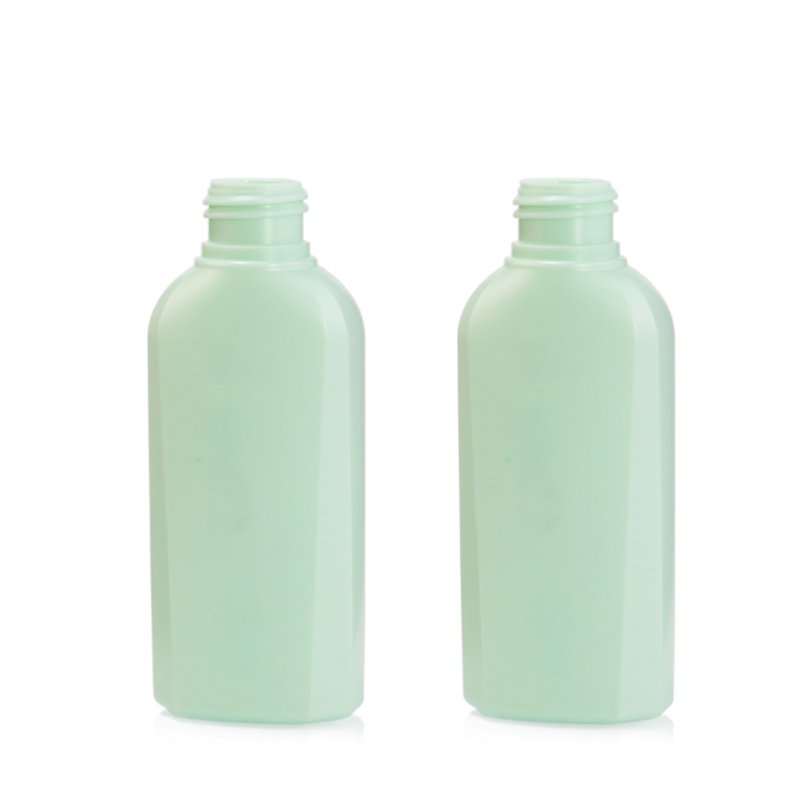
100ml HDPE Cosmetic Bottle
PE · 100 ml
100ml HDPE Cosmetic Bottle – Custom Logo
HDPE · 100 ml
100ml PE Cosmetic Bottle for Facial Cleanser & Lotion – 20mm Neck, 18g
PE · 100 ml
100ml PE Soft Touch Cosmetic Bottle – 24mm Neck
PE · 100 ml