
PCR & rPET Cosmetic Bottles: A Sourcing Guide to Recycled Content, Certificates and Limits
Quick answer: PCR (post-consumer recycled) resin is recovered from packaging after consumer use; rPET is the PET subset of that stream. For cosmetic bottles the workable range is roughly 30–100% PCR content, with 50% the most common commercial compromise. What decides whether a PCR programme actually holds up is not the percentage — it is whether your supplier can produce a GRS Transaction Certificate naming your specific product and lot, a per-lot Certificate of Analysis, and a migration test report on the finished article. PCR also carries inherent limits: a grey or green cast, higher haze, and a small odour risk, which is why it is usually specified for opaque or heavily tinted bottles rather than crystal-clear ones.
What PCR, rPET, PIR and regrind actually mean
These four terms get used interchangeably in quotations, and they are not the same material. The difference changes both the price you pay and the claim you are allowed to print.
| Term | Source of the material | Can it carry a GRS claim | Typical consistency |
|---|---|---|---|
| PCR (post-consumer recycled) | Collected household / commercial waste stream | Yes, with a Transaction Certificate | Widest batch-to-batch variation |
| rPET | The PET fraction of PCR | Yes | Colour drift is the main issue |
| PIR (post-industrial recycled) | Factory scrap, off-cuts, start-up waste | Sometimes, depending on scheme | Tighter than PCR — cleaner input |
| In-house regrind | Your own sprues and rejects, re-melted | Generally not for a consumer-facing claim | Depends entirely on melt count |
| Prime virgin | New polymer, one documented heat history | No — and it should not claim one | Tightest |
The trap in this table is in-house regrind. It is legitimate manufacturing practice to re-melt your own clean scrap, but a “made with recycled content” claim on a retail pack needs a certified chain of custody, not just a factory saying it recycles its own waste.
What percentage is realistic, and what each level costs you
| PCR content | Clarity | Colour control | Odour risk | Typical use |
|---|---|---|---|---|
| 30% | Slight haze, usually acceptable in tinted bottles | Manageable | Low | Entry-level sustainability claim |
| 50% | Visible haze; needs tint or opaque finish | Needs a signed-off reference chip | Low to moderate | Most common commercial choice |
| 70–100% | Effectively opaque | Batch matching is the hard part | Moderate | Brand-led programmes with approved colour range |
Two practical notes. First, 100% PCR is a marketing number more often than a production reality — many “100% PCR” bottles are 100% PCR in the body with virgin closures and pumps, because the moving parts need tighter tolerances than PCR currently delivers. Ask what percentage applies to which component. Second, PCR content and wall thickness interact: as haze rises, designers often thicken the wall to hide it, which partly cancels the material saving.
The certificate that matters: Transaction Certificate versus scope certificate
This is where most recycled-content programmes quietly fail an audit.
- A scope certificate says the factory is certified to handle recycled material. It says nothing about your product.
- A Transaction Certificate (TC) names your specific product, the recycled percentage, the lot and the date. This is the document a retailer, a brand owner or an EU regulator will ask for.
If a supplier sends you a scope certificate when you asked for a TC, that is the gap. Ask for the TC on every production lot, not once a year.
Alongside it you want three more documents: a Declaration of Compliance naming the regulation (EU 10/2011 for food contact, EC 1223/2009 as the cosmetic framework), a migration test report dated within 12 months, and a per-lot COA.
Where PCR works — and where it does not
PCR works well for: shampoo and body wash bottles, lotion bottles with opaque or pearlised finish, detergent and household containers, and any pack where a tinted or frosted look is part of the design.
PCR is a poor choice for: crystal-clear serum bottles where the product colour sells the product, anything requiring a very tight colour match across a long repeat run, high-clarity dropper bottles, and any application where the formula is sensitive to trace odour.
The honest framing for a brand: PCR buys you a claim and a marketing story, and it costs you some optical consistency. If the pack design cannot absorb that, PCR is the wrong specification — not a problem to be engineered away.
How recycled content is counted: mass balance versus physical segregation
Two quotations can both read “50% PCR” and describe two materially different bottles. The difference is not the resin — it is the accounting method behind the number, and it decides what you are allowed to print on pack.
- Physical segregation keeps the recycled stream apart end to end: separate silos, separate conveying, a dedicated run. Every bottle in the lot physically contains the recycled material, and the claim is verifiable at the level of the individual pack. You pay for that certainty in cleaning between runs, separate storage and a narrower supply pool.
- Mass balance — also called attributed content — runs recycled and virgin feedstock through the same process and allocates the recycled share to output through an audited ledger. The claim is reconciled against a production period rather than a single bottle. You gain availability and a lower price; you lose per-bottle precision.
Both models are recognised, and both can be certified. Mass balance is what allows recycled resin to displace virgin at industrial scale, because segregated streams are limited by how much clean, single-grade post-consumer material can be collected and kept clean. The failure mode is never the model itself — it is a brand printing a segregated-grade claim while buying under mass balance.
| Physical segregation | Mass balance (attributed) | |
|---|---|---|
| What is physically in your bottle | The recycled material itself | A blend; the recycled share is allocated |
| Claim strength | Strongest — verifiable per bottle | Valid, if worded as attributed content |
| Cost | Higher — segregation, cleaning, scheduling | Lower — standard supply chain |
| Supply at volume | Limited; tighter for colour-critical work | Broad; easier at volume |
| Best for | The SKU that carries your sustainability message | Volume programmes and colour-critical ranges |
The practical rule we give buyers is simple: segregation buys certainty, mass balance buys scale. Choose the model first, then write the on-pack sentence to match it — a claim that outruns its model is the single most common compliance failure we see in recycled packaging. Attributed content also has to reach your product rather than merely the factory, which is why the useful document is a transaction certificate naming your product, percentage, lot and date, not a scope certificate proving the facility is capable. We go through the reconciliation logic and the four document families behind it in how recycled content is actually calculated.
Where the recycled pellet physically comes from
A PCR pellet is not the output of one factory — it is the output of a six-stage chain, and the material changes hands at nearly every stage:
- Collection — kerbside mixed recycling, or a deposit return scheme.
- Sorting — largely near-infrared sorting at a materials recovery facility, which reads polymer type optically.
- Baling — the first tradable unit in the chain.
- Washing — shred, float-sink separation by density, hot caustic wash, rinse, dry.
- Pelletising — melt, filter to a defined micron rating, extrude into pellets.
- Decontamination — for food contact, a validated super-clean process capable of removing contamination from previous contents.
The observation that matters for a buyer is that the weakest links are commercial, not technical. Bales and flake are traded commodities, and each trade is an opportunity for provenance to be documented loosely or not at all. Deposit return schemes matter for a reason that is easy to miss: because they collect dominantly beverage containers, the stream is narrow and clean, which is why bottle-to-bottle recycled content tends to be built on DRS-sourced material — and why regions without a deposit scheme find food-grade rPET harder to supply.
| Stage | Where traceability weakens | Document that should exist |
|---|---|---|
| Collection | Origin is aggregated; containers anonymised | Scheme or municipal records |
| Sorting | Output quality varies by shift and line configuration | MRF output specification |
| Baling | Bales change hands; loads are consolidated | Bale specification and trader records |
| Washing | Operator-dependent cleanliness and odour | Recycler audit / traceability certificate |
| Pelletising | Lots blended during extrusion | Batch records and filtration rating |
| Decontamination | Only authorised processes qualify | Process authorisation and per-lot test data |
It is also why the same collected bottle can end up in two very different places. Bottle-to-bottle keeps the material inside the packaging loop and demands the cleanest feedstock, the most validated processing and the strictest documentation, which is why it commands the highest value. Bottle-to-fibre downgrades it into polyester fibre, which tolerates more contamination and needs no food-contact validation — legitimate recovery, but not a closed loop, because the fibre rarely returns as a bottle. If your claim says bottle back to bottle, stage six has to be in the chain.
On food contact, the regulatory question is the same on both sides of the Atlantic: it is the process that is authorised, not the resin. In the EU, recycled plastic for food contact is regulated under Regulation (EU) 2022/1616, which requires the recycling process itself to be authorised and monitored along the chain; in the US, the FDA evaluates recycling processes and issues a no-objection letter naming the process owner, the feedstock and the use conditions covered. The full route, stage by stage, is traced in from kerbside bin to food-grade pellet.
What we verify on every PCR lot
At Shijin, PCR and virgin resins run through the same incoming inspection, with PCR getting two extra checks because the input varies more.
- Prime virgin resin for everything else. Where a component is specified virgin, it is prime virgin with a single documented heat history and a full COA — not wide-spec off-grade material, which is the resin behind most field failures.
- Per-lot COA. Melt flow index or intrinsic value (IV for PET bottle grade, typically 0.70–0.85 dl/g), density, and ash content. PCR lots get IV checked individually because each additional melt shortens the polymer chain.
- Batch traceability both directions. Resin lot number to work order to finished-goods lot, and back again. If a customer reports an issue twelve months later, we can pull the resin lot.
- GRS Transaction Certificate per lot, issued against the specific product and percentage — not a copy of an annual scope certificate.
- Migration testing on the finished article. Overall migration and specific migration against EU 10/2011 limits, plus primary aromatic amines, which must be not detected.
We do not name specific resin brands or grades in writing, because those change with availability. What we commit to is the document set above, and it is the same set we would want if we were buying.
Colour, haze and batch consistency on a PCR run
Appearance is where PCR programmes are actually won or lost, and it is three separate problems rather than one:
- Base tint. Post-consumer feedstock carries a residual grey-yellow cast that survives washing and pelletising. Reds and oranges drift brownish, blues and greens go dusty, whites stop being white, and pastels lose their crispness fastest.
- Haze. Residual contaminants, gel formation and crystallisation differences scatter light, so a clear PCR bottle will not read as optically identical to virgin — most visibly in thick walls and heavy bases where the light path is longer.
- Batch drift. Recycled feedstock varies with what was collected, when, and how well it was sorted, so two deliveries of nominally identical PCR can differ noticeably. Most colour complaints originate here — from a shade approved once, on one batch, and never re-checked.
The fastest way to make PCR painless is to choose a finish whose design intent absorbs the variation. Natural and translucent hide the tint entirely; opaque dark absorbs tint and haze; frosted and matte surfaces turn haze into the feature rather than the defect. That is precisely why so many recycled-content skincare bottles are matte or natural rather than bright and glossy — finish choice is a colour-control decision, not only a styling one. Where a transparent pack is unavoidable, decide early whether the SKU genuinely needs glass-like clarity, because a toner, a micellar water or a bath oil reads perfectly well through a slightly hazed wall while an expensive serum invites the consumer to inspect the liquid.
Four disciplines then hold the standard in production. Sign the colour standard against physical PCR samples, never a pantone chip printed on paper with virgin ink. Agree a numeric tolerance in CIELAB ΔE, so “it looks a bit different” becomes an objective pass or fail. Define the viewing condition — normally controlled daylight rather than warm office or warehouse lighting — and have both sides judge from the same type of booth, because a large share of colour disputes are disputes about the lamp. Finally, compare each new production lot against a retained reference from the approved batch rather than against the previous delivery, and blend feedstock lots to a target instead of chasing the tint with masterbatch, which only produces a moving standard. The signing discipline is set out in our bottle colour specification guide, and the full appearance treatment is in PCR bottle colour, haze and batch consistency.
Odour: what causes it, and how we test it
Odour is the property buyers underestimate most, and it comes from four sources:
- Product residue. Bottles are collected with product still inside them, and fragrance compounds are designed to be persistent — that is their commercial purpose. Whatever survives the hot wash is what you eventually smell.
- Adhesive and ink residue. Label adhesives and printing inks carry solvent and tackifier chemistry into the melt.
- Thermal history. Every melt generates volatiles; PET releases aldehydes including acetaldehyde with its sharp solvent-fruity note, while polyolefins tend toward waxy and rancid notes. A feedstock reprocessed more than once arrives with a higher baseline load.
- Washing and drying practice. Wash temperature, caustic concentration, dwell time and drying effectiveness set the final odour level, and two recyclers processing the same bale can deliver noticeably different sensory profiles.
This is why odour tracks feedstock origin more than recycled percentage: a stream collected from beverage bottles behaves very differently from one collected from personal-care and cleaning packaging. It also means odour is a useful early-warning signal rather than a verdict — but it is not a safety indicator. Food-contact and cosmetic safety are established by resin grade, migration testing and regulatory authorisation, and those are separate lines on the specification. A compliant resin can smell; a pleasant-smelling resin can be non-compliant.
Three routes exist to measure it, and a serious supplier should be able to specify at least one. A trained sensory panel scores intensity after a controlled conditioning period, which is closest to what a consumer experiences. GC-MS identifies which volatile compounds are present and in what concentration, turning a complaint into actionable evidence. GC-O then separates the compounds that actually contribute to the perceived smell from the many that merely register on a machine. In practice the workable procurement specification is a threshold statement with a written protocol agreed before the order, plus a rejection clause — so a dispute becomes a re-test rather than an argument.
| Application | Odour sensitivity | Practical approach |
|---|---|---|
| Fragrance-free skincare, baby, sensitive skin | Very high — no scent to mask anything | Specify the tightest odour grade you can afford; air the bottle before filling |
| Premium facial care | High — sensory expectation is part of the price | Odour-graded resin; consider a barrier or inner finish |
| Fragranced skincare and body care | Moderate — product fragrance masks mild notes | Standard grades usually acceptable; validate on your own fill |
| Home care and detergent | Low — product scent dominates entirely | Odour grade rarely constrains the choice |
Two cheap production-side measures reduce the odour that actually reaches the consumer without changing the material at all: let freshly moulded bottles air in an open state with the closure loose for a defined period, and ask your recycler for a sensory and GC analysis on the batch whenever a lot fails the threshold. Both halves — the chemistry and the test protocol — are covered in why PCR plastic smells, and how to test it.
PCR and rPET bottles in our range
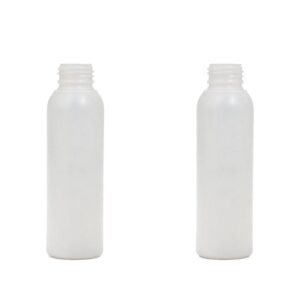
100ml HDPE Cosmetic Bottle
PE · 100 ml
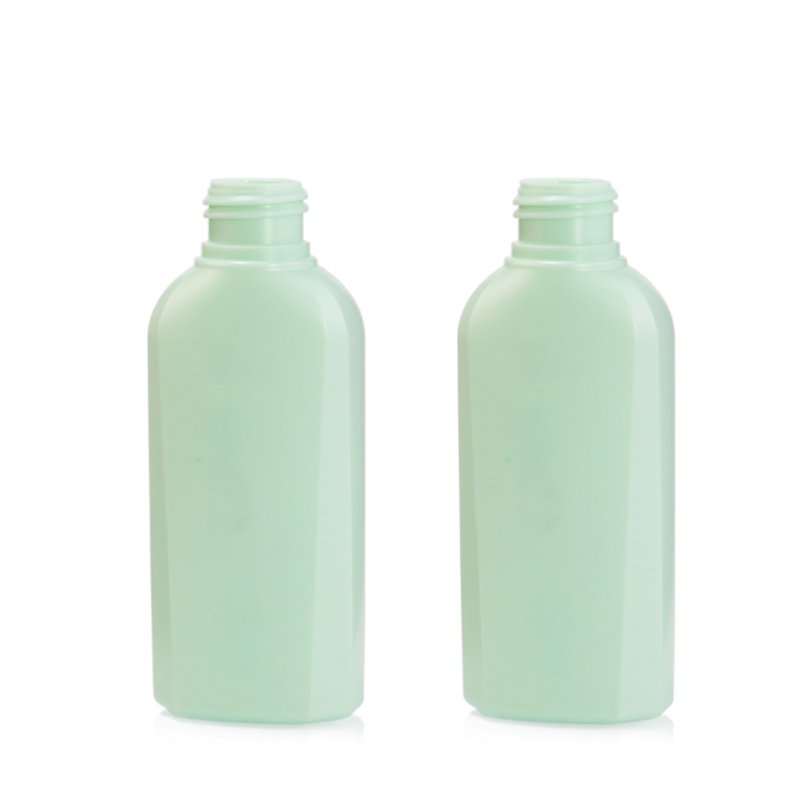
100ml HDPE Cosmetic Bottle – Custom Logo
HDPE · 100 ml

100ml PE Cosmetic Bottle for Facial Cleanser & Lotion – 20mm Neck, 18g
PE · 100 ml

100ml PE Soft Touch Cosmetic Bottle – 24mm Neck
PE · 100 ml
100ml PET Cosmetic Bottle with Dropper & Mist Sprayer (28/410 Neck)
PET · 100 ml
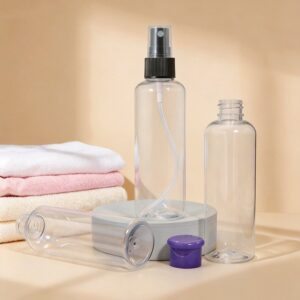
100ml PET Cosmetic Bottle with Lotion Pump & Disc-Top (24/410 Neck)
PET · 100 ml

100ml PET Cosmetic Bottle with Roll-on Applicator (24/410 Neck)
PET · 100 ml

100ml PET Flat Bottle for Lotion & Treatment – 24mm Neck, 18g
PET · 100 ml

100ml PET PET Cosmetic Bottle for Facial Toner Packaging
PET · 100 ml

100ml PET Round Bottle for Serum & Lotion – 20mm Neck, 18g
PET · 100 ml
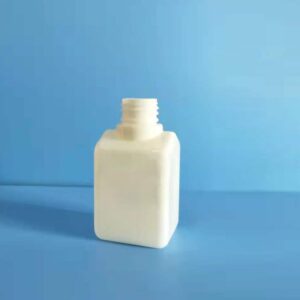
100ml PET Round Bottle for Serum & Sample – 20mm Neck, 18g
PET · 100 ml

100ml PET Spray Bottle for Facial Mist & Toner – 20mm Neck, 18g
PET · 100 ml
The bottles above are produced in cosmetic-bottle tooling. PCR content is specified per order — tell us the target percentage, the closure type and whether the finish is opaque or tinted, and we will confirm what is achievable and what it does to colour tolerance.
Frequently asked questions
Can you do 100% PCR on a cosmetic bottle?
The bottle body, usually yes. The closure and pump are a separate question — moving parts need tighter tolerances, and most 100% PCR programmes use virgin or high-PIR content in the closure. Ask your supplier to state the percentage for each component rather than for the pack as a whole.
Does PCR resin smell?
It can. Every melt generates some volatile content, and PCR resin arrives with more melt history than virgin. A properly processed PCR lot from a competent compounder should pass an odour panel, but if your formula is fragrance-free or very lightly fragranced, raise this before you commit and ask for a production-sample odour check.
Is rPET the same as PCR?
rPET is a subset. PCR is the umbrella term for any post-consumer recycled resin; rPET specifically means the PET fraction. A “50% PCR” label on a PET bottle is effectively 50% rPET, but on an HDPE bottle the PCR content is recycled polyethylene, not rPET.
What is the minimum order for a PCR run?
PCR lots need a committed resin purchase because the material is bought against a Transaction Certificate, so MOQs are typically at or slightly above a standard run — in our case from 5,000 pieces. Small trial runs are possible but the TC paperwork makes them disproportionately expensive.
Will PCR content change my decoration options?
Silk-screen and hot stamping both work on PCR bottles. The practical difference is surface energy: recycled content can sit lower and less predictably, so we check dyne levels before printing and, where needed, run flame or corona treatment to bring the surface to at least 38 dynes/cm. Adhesion is then verified with the ASTM D3359 cross-hatch test, targeting 4B to 5B.
How do I verify a supplier’s GRS claim is real?
Ask for the Transaction Certificate and then check two things on it: that it names your product and percentage, and that the TC number can be verified with the issuing certification body. A scope certificate, a logo on a website, or a “GRS compliant” line in a quotation are not evidence.
Last updated: September 2026. Written by the Shijin Packaging technical team, Huizhou, Guangdong.