
Last updated: 29 August 2026. All capacity and facility figures below are stated as of this date.
Quick answer: To choose a cosmetic plastic bottle manufacturer in China, verify four things before you compare prices: that the factory owns and runs its own molds, that the material and neck finish match your formula, that MOQ and lead time are stated in writing, and that current ISO 9001 and FDA-compliant material documentation exists. Every other variable, including decoration and freight, can be negotiated later.
Sourcing packaging from China is not difficult because suppliers are hard to find. It is difficult because the search results are dominated by trading companies that present themselves as factories. This guide is written for skincare, personal-care and daily-chemical brand owners who are evaluating a Chinese bottle manufacturer for the first time, or replacing one that failed them.
-300x300.jpg)
Why do buyers source cosmetic bottles from China?
Because the mold library already exists. A mature Chinese packaging factory has accumulated thousands of bottle and closure tools over decades, which means a brand can launch a private-label product on an existing mold in weeks instead of commissioning tooling from scratch.
At Shijin Packaging, which has produced cosmetic and daily-chemical bottles since 2003, the mold library has grown past 2,000 PET, HDPE and PETG bottle and closure tools as of August 2026. That single number determines most of what a buyer experiences downstream: how fast sampling happens, how low the MOQ can go, and how much a custom shape will cost.
The practical implication is simple. Ask how many molds a supplier owns before you ask for a quote. A factory with a large library can offer you an existing shape at a low MOQ. A trading company can only forward your enquiry to whoever owns the tool, adding a layer of cost and delay you will never see itemised.
Factory, distributor or trading company: which one are you talking to?
This is the first and most consequential filter, and it is where most first-time buyers lose money.
| What you see | Factory (owns tooling) | Trading company | Distributor / stockist |
|---|---|---|---|
| Can modify an existing bottle shape | Yes, in-house tooling | Only by asking the factory | No |
| Mold ownership | Owns the tool | Does not own it | Does not own it |
| Quoted MOQ | Set by production run | Factory MOQ plus margin | Fixed by stock |
| Lead time control | Direct | Relayed | Limited to stock |
| Traceability of resin batch | Available on request | Slow or unavailable | Usually unavailable |
| Price level | Lowest | Factory price plus 10-30% | Higher, but fast |
None of these is dishonest by default. A trading company can be the right choice for a small brand that needs mixed SKUs from five different factories. But you should know which one you are dealing with, because the failure modes differ: a factory fails on flexibility across categories, while a trading company fails on technical depth and traceability.
How to check in one conversation: ask for a video walk-through of the blow-molding floor with the company name visible, and ask who owns the mold for the specific bottle you are quoted on. A genuine factory answers both immediately.
Does the factory actually run its own molds?
Owning molds is not the same as running them. Some suppliers list tooling they have access to rather than tooling they operate.
Specific questions that reveal the answer:
- How many blow-molding lines and injection machines do you operate? (A real factory answers with numbers, not adjectives.)
- What is your daily output in pieces?
- If we change the neck finish, do you cut a new mold in-house or subcontract it?
- Can I see the mold maintenance record for the tool my bottle runs on?
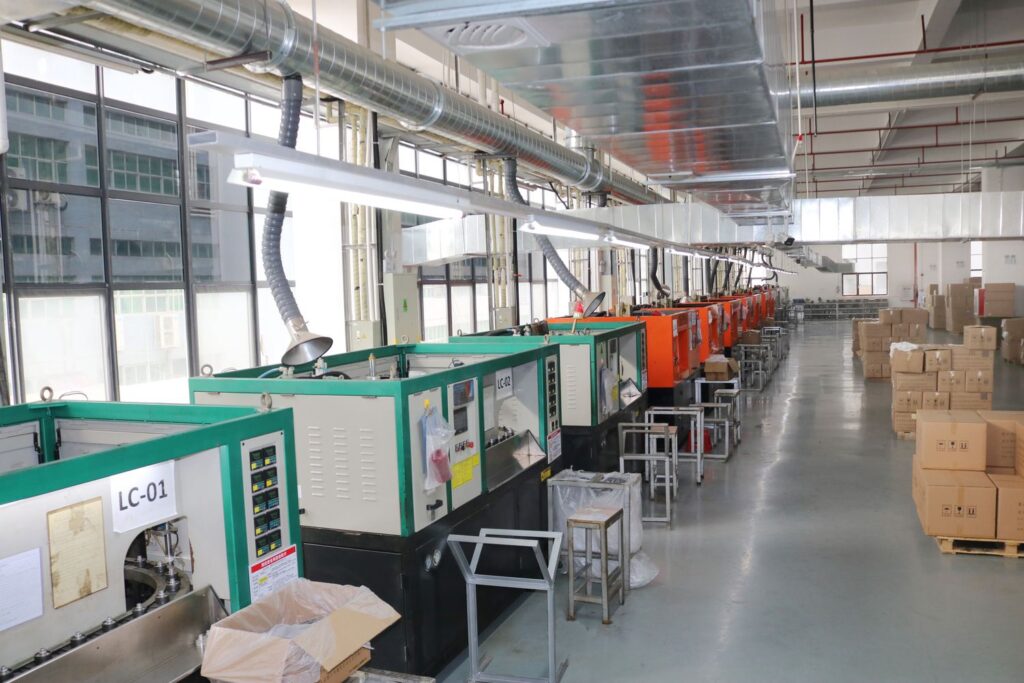
For reference, as of August 2026 our Huizhou plant operates 30+ automatic blow-molding lines and 10+ injection-molding machines, with a daily capacity of approximately 200,000 pieces across a 15,000 m² integrated facility. These are the kinds of figures a factory can state without hesitation, because they are operational facts rather than marketing claims.
Which material matches your formula: PET, HDPE, PP or PETG?
Material selection is a chemistry decision before it is a marketing decision. A bottle that looks right and fails compatibility testing is a lost production run.
| Material | Clarity | Chemical resistance | Typical cosmetic use | Watch out for |
|---|---|---|---|---|
| PET | High, glass-like | Moderate | Toners, serums, lotions, facial mists | Stress cracking with certain oils |
| HDPE (PE) | Opaque | High | Shampoo, body wash, hand wash, household | Poor clarity; best for opaque brands |
| PP | Translucent | High, heat resistant | Closures, jars, hot-fill products | Lower impact strength at low temperature |
| PETG | High, tough | Moderate | Premium skincare, thick-wall jars | Higher material cost |
The rule of thumb: test your actual formula against the actual resin, not a generic data sheet. Oil-based serums and high-surfactant formulas behave very differently in contact with the same polymer. Reputable manufacturers will run a compatibility soak test at elevated temperature before you commit to a bulk order.
What MOQ and lead time should you expect from a Chinese factory?
Buyers consistently underestimate this, and it is the most common cause of a stalled launch.
| Stage | Typical figure (existing mold) | Typical figure (new tooling) |
|---|---|---|
| Sampling | 3–10 days | 15-30 days |
| Standard MOQ | 5,000 pcs | 5,000 pcs |
| Custom colour / plating | from 5,000 pcs | from 5,000 pcs |
| Mass production lead time | 15-30 days | 15-30 days after sample approval |
Two things in that table matter more than the numbers themselves:
- MOQ is driven by the production run, not by policy. A mold that runs efficiently at 5,000 pieces cannot be set up for 500 without the unit price rising sharply. If you genuinely need 500 pieces, say so early and ask for a stock or semi-custom option instead of negotiating the MOQ down.
- Lead time starts after sample approval, not after enquiry. Most “delays” are actually approval cycles on the buyer’s side.
Which certifications actually matter for cosmetic packaging?
Certification lists on supplier websites are often padded. For cosmetic and personal-care packaging, these are the ones that change your risk profile:
- ISO 9001:2015 — quality management system. The baseline; it verifies the process, not the product.
- FDA-regulated, not FDA-approved — the FDA does not approve cosmetics or their packaging; it regulates them. For the U.S. market, ask for resin and additive compliance statements, and treat any supplier claiming “FDA approval” as a warning sign.
- Regulation (EU) No 10/2011 — the European framework for plastic materials intended to come into contact with food.
- Regulation (EC) No 1223/2009 — the EU cosmetics regulation, under which packaging material safety forms part of the product safety assessment.
- GRS (Global Recycled Standard) — if you are claiming PCR content, this is the credential that makes the claim defensible at retail.
- SGS or equivalent third-party test reports — verifiable, dated, and tied to a specific batch.
Note the wording in the second point, because it is the claim most often abused in this industry. No Chinese factory can sell you an “FDA-approved” cosmetic bottle, because the FDA does not approve cosmetic packaging. What a credible factory supplies is a material compliance statement backed by third-party test reports.
How to verify rather than believe: ask for the certificate number and the issuing body, then check the expiry date. An ISO certificate that expired 14 months ago is the single most common red flag in the industry.
How do you verify quality before placing a bulk order?
The sequence that protects you, in order:
- Written specification. Material, capacity, neck finish, weight in grams, colour reference, decoration method, tolerance. If it is not written, it will not be honoured.
- First-article sample. Produced on the actual production tool, not a 3D print or a hand-finished prototype.
- Compatibility soak test. Your formula, in the actual bottle, at elevated temperature for 2-4 weeks.
- Colour standard. Physical signed-off swatch retained by both sides, because screen references drift.
- Pre-shipment inspection report. With actual measured dimensions and a defect rate, not a checklist of ticks.
- Retained reference sample. Kept for comparison against future re-orders.
Step 3 is the one buyers skip most often and regret most often. Packaging failures rarely appear as a broken bottle; they appear as a formula that changes colour, separates, or degrades in month three.
Red flags that should end the conversation
- Refusal to show the production floor on video, or answers that always defer to “our factory partner”.
- A quotation with no neck finish specification, no gram weight, and no tolerance.
- Certificates without certificate numbers, issuing bodies, or visible expiry dates.
- MOQ and lead time that change after you accept the price.
- Pressure to move the conversation off-platform before a specification is agreed.
- Samples that arrive faster than the stated tooling time, which usually means the sample was not made on your tool.
Frequently asked questions
What is the typical MOQ for custom cosmetic bottles in China?
Around 5,000 pieces for a standard run on an existing mold, including custom colour. New tooling generally requires the same volume. Below that, expect either a significant unit-price premium or a stock-based alternative.
How long does sampling take?
3–10 days on an existing mold, and 15-30 days when new tooling has to be cut. Mass production typically runs 15-30 days after you approve the sample.
Can I get recycled PCR content in a cosmetic bottle?
Yes, in PET and HDPE, though PCR resin affects colour consistency and clarity. If you intend to print a recycling claim on pack, ask for GRS certification so the claim is defensible.
Do Chinese factories provide FDA documentation for cosmetic bottles?
They provide material compliance statements and third-party test reports, not FDA approval, because the FDA does not approve cosmetic packaging. Ask for the documentation with the quotation rather than after the order.
How do I keep bottle colour consistent across re-orders?
Retain a physical signed-off swatch on both sides and reference it in the purchase order. Relying on Pantone numbers alone is the most common cause of visible colour drift between batches.
Is it cheaper to buy through a trading company?
Rarely. A trading company adds a margin to the factory price. The value they add is consolidation across multiple factories, which only matters if you are buying many different packaging types in small volumes.
Next step
If you are evaluating a cosmetic bottle manufacturer in China, send us three things and we will tell you honestly whether we are a fit: your product formula type, your target capacity and neck finish, and your launch volume. If an existing mold in our 2,000+ library matches, you will get a quotation against a real tool rather than an estimate.
Shijin Packaging — factory-direct cosmetic and daily-chemical plastic bottles since 2003. PET, HDPE, PP, PETG and PCR bottles, preforms and closures, with in-house mold making, blow molding, injection molding and decoration.
- Website: https://shijinpackaging.com
- Full catalogue: https://shijinpackaging.com/catalog/
- Email: sales@shijinpackaging.com