
Last updated: 30 August 2026.
Quick answer: The packaging trends that actually change what you should order in 2026, rather than what looks good in a trend report, are: sustainability with proof (PCR and mono-material designs backed by certification, not vague “eco” claims), refillable and reusable formats, minimal premium aesthetics, precision dosing (airless and dropper formats for active ingredients), and regulatory tightening led by the EU’s packaging rules and the US Modernization of Cosmetics Regulation Act. Each one has a concrete packaging consequence — and a cost — which is what this guide translates.
Trends in packaging are only useful when they reach a purchase order. Most of what circulates as “the future of packaging” is styling; the five shifts below are structural, because they are being driven by regulation and by what retailers and consumers now ask for, not by a design studio.
This guide separates the structural shifts from the styling, and tells you what each means for the bottle, jar, pump or sprayer you actually buy.
Trend 1: Sustainability with proof
Recycled content and recyclability have moved from a nice-to-have to a procurement checkbox, and the market now distinguishes between a claim and a certificate.
The claim “eco-friendly” is unenforceable. The certificate that makes recycled content defensible at retail is the Global Recycled Standard (GRS) — it verifies the recycled content is real and the material is traceable. For the EU market, recyclability and recycled-content obligations sit within a broader packaging regulation that is tightening every year.
What this means for the bottle:
- PCR (post-consumer recycled) content is the dominant material trend, with a cost premium and slightly reduced clarity over virgin resin.
- Mono-material design — a bottle, closure and label all in one polymer — is what makes a package genuinely recyclable, and it is easier to achieve in PET than in mixed-material assemblies.
- Lighter weight is sustainability that also cuts cost and freight, but only to the point where the bottle still survives transit and stacking.
The practical rule: ask for the GRS certificate for any recycled-content claim, and re-approve your colour on the PCR resin, because it will not match the virgin-resin swatch.
Trend 2: Refillable and reusable formats
Refillability is the sharpest expression of the sustainability shift, and it changes the packaging itself, not just the messaging.
| Refill model | Packaging consequence |
|---|---|
| Refill pouch into a keeper bottle | The bottle must survive many refills — heavier, more durable |
| Replaceable inner cartridge | The outer shell and inner cartridge are separate SKUs |
| Return-and-refill programmes | The bottle is designed for cleaning, return and reuse |
Refillable packaging is more expensive to produce because it must be durable enough to last, and it asks the consumer to change behaviour. It is strongest in prestige skincare and home care, where the brand relationship already justifies a keeper bottle. If you adopt it, the bottle specification — wall thickness, closure durability, resealability — changes materially.
Trend 3: Minimal premium aesthetics
The dominant visual language of prestige packaging in 2026 is less, not more: clean geometry, soft-touch finishes, and a smaller, quieter brand mark.
What this means in a specification:
- Soft-touch and matte finishes replace glossy decoration on premium lines.
- Frosted and translucent colour — the 2% loading described in our colour guide — reads as modern premium without the opacity of a full solid colour.
- Simplified labelling shifts emphasis to the bottle shape and finish rather than printed decoration.
The catch is that minimal looks are achieved through finish and tooling, which cost money — a soft-touch finish and a frosted tint are both line items, not defaults.
Trend 4: Precision dosing for active ingredients
As formulas become more active — vitamin C, retinol, peptides — the packaging that protects and doses them precisely moves from optional to necessary.
- Airless pumps protect oxidation-sensitive formulas and dose consistently; they are the default for premium serums and treatments.
- Dropper bottles remain the precision format for oils and concentrated serums.
- Dose accuracy (a stated output per stroke) is now part of the specification, not just a feature.
The consequence for buyers: dosing is a specification you can and should pin down — output per stroke, neck finish, and material compatibility of the wetted parts — rather than a feature you discover after the order.
Trend 5: Regulatory tightening
The strongest force behind the other four trends is regulation, and it is moving in one direction: more documentation, more traceability, more responsibility.
- In the US, the Modernization of Cosmetics Regulation Act (MoCRA) requires facility registration, product listing and good manufacturing practice, and it adds adverse-event reporting.
- In the EU, packaging is governed by a tightening waste-and-recyclability framework, on top of material rules such as Regulation (EU) No 10/2011 for plastic food-contact materials.
The practical consequence for a sourcing decision: choose suppliers who can produce documentation on demand — resin compliance statements, dated test reports, certificates with numbers and expiry dates. The brands that can answer a retailer’s questionnaire in a day are the ones that will keep their shelf space.
How do you turn trends into a purchase order?
Trends become specifications or they become nothing. Translate each one before you buy:
| Trend | Turn it into this specification |
|---|---|
| Sustainability | recycled-content PCR percentage, mono-material where possible |
| Refillability | Wall thickness and closure durability for reuse |
| Minimal premium | Soft-touch or frosted finish as a named line item |
| Precision dosing | Output per stroke and wetted-part compatibility |
| Regulatory | Compliance file — resin statements and dated test reports |
If a trend cannot be written as a specification, it is styling, not strategy — buy it if you like it, but do not mistake it for a structural shift.
Frequently asked questions
What is the biggest packaging trend in 2026?
Sustainability with proof — PCR and mono-material designs backed by verifiable recycled-content documentation rather than vague “eco” claims — driven by regulation as much as by consumer preference.
Is PCR worth the cost premium?
For brands selling sustainability as part of the value proposition, yes — but confirm the recycled content with a GRS certificate and re-approve your colour on the PCR resin, which is slightly less clear than virgin.
What is mono-material packaging and why does it matter?
A mono-material package is one where the bottle, closure and label are a single polymer, which makes it genuinely recyclable. It is easier to achieve in PET than in mixed-material assemblies.
Are refillable bottles more expensive?
Yes — they must be durable enough to survive repeated use and refilling, so wall thickness and closure quality are higher. The economics work in prestige skincare and home care, where a keeper bottle is part of the brand.
What is precision dosing in cosmetic packaging?
A specified output per stroke — for example 0.25 ml on an airless pump — so the consumer gets a consistent dose. Airless pumps and dropper bottles are the formats that deliver it.
How does MoCRA affect my packaging supplier?
MoCRA requires cosmetic facility registration, product listing, GMP and adverse-event reporting, so you need suppliers who can produce documentation — resin statements and dated test reports — on demand.
What is the difference between a trend and a specification?
A trend is a direction; a specification is a number. “Sustainable” is a trend; “30% documented PCR, mono-material PET” is a specification. Only the latter survives contact with a purchase order.
Next step
If you are planning a 2026 line, send us the format you have in mind — serum, cream, cleanser or treatment — and we will map the current trends onto a concrete specification, including PCR options with recycled-content supply-chain documentation and the finishes that deliver the premium look. If a stock shape in our 2,000+ mold library fits, we will tell you.
Shijin Packaging — factory-direct cosmetic and daily-chemical plastic bottles since 2003, operating 30+ automatic blow-molding lines and 10+ injection-molding machines across a 15,000 m² facility in Huizhou, Guangdong, with daily capacity of approximately 200,000 pieces.
- Website: https://shijinpackaging.com
- Full catalogue: https://shijinpackaging.com/catalog/
- Email: sales@shijinpackaging.com
Related reading
- Recycled (PCR) Plastic Bottles: A Buyer’s Guide
- Airless Pump Bottles: The Complete Buyer’s Guide
- FDA Cosmetic Packaging Rules: What “Not FDA Approved” Really Means
Related Cosmetic Bottles
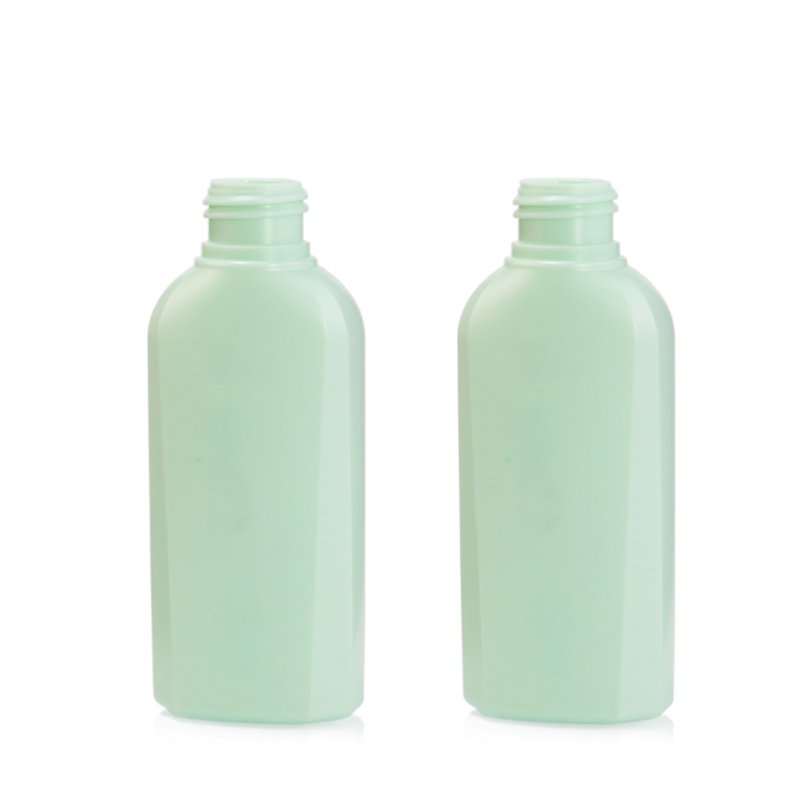
100ml HDPE Cosmetic Bottle
PE · 100 ml
100ml HDPE Cosmetic Bottle – Custom Logo
HDPE · 100 ml
100ml PE Cosmetic Bottle for Facial Cleanser & Lotion – 20mm Neck, 18g
PE · 100 ml
100ml PE Soft Touch Cosmetic Bottle – 24mm Neck
PE · 100 ml