
Last updated: 30 August 2026.
Quick answer: When you shortlist Chinese cosmetic-bottle factories, the single most predictive signal is track record — how long the factory has run, how many molds it holds, and which certifications it maintains. A factory with 20 years and a mold library in the thousands has already paid off its tooling, solved the quality problems a newcomer has not met yet, and survived the compliance audits that decide whether your bottles clear customs. A new factory may quote a lower unit price, but the hidden cost is risk: tooling you fund yourself, a thinner mold library, and no demonstrated record of export compliance.
Why does factory age matter in cosmetic packaging?
Factory age is a proxy for accumulated capability, not just a number of years. In cosmetic packaging, three things compound over time:
- Mold investment — every new bottle shape requires a mold, and molds are expensive. An established factory has amortised those molds across many orders, which is why it can offer proven shapes without charging you for tooling.
- Problem-solving — blow molding, injection molding and decoration all have failure modes — flashing, sink marks, closure mismatch, print adhesion. A factory that has been running for two decades has met and fixed these problems already.
- Compliance history — export-ready factories have passed audits and maintained certificates year after year. A newcomer may hold a fresh certificate but not yet have the track record of holding tolerances and documentation over repeated production runs.
In short, age is a crude but useful proxy for “this factory has already paid to learn what a new factory is about to learn on your order.”
| Factor | New factory | Established factory (20+ years) |
|---|---|---|
| Mold library | Small; you fund new tooling | Thousands of proven shapes |
| Certifications | Fresh, unproven | Repeated audits, verifiable |
| Compliance history | Limited | Exports to many countries |
| Risk on your order | Higher | Lower |
What does a mold library in the thousands actually save you?
A large mold library is the most concrete financial advantage of an established supplier. New tooling for a single bottle commonly costs thousands of dollars and adds weeks to the timeline. An existing mold changes the economics:
| Item | New tooling | Existing mold |
|---|---|---|
| Tooling cost | You pay the full mold | Usually waived or minimal |
| Time to sample | Weeks (new mold) | Days (existing mold) |
| First-run risk | Untested geometry | Proven shape and neck finish |
| MOQ flexibility | Often higher to justify tooling | Lower, since tooling is sunk |
This is why an established factory can take a buyer from brief to sample faster and cheaper: it is pulling a proven mold off the shelf instead of cutting a new one. See our MOQ, tooling cost and lead-time guide for the full cost breakdown.
Which certifications separate export-ready suppliers?
Certifications are the documented evidence behind a factory’s claims. For cosmetic packaging the ones that matter are:
- ISO 9001:2015 — the baseline quality-management certification; it shows the factory has documented, auditable process control.
- FDA-regulated cosmetics — in the US, cosmetics are regulated, not approved. The FDA states explicitly that it does not approve cosmetic products or ingredients, so a supplier claiming “FDA approved” bottles is a red flag.
- EU Regulation 10/2011 — the food-contact plastics regulation used as the reference for migration-safety testing of packaging into the EU.
- EC 1223/2009 — the EU Cosmetics Regulation, governing safety and labelling for the products the packaging will hold.
- GRS (Global Recycled Standard) — for brands making recycled-content claims, the Global Recycled Standard is the recognised chain-of-custody certification.
A factory that can produce the certificate numbers — and survives a verification call to the issuing body — is a different risk profile from one that only pastes logos on a website.
How do you verify a factory’s claims?
Verification separates a real track record from a marketing page. The practical checks:
- Ask for certificate numbers — then confirm them with the issuing body. ISO and GRS certificates are verifiable.
- Request a live or recorded factory walkthrough — the mold library, machine lines and decoration floor should be visible.
- Check the mold library is real — ask whether your target shape is an existing mold or requires new tooling, and ask to see samples of prior similar bottles.
- Confirm export history — a factory that exports to 30+ countries has repeatedly cleared customs and met buyer-specific compliance, which is evidence you cannot fake.
- Send a test order or sample request — sampling speed and quality reveal the actual operating rhythm of the factory.
For a fuller screening list, see the red flags to check before paying a deposit.
What is the cost of choosing the wrong factory?
The cost of a failed supplier shows up after the order, not at the quote:
- Tooling you funded is lost if the factory cannot deliver.
- Non-compliant material or decoration can fail a migration test or a customs check, stranding a shipment.
- Late or inconsistent production breaks your launch or reorder cycle.
- Remediation — finding a second supplier mid-crisis — costs far more than the initial price difference.
This is why a marginally higher unit price from a factory with a 20-year track record, a 2,000+ mold library and verifiable certifications is usually the cheaper decision in total.
Frequently asked questions
Why does factory age matter for cosmetic packaging?
Age proxies accumulated capability — a paid-off mold library, solved production problems and a repeated compliance history — which reduces the risk that the factory learns on your order.
What does a large mold library save me?
It can remove new-tooling cost and cut sampling time from weeks to days, because the factory uses a proven mold instead of cutting a new one.
Which certifications matter for cosmetic bottles?
ISO 9001:2015 for quality, FDA-regulated (not approved) cosmetics for the US, EU 10/2011 and EC 1223/2009 for Europe, and recycled-content supply-chain documentation for PCR claims.
How do I verify a factory’s certifications?
Ask for the certificate numbers and confirm them with the issuing body, and request a factory walkthrough, samples and evidence of export history.
Is a new factory always riskier?
Not always, but a new factory lacks the mold library, problem history and compliance track record that an established one has already accumulated, which is a real risk on your order.
Is a slightly higher unit price worth it for an established factory?
Usually yes, because the avoided cost of tooling, non-compliance, delay and remediation typically exceeds the small price difference.
Next step
Ask us whether your target bottle is an existing mold in our 2,000+ library, and we will send samples, certificate details and a walkthrough of our Huizhou facility.
Shijin Packaging — factory-direct cosmetic and daily-chemical plastic bottles since 2003, operating 30+ automatic blow-molding lines and 10+ injection-molding machines across a 15,000 m² facility in Huizhou, Guangdong, with daily capacity of approximately 200,000 pieces and exports to 30+ countries.
- Website: https://shijinpackaging.com
- Full catalogue: https://shijinpackaging.com/catalog/
- Email: sales@shijinpackaging.com
Related reading
- How to Choose a Cosmetic Plastic Bottle Manufacturer in China
- 7 Red Flags When Sourcing Cosmetic Bottles from China
- Cosmetic Bottle MOQ, Tooling Cost and Lead Time
- Cosmetic Labeling and MoCRA Compliance Guide
Related Cosmetic Bottles
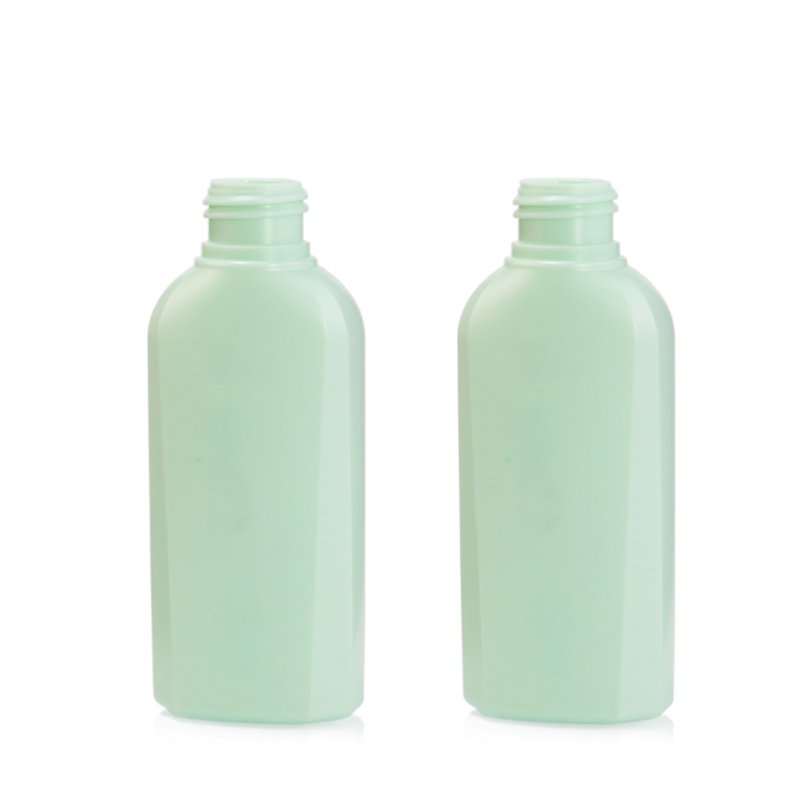
100ml HDPE Cosmetic Bottle
PE · 100 ml
100ml HDPE Cosmetic Bottle – Custom Logo
HDPE · 100 ml
100ml PE Cosmetic Bottle for Facial Cleanser & Lotion – 20mm Neck, 18g
PE · 100 ml
100ml PE Soft Touch Cosmetic Bottle – 24mm Neck
PE · 100 ml