
Last updated: 14 September 2026.
Quick answer: Recycled resin changes bottle appearance in three separate ways — a base tint (the natural grey-yellow of post-consumer feedstock), haze (clear bottles lose some transparency), and batch-to-batch drift (colour moves between deliveries). They are managed, not eliminated. The workable method is to sign your colour standard against physical PCR samples rather than a virgin reference, choose a finish that absorbs the variation you cannot control, specify a ΔE tolerance, and approve colour per batch rather than once at the start.
Where this fits: This is the appearance chapter of the PCR cosmetic bottles guide. Read it after you have settled the recycled percentage — the 30% vs 50% vs 100% decision sets how much variation you are signing up for.
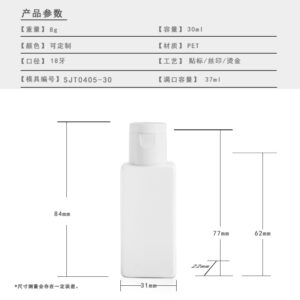
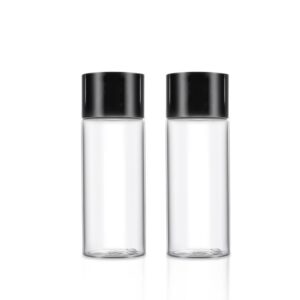

The three ways PCR changes how a bottle looks
Brands often treat “PCR looks different” as one problem. It is three, and they have different fixes.
1. Base tint
Post-consumer feedstock carries a residual colour cast — typically a warm grey-yellow — that survives washing and pelletising. It is not dirt; it is the accumulated colour of everything that was ever put in the bottle plus the thermal history of reprocessing. At low recycled percentages the cast is barely perceptible. As the percentage climbs, every colour you mix on top of it shifts toward muted, earthy tones:
- Reds and oranges drift brownish.
- Blues and greens go slightly dusty.
- Whites stop being white and become off-white.
- Pastels — the most demanding category — lose their crispness fastest.
2. Haze
Haze is the scattering of light that makes a transparent material look milky rather than glass-clear. In PCR it comes from residual contaminants, fine particles, gel formation and slight crystallisation differences in the recycled stream. The effect is measured as haze percentage (ASTM D1003), and the practical translation is simple: a clear PCR bottle will not read as optically identical to a clear virgin bottle, particularly in thick walls and heavy bases where light travels further.
The honest design response is to decide up front whether your transparent SKU genuinely needs glass-like clarity. Many do not — a toner, a micellar water, a bath oil all read perfectly well through a slightly hazed wall. A premium fragrance or an expensive serum, where the consumer inspects the liquid, is where haze becomes a real constraint.
3. Batch-to-batch drift
Virgin resin arrives at a stable, contracted colour. Recycled feedstock varies with what was collected, when, and how well it was sorted and washed. Two deliveries of nominally identical PCR can differ noticeably in tint, and that difference shows up in the bottle.
This is where most PCR colour complaints originate — not from a badly chosen shade, but from a shade that was approved once, on one batch, and never re-checked.
How each finish absorbs PCR variation
The fastest way to make PCR painless is to choose a finish whose design intent tolerates variation.
| Finish | How it handles PCR variation | Watch out for |
|---|---|---|
| Natural / translucent | Hides tint entirely — the material is the colour | Reads as “unfinished” to some consumers |
| Opaque white | Visible off-white cast; needs a real white standard against PCR | Bright-white expectations; price of whitening |
| Opaque dark / black | Absorbs tint and haze almost completely | Carbon-black packaging is under scrutiny in recycling sorting |
| Solid colour (mid-tone) | Good, if the standard is signed on PCR base | Pastels and exact brand palettes drift |
| Clear / transparent | Tint and haze both visible | Any clarity claim; thick walls amplify haze |
| Frosted / matte finish | Haze becomes the feature, not the defect | More surface area for scuffing in transit |
The strategic point: finish choice is a colour-control decision, not just a styling decision. A frosted or matte surface turns PCR’s biggest appearance liability into a deliberate design language, which is why so many recycled-content skincare bottles are matte or natural rather than bright and glossy.
Setting a colour standard that survives PCR
Four disciplines separate a PCR colour programme that holds from one that drifts.
Sign the standard against physical PCR samples. A Pantone chip is printed on paper with virgin ink; it tells you nothing about how a shade behaves over a grey-yellow base. Every colour standard for a recycled bottle should be a physical bottle or plaque produced from the actual PCR stream you will be running — the signing discipline is covered in our colour specification guide.
Specify a tolerance, and specify it numerically. Colour difference is normally expressed in CIELAB as ΔE — the smaller the number, the tighter the match. Agreeing a ΔE figure in the contract turns “it looks a bit different” into an objective pass/fail, and it forces both sides to say how much variation is acceptable before the tooling is paid for.
Define the viewing condition. Colour judgements are meaningless without a light source. Standard practice is to evaluate under controlled daylight (D65) rather than warm office lighting or warehouse sodium lamps, with both parties approving from the same type of booth. Most disputes we see are disputes about the lamp, not the bottle.
Track yellowing separately. The grey-yellow cast can be monitored as a yellowness index, which is useful for white and very light shades where a small drift is highly visible. It gives you a trend line between batches instead of a binary complaint.
Managing drift in production, not just at approval
Once a standard is set, the operating discipline is about keeping batches inside it.
- Per-batch colour approval. Retain a physical reference from the approved batch and compare each new production lot against it, not against the last delivery.
- Hold samples with dates. A dated retention sample library lets you escalate a drift to the recycler with evidence of when it began — which is what makes a feedstock complaint actionable.
- Blend, do not chase. Reputable converters manage tint by blending feedstock lots to a target rather than readjusting masterbatch every run. Chasing with masterbatch produces a moving standard and compounds variation.
- Control the masterbatch as a variable. Masterbatch dosage interacts with the recycled base; a dosage that held perfectly on virgin may need retuning on PCR. Treat the first PCR run as a new setup.
- Give the shift a documented line. “ΔE within agreed tolerance, evaluated under D65, against the signed PCR reference” is a sentence an operator can act on. “Match the approved colour” is not.
Frequently asked questions
Why is my PCR bottle not pure white?
Recycled resin carries a natural tint that resists full bleaching. Near-white is achievable with careful feedstock selection, but it is a specified premium variant rather than a default. Set the expectation with a physical colour standard made from PCR material, not from a pantone book or a virgin sample.
Can I match an exact brand colour in PCR?
Yes, in most of the palette — the match is made in the masterbatch over the recycled base, not in the base itself. Pastels, bright whites and very saturated yellows are the hardest families, because the base tint sits closest to them. The standard must be signed on PCR samples.
Does a clearer PCR grade exist?
Recycled feedstock quality varies widely, and some flows produce noticeably lower haze than others. What matters commercially is that you specify a haze expectation for your transparent SKU and select the grade against it, rather than assuming all rPET is equal.
Will PCR colour improve after the first order?
Drift usually decreases over successive runs, because the converter builds a history of which feedstock lots hold your standard. Most of the gained consistency comes from feedstock sourcing discipline rather than from the resin magically stabilising.
Does matte or frosted finishing fix the colour problem?
It converts the problem into a feature. Haze reads as intentional softness rather than loss of clarity, and surface texture makes small tint variations far less noticeable. It is the most common design answer for recycled cosmetics bottles.
Why does PCR colour change between two identical orders?
Because the feedstock changed. Recycled streams are not contract-graded to a fixed colour the way virgin resin is, so the tint moves with the material collected. Per-batch approval against a retained reference is how you detect and escalate it rather than discover it on the shelf.
Shijin Packaging — factory-direct cosmetic and daily-chemical plastic bottles since 2003, operating 30+ automatic blow-molding lines and 10+ injection-molding machines across a 15,000 m² facility in Huizhou, Guangdong, with daily capacity of approximately 200,000 pieces; recycled-content PCR bottles with per-batch chain-of-custody documentation.
- Website: https://shijinpackaging.com
- Full catalogue: https://shijinpackaging.com/catalog/
- Email: sales@shijinpackaging.com