
Last updated: 5 September 2026.
Quick answer: More PCR is not automatically better — the right percentage is where your claim, your colour tolerance and your material performance intersect. Around 30% is the workhorse level: a meaningful, certifiable claim with minimal appearance and processing impact. Around 50% pushes the environmental story while staying manageable for coloured bottles. 100% makes the strongest claim and accepts the most constraints — natural tints, tighter colour control, and supply booked properly ahead. Choose by deciding what the packaging must look like first; the percentage follows.
Where this fits: For the full picture on recycled content — what PCR is, how GRS certification works and where it applies — see our PCR cosmetic bottles guide. This page is only about choosing the percentage.
First, what PCR actually changes in a bottle
Post-consumer recycled resin is not virgin resin with a story — it is a slightly different processing material, and the differences are predictable:
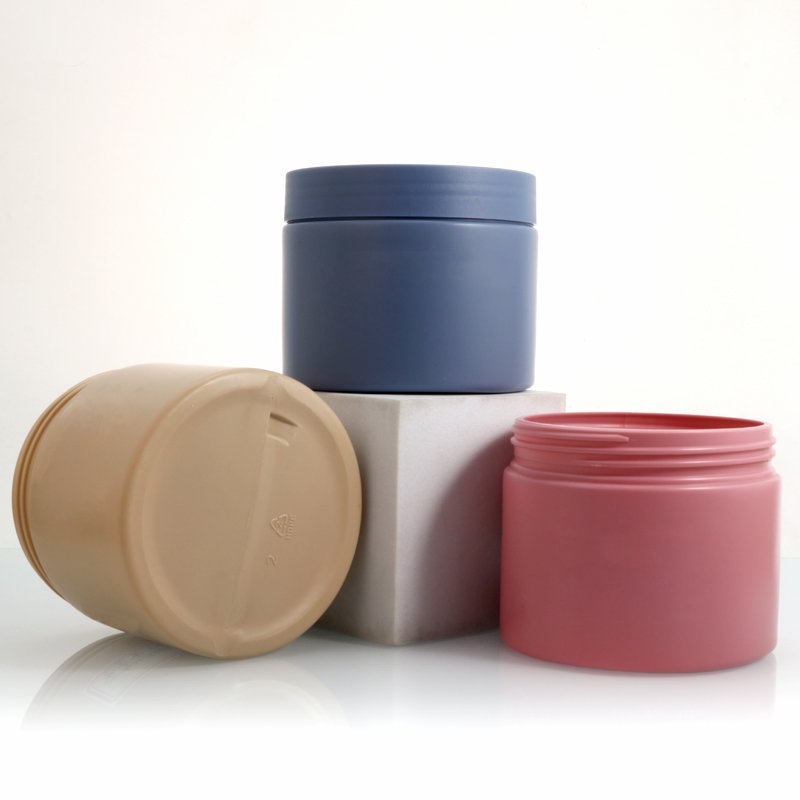
- Colour: PCR carries a natural grey-yellow tint. The higher the percentage, the more it pulls every colour toward muted, “earthy” tones — and the harder exact colour matching becomes. Natural and amber bottles hide it completely; bright whites and pastels show it.
- Consistency: recycled feedstock varies batch to batch more than virgin; reputable suppliers manage this with blending and per-batch verification (we run per-batch COAs and chain-of-custody records — the mechanics are in our PCR and GRS guide).
- Performance: at cosmetic-bottle percentages, drop strength and top-load are engineered to match virgin — but wall design sometimes needs a gram or two of compensation, which has a cost.
- Price: PCR has its own market, and at times recycled grades price above virgin. Sustainability claims sometimes carry a premium; budget for it rather than assuming PCR is cheaper.
The key mental model: the claim you can make, the colour you can hold, and the price you pay all move together as the percentage rises. Our PCR bottle hub keeps the full material picture.
The three levels, and who each is for
| ~30% PCR | ~50% PCR | 100% PCR | |
|---|---|---|---|
| Claim strength | Solid, credible | Strong | Maximum |
| Colour flexibility | Nearly full — most shades match | Good, with adjusted standards | Natural tints and dark shades are the honest palette |
| Appearance risk | Minimal | Low with a good supplier | Visible character — embrace it deliberately |
| Best for | First PCR step, colour-led brands | Sustainability-led brands with design systems | Brands whose story is the material |
| What to watch | Just verify certification | Colour standard in earth-adjusted terms | Supply booked ahead; every batch checked |
Around 30% is where most brands should start, for an unfashionable reason: it survives contact with real design requirements. A brand built on a specific pantone can hold that pantone at 30% with minor standard adjustments, which is exactly why it is also where colour-led categories (skincare with strict brand palettes) settle.
Around 50% doubles the claim while staying inside normal production discipline. It suits brands whose design language already tolerates slight batch character — and it photographs honestly, which matters as scrutiny of green claims rises.
100% is a real and growing choice, but it is a design commitment, not a number on a spec sheet. The bottles look recycled — slight tints, tiny batch variation — and the brands that win with 100% are the ones who put that character in the brand story rather than fighting it. If your design brief says “pure white gloss bottle”, 100% PCR will fight you; if it says “honest, natural, recycled”, it is the point.
The claim and the proof: what regulators and retailers ask
The percentage on your spec sheet must survive three questions:
- Is it certified? Certified content (e.g. under a documented chain of custody) is what separates a claim from a story. Per-batch documentation matters more than the headline percentage.
- Can you show it? Retailers and marketplaces increasingly ask for the certificates behind on-pack recycling claims. The document set in our six documents guide is where this lives.
- Is the claim worded correctly for the market? Recycling and recycled-content rules vary by jurisdiction — the export compliance map covers the regional baselines.
One myth worth killing while we’re here: PCR is not a compromise you hide. The brands getting value from it are the ones designing bottles that look intentional in recycled material — our article on why some bottles look more expensive shows how finish and weight carry perception when clarity steps back.
A decision path that takes five minutes
- Is your bottle natural, amber, or dark? PCR is nearly invisible → go as high as the story justifies (50%+).
- Is your bottle colour-critical (exact pastels, pure white)? Start at 30%, hold the standard, step up once a batch or two confirms the colour discipline.
- Is recycled character part of the brand? 100%, embrace the tint, and design the identity around it.
- Either way: verify certification chain, get colour standards signed against PCR samples (not virgin references), and test your formula in the PCR bottle — the sample checklist covers it.
Frequently asked questions
Does PCR content weaken the bottle?
Properly specified, no — walls are engineered so PCR bottles meet the same drop and top-load standards as virgin ones, sometimes with a gram or two of compensation. The failures we see come from unspecified feedstock, not from recycled content itself.
Why is my PCR bottle not pure white?
Recycled resin carries a natural tint that resists full bleaching; achieving near-white requires either careful feedstock selection or accepting an off-white. Bright-white PCR at scale is possible but priced accordingly — set the expectation with a physical colour standard, not a pantone book.
Is 30% PCR enough to claim “sustainable packaging”?
It is enough to make a specific, verifiable recycled-content claim — which is what regulators and retailers actually assess. Vague “sustainable” claims are the risky ones; precise, certified percentages are the safe ones. See our four paths to sustainable packaging for the strategy layer.
Is PCR more expensive than virgin resin?
It has its own market and frequently prices at or above virgin. The claim, the supply security and the certification are what you’re buying. Budget the premium into the SKU rather than discovering it mid-project.
Can I mix PCR with my brand colour?
Yes — colour matching happens in the masterbatch against the PCR base. The standard must be signed against physical PCR samples, because the tint interacts with every shade. Our colour consistency guide covers the signing discipline.
What does GRS certification actually give me?
Chain of custody: documented proof that the recycled content in your bottles is what the invoice says it is, traceable through the supply chain. Our PCR and GRS explainer details what to check on the certificates.
Shijin Packaging — factory-direct cosmetic and daily-chemical plastic bottles since 2003, operating 30+ automatic blow-molding lines and 10+ injection-molding machines across a 15,000 m² facility in Huizhou, Guangdong, with daily capacity of approximately 200,000 pieces; recycled-content PCR bottles with per-batch chain-of-custody documentation.
- Website: https://shijinpackaging.com
- Full catalogue: https://shijinpackaging.com/catalog/
- Email: sales@shijinpackaging.com