
Last updated: 30 August 2026.
Quick answer: A lotion pump bottle is defined by three specifications that buyers routinely get wrong: the neck finish (24/410 and 24/415 are the standards), the output per stroke (0.5 ml to 4 ml, matching your dosage), and the pump’s material compatibility with your formula. Nail these three — plus a down-lock or clip for shipping — and you avoid the two most common failures: a pump that will not prime, and a pump that leaks or clogs with your specific formula.

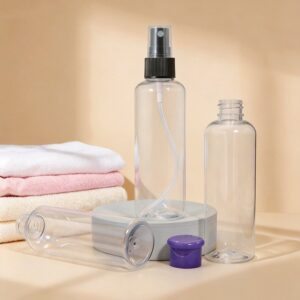

How a lotion pump actually works
A lotion pump is a small positive-displacement mechanism: a piston inside a chamber draws product up through a dip tube on the upstroke and dispenses it through the actuator on the downstroke. Understanding the parts matters because each one is a specification.
- Actuator — the top you press; its orifice size shapes the dose and the spray/stream pattern.
- Closure — the threaded collar that mounts to the bottle neck; its size is the neck finish.
- Piston and spring — the moving parts; spring material is the key compatibility risk.
- Dip tube — the straw reaching the bottom; its length must match the bottle height.
Neck finish: the spec that decides whether your pump even fits
The neck finish is the thread and opening size at the top of the bottle. For lotion pumps, two dominate:
| Neck finish | Thread diameter | Typical use |
|---|---|---|
| 24/410 | 24 mm | Standard lotion, shampoo, body wash |
| 24/415 | 24 mm, taller | Creams and higher-viscosity formulas |
| 28/410 | 28 mm | Larger bottles, higher output |
| 20/410 | 20 mm | Small and sample sizes |
The two numbers mean the diameter (24 mm) and the thread style/height (410 or 415). A pump and a bottle must match on both, or the closure will not seat and the product will leak.
Output per stroke: matching the dose to the product
Pump output is measured in millilitres per stroke, and it should match how the customer uses the product.
| Output per stroke | Typical product |
|---|---|
| 0.5–1.0 ml | Serums, eye creams, precise dosing |
| 1.0–2.0 ml | Facial lotions, treatment products |
| 2.0–4.0 ml | Body lotion, shampoo, hand soap |
Specify the output in the purchase order, not just “a pump.” A hand cream dispensed at 3 ml per stroke feels wasteful; a body lotion at 0.5 ml feels stingy.
Locking mechanisms: the shipping detail that prevents a mess
Lotion pumps need a lock or clip so they do not actuate in transit. The options:
- Down-lock — the actuator twists and locks in the down position; the most common and robust.
- Up-lock (clip) — a plastic clip holds the actuator up; common on higher-end pumps.
- Lockless — a sealed cap; acceptable only for short domestic runs.
A down-lock is the safest default for anything shipped internationally, because it cannot be pressed during freight.
Pump material compatibility: where formulas break pumps
The spring is usually metal (stainless or plated), and the piston is usually PE or PP. The failure modes:
- Metal spring corrosion with acidic or oxidising formulas — ask for a stainless-steel spring or a plastic spring for aggressive products.
- Softening of the piston seal with high-alcohol or solvent formulas.
- Clogging of the orifice with high-viscosity or particulate formulas — a larger orifice or a different pump design may be needed.
Always disclose your formula’s pH, alcohol content and viscosity to the pump supplier before ordering, and request a compatibility test. This is also where a supplier’s quality system matters: a facility certified to ISO 9001:2015 has the documented processes to hold output, spring and seal tolerances lot after lot, which is what keeps a pump consistent in the field.
The most common failures and how to prevent them
| Symptom | Likely cause | Fix |
|---|---|---|
| Pump will not prime | Air in the chamber, or dip tube too short | Prime on arrival; verify dip-tube length |
| Pump does not pop back up | Weak or corroded spring | Stainless or plastic spring; check formula |
| Leaks around the closure | Neck finish mismatch | Match 24/410 or 24/415 exactly |
| Weak or inconsistent dose | Worn piston or wrong output spec | Re-spec output; quality-check the lot |
A specification checklist for your next order
- Neck finish — confirm 24/410 or 24/415, and that bottle and pump match.
- Output per stroke — state the exact millilitres.
- Dip tube length — matched to the bottle height, cut to reach the bottom.
- Spring material — stainless or plastic, matched to formula compatibility.
- Locking — down-lock for international shipping.
- Bottle material — PET, HDPE or PP, matched to the formula and look.
Frequently asked questions
What is the standard neck finish for a lotion pump?
24/410 is the most common, used for lotions, shampoos and body washes. 24/415 is the same diameter with a taller thread, preferred for thicker creams.
How do I fix a lotion pump that will not pump?
Prime it by pressing several times with the bottle upright until product fills the chamber, and check that the dip tube reaches the bottom of the bottle and is not curled or too short.
What does output per stroke mean?
It is the volume dispensed with one full press, usually 0.5 ml to 4 ml. Specify it to match the dose — small outputs for serums, larger for body lotion.
Why does my lotion pump leak?
Usually a neck-finish mismatch between the bottle and pump, or a damaged seal. Confirm both the diameter and the thread style (410 vs 415) match.
Can lotion pumps handle thick creams?
Yes, but choose a higher-output or higher-torque pump and the 24/415 neck, and disclose the viscosity so the supplier matches the piston and spring.
Do I need a lock on my lotion pump?
Yes for shipping. A down-lock is the safest default because it cannot be pressed during transit; a clip is a good alternative for premium pumps.
Next step
Send us your bottle size, formula type and desired dose per stroke, and we will match a 24/410 or 24/415 pump with the right output, spring material and lock for your product.
Shijin Packaging — factory-direct cosmetic and daily-chemical plastic bottles since 2003, operating 30+ automatic blow-molding lines and 10+ injection-molding machines across a 15,000 m² facility in Huizhou, Guangdong, with daily capacity of approximately 200,000 pieces.
- Website: https://shijinpackaging.com
- Full catalogue: https://shijinpackaging.com/catalog/
- Email: sales@shijinpackaging.com
Related reading
- Airless Pump Bottles: The Complete Buyer’s Guide
- Mist & Atomizer Spray Bottles: A Fine Mist Sprayer Guide
- How to Choose a Cosmetic Plastic Bottle Manufacturer in China
- Cosmetic Bottle MOQ, Tooling Cost and Lead Time
Related Lotion Pump Bottles
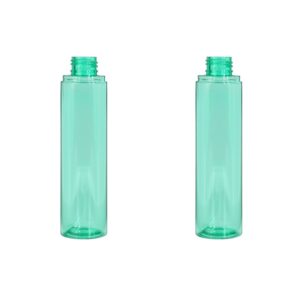
150ml PET PET Lotion Bottle for Massage Oil Packaging
PET · 150 ml
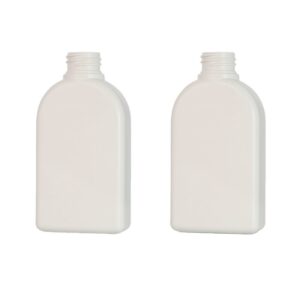
200ml PE Lotion Bottle for Body Lotion – 24mm Neck, 25g
PE · 200 ml

200ml PET Lotion Bottle for Lotion & Treatment – 24mm Neck, 26g
PET · 200 ml
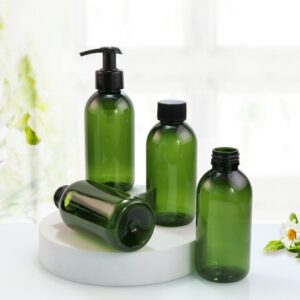
200ml PET Round Bottle for Lotion & Cream – 24mm Neck, 26g
PET · 200 ml