
Last updated: 30 August 2026.
Quick answer: The global cosmetic packaging market is estimated at roughly USD 36–37 billion for 2026, depending on which research house you read, and it is growing at a mid-single-digit rate. Three facts are consistent across sources: plastic is the dominant material, the bottle is the dominant format, and Asia Pacific is the largest and fastest-growing region. If you are about to source cosmetic bottles, the data points one way — you will be buying plastic bottles, and the centre of gravity for making them is Asia, above all China.


How big is the market, really?
Market-size figures differ because research houses define the category differently. That spread is itself useful — it tells you the market is large, and the differences are mostly definitional:
| Source | 2026 estimate | Scope |
|---|---|---|
| Grand View Research — cosmetic packaging | USD 37.2B | Cosmetics only |
| Grand View Research — personal care packaging | USD 39.9B | Personal care, broader |
| Future Market Insights — beauty & cosmetic packaging | USD 36.2B | Beauty + cosmetics |
Read the scope before you cite a number. The takeaway that does not change across sources: this is a multibillion-dollar market growing at roughly 4–6% a year, and the bottle is its largest single format.
Which material wins: plastic or glass?
Plastic dominates cosmetic packaging by a wide margin. Future Market Insights puts plastic at 52% of material demand in 2026. Glass holds a meaningful premium segment — particularly for fragrance and high-end serums — but plastic wins on cost, weight, design flexibility and breakage resistance, which is why it leads across mass and mid-market skincare.
| Material | Typical role in cosmetics |
|---|---|
| Plastic (PET, HDPE, PP, PETG) | Bottles, jars, tubes, closures — dominant format |
| Glass | Fragrance, premium serums, dropper bottles |
| Metal | Cases, tubes, some closures |
| Paper / board | Outer cartons and boxes |
For a buyer, the material decision is rarely “plastic or not” — it is which plastic and which finish. See our plastic vs glass comparison for the landed-cost and breakage economics.
Which format leads: bottles, jars or tubes?
Across sources, the bottle is the largest product format. Grand View Research puts bottles at more than 30% of personal-care packaging by value; Future Market Insights puts bottles at 32% of beauty-packaging product sales in 2026. Jars, tubes and pouches split the rest.
The bottle’s lead makes sense: it is compatible with existing filling lines, it works for nearly every liquid and semi-liquid formulation, and it accepts the full range of decoration. That is why a supplier with a deep bottle mold library — not just a catalogue of a few shapes — is the practical prerequisite for a cosmetics brand.
What is driving growth?
Three drivers show up consistently in the market data:
- Skincare — Grand View Research reports skincare as the largest application at more than 33% of personal-care packaging; Future Market Insights puts skincare at 34%. Skincare’s rise is the structural engine behind demand for pumps, airless bottles, droppers and jars.
- Sustainability and refill — recyclable, recycled-content and refillable formats are the fastest-growing design theme, as buyers and regulators push away from single-use.
- Asia Pacific demand — Grand View Research reports Asia Pacific at a 41.1% share of cosmetic packaging, the largest region and the one adding most incremental demand.
Each of these maps directly onto a sourcing decision: skincare means dispensing systems; sustainability means choosing a factory that can document recycled content and compliance; Asia Pacific means the supplier is likely in China.
Where is demand concentrated?
The market is global but the production is concentrated. Asia Pacific is the largest demand region — roughly 41–52% depending on the study — and within it, China is the largest producer of plastic packaging overall, accounting for about 19% of global production volume and 24% of exports, according to IndexBox trade data.
That asymmetry — large Western demand, concentrated Asian production — is the single most important structural fact in cosmetic packaging sourcing. It is why “where do I get bottles” almost always resolves to “from a Chinese factory,” and why the real work is selecting and verifying the right one.
What this means for your sourcing decision
The data reduces to a short, actionable conclusion:
- You will almost certainly buy plastic bottles, the dominant material and format.
- Your demand sits in a market growing on skincare, sustainability and Asia Pacific.
- Production is concentrated in China, where a complete supply chain and a deep mold library live together.
That does not make the choice of supplier automatic — it makes it the decisive step. For how to turn that decision into a verified supplier, see our guide to choosing a cosmetic bottle manufacturer in China and the red flags to screen out before paying a deposit.
Frequently asked questions
How big is the cosmetic packaging market in 2026?
Roughly USD 36–37 billion depending on the research house: Grand View Research estimates USD 37.2 billion for cosmetics packaging, and Future Market Insights USD 36.2 billion for beauty and cosmetic packaging.
Which material dominates cosmetic packaging?
Plastic, at about 52% of material demand in 2026 according to Future Market Insights, ahead of glass, metal and paper.
Which packaging format is the largest?
The bottle, at more than 30% of personal-care packaging by value (Grand View Research) and 32% of beauty-packaging product sales (Future Market Insights).
Which application drives the most demand?
Skincare, at 33–34% of the market across major sources, which is why pumps, droppers, airless bottles and jars are the fastest-moving formats.
Which region is the largest cosmetic packaging market?
Asia Pacific, holding a 41.1% share according to Grand View Research, and it is the region adding the most incremental demand.
Where is most cosmetic packaging produced?
China, the world’s largest plastic-packaging producer at about 19% of global volume and 24% of exports, according to IndexBox trade data.
Next step
Tell us your product category, target material and volume, and we will map it to the formats and molds that match the 2026 market — plastic bottles, pumps and jars — from our 2,000+ mold library.
Shijin Packaging — factory-direct cosmetic and daily-chemical plastic bottles since 2003, operating 30+ automatic blow-molding lines and 10+ injection-molding machines across a 15,000 m² facility in Huizhou, Guangdong, with daily capacity of approximately 200,000 pieces.
- Website: https://shijinpackaging.com
- Full catalogue: https://shijinpackaging.com/catalog/
- Email: sales@shijinpackaging.com
Related reading
- How to Choose a Cosmetic Plastic Bottle Manufacturer in China
- Plastic vs Glass Cosmetic Bottles: Which Is Right?
- Sustainable Cosmetic Packaging: A Buyer’s Guide
- OEM vs ODM Cosmetic Packaging
Related Cosmetic Bottles
100ml HDPE Cosmetic Bottle
PE · 100 ml
100ml HDPE Cosmetic Bottle – Custom Logo
HDPE · 100 ml
100ml PE Cosmetic Bottle for Facial Cleanser & Lotion – 20mm Neck, 18g
PE · 100 ml
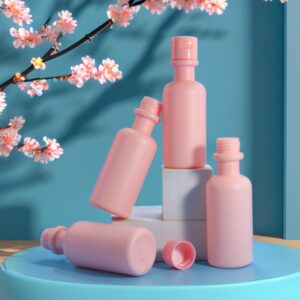
100ml PE Soft Touch Cosmetic Bottle – 24mm Neck
PE · 100 ml