
Last updated: 1 September 2026.
Quick answer: The unit price on a quotation is typically 55–70% of what a cosmetic bottle actually costs you by the time it is on your filling line. The rest is tooling amortisation, closures and pumps, decoration, packing, inland haulage, ocean freight and insurance, duties and customs clearance, warehousing, defect and rework allowance, and the working capital tied up while all of that is in transit. Buyers who compare suppliers on unit price alone routinely pick the option that costs more landed. The fix is a simple one-page landed-cost model that you run on every quote, with the same assumptions for every supplier.
What is included in landed cost, exactly?
Landed cost is everything between the supplier’s raw material and your finished, filled product — not just the price of the bottle.
| Cost layer | Typical visibility | Where it is decided |
|---|---|---|
| Bottle unit price | On the quote | Gram weight, resin grade, cavities |
| Tooling amortisation | Often invisible | Private mold cost ÷ lifetime volume |
| Closures, pumps, sprayers | Sometimes bundled | Component specification |
| Decoration | Quoted separately | Method and colour count |
| Packing materials | Sometimes | Carton spec and pieces per carton |
| Inland haulage to port | Under Incoterm | Distance and consolidation |
| Ocean freight and insurance | Under Incoterm | Volume, route, season |
| Duties and tariffs | Usually excluded | HTS classification and origin |
| Customs clearance and brokerage | Always excluded | Destination country |
| Warehousing and handling | Internal | Your inventory policy |
| Defect and rework allowance | Invisible | Supplier process control |
| Working capital cost | Invisible | Payment terms and transit time |
The two rows that most often get overlooked are the last two. A shipment that is 8 weeks at sea is 8 weeks of capital, and a 3% defect rate on a filled product costs far more than 3% of the bottle price.
Why does the unit price mislead so consistently?
Because it is the only number that appears on every quote, while the costs that differentiate suppliers often do not appear on any of them.
Consider two suppliers for the same specified bottle. Supplier A quotes a lower unit price but ships from a factory with no in-house mold shop, uses a packing spec that wastes container space, and requires 100% payment before shipment. Supplier B quotes higher but consolidates efficiently and offers standard terms. On unit price, A wins. On landed cost, once freight volume, capital cost and risk are priced in, B may be cheaper — and B’s price is far more likely to hold through production.
This is also why the spread between two quotes for the same bottle can be large without either supplier being dishonest. The mechanics of that gap are set out in why two quotes for the same bottle differ by 30%.
How much does freight actually add?
Freight is charged on volume, not weight, for most packaging shipments — which means the packing spec and the bottle shape drive the cost more than the resin does.
- Volume efficiency — a round bottle packs reasonably well; a flat or oval bottle can waste meaningful container space. Two cartons of the same piece count can occupy different volumes.
- Nesting and stacking — bottles shipped with closures fitted take more space than bottles and closures packed separately.
- Consolidation — a supplier who can consolidate your bottle, closure and pump into one shipment saves you a second freight bill and a second clearance.
- Route and season — rates move with capacity. A quote given in peak season is not a quote for the rest of the year.
The practical step is to ask every supplier for pieces per carton, carton dimensions and pieces per container. That single line on a quotation makes freight comparable across suppliers, and it is the number most quotations omit.
See how to ship cosmetic bottles from China for the freight, customs and Incoterm mechanics in detail.
Where do duties and compliance fit?
Duties are a function of classification and origin, not of your supplier’s quote — but they are real cost, and they are almost never in the quoted price.
- Classification — plastic bottles and closures are classified under harmonised tariff headings for plastic packaging articles. Duty rates differ by heading and by destination country, and the correct classification is the importer’s responsibility.
- Verification — duty rates change with trade policy. Any specific rate should be confirmed against the current official tariff schedule for your market, or with your customs broker, before you commit to a sourcing decision.
- Compliance documentation — cosmetic packaging sold into the EU must satisfy the framework in EC Regulation 1223/2009 on cosmetic products; food-contact applications engage EU Regulation 10/2011. In the US, cosmetics are regulated rather than approved by the FDA, a distinction the FDA states explicitly.
Budget for a customs broker, and treat any duty estimate from a supplier as indicative rather than authoritative.
What is the working capital cost of a long supply line?
It is the cost most landed-cost models leave out, and on a long route it is not small. A container on the water for five weeks is five weeks of money that is not doing anything else — plus the buffer stock you need to hold because the pipeline is long.
Two practical implications:
- Shorter pipelines let you hold less safety stock, which releases cash. This is the strongest genuine argument for nearshoring, and we set it out honestly in why the Guangdong cluster keeps China competitive.
- Payment terms are a cost line. A 30% deposit with balance against bill of lading ties up less capital than 100% prepayment. Price the difference.
A supplier with a deep mold library also shortens the capital cycle in a way that has nothing to do with freight: starting on an existing mold removes tooling weeks from the schedule entirely, which is the subject of how in-house tooling shortens sampling lead time.
How do you price the risk that never appears on a quote?
Three invisible cost lines do most of the damage when a low-price supplier is chosen:
- Defect and rework — a bottle that leaks after filling costs you the bottle, the product, the labour and possibly the retailer relationship. Process control under ISO 9001:2015 is what makes defect rates predictable rather than hopeful.
- Re-order inconsistency — a colour or neck dimension that drifts between production runs creates line stoppages. Colour control is covered in how to specify bottle colour.
- Single-source exposure — one factory, one mold, no fallback. The mitigation is a documented second source, which we cover in how to vet a second supplier.
None of these appear on a quotation. All of them appear in your P&L eventually, which is why the cheapest quote is often the most expensive decision.
A one-page model you can run on every quote
Set up a spreadsheet with these rows, fill it once per supplier, and compare the bottom line:
| Row | Input | Where to get it |
|---|---|---|
| 1 | Unit price × quantity | Supplier quote |
| 2 | Tooling ÷ expected lifetime volume | Supplier quote + your forecast |
| 3 | Closure / pump / sprayer cost | Supplier quote or component supplier |
| 4 | Decoration cost | Supplier quote, per colour per pass |
| 5 | Packing cost | Supplier quote |
| 6 | Inland haulage | Freight forwarder |
| 7 | Ocean freight + insurance | Freight forwarder, per container |
| 8 | Duty at current verified rate | Customs broker or official schedule |
| 9 | Customs clearance and brokerage | Broker |
| 10 | Warehousing and internal handling | Your finance team |
| 11 | Defect allowance (× unit + fill cost) | Your quality data, or 2–3% if unknown |
| 12 | Working capital cost (days × cost of capital) | Your finance team |
| Total | Landed cost per unit |
Run it with identical assumptions across suppliers. It takes about fifteen minutes per quote and it will change your sourcing decisions.
The decision, in one paragraph
Unit price is the number suppliers compete on; landed cost is the number your business pays. Build the model once, use the same assumptions for every supplier, and you will routinely find that the lowest unit price is not the lowest total — and that the supplier who quotes a complete, specifiable bottle with predictable freight, defect and lead-time behaviour is the cheaper one. To see how a Chinese factory builds that unit price in the first place, read how much a custom cosmetic bottle costs in China.
Frequently asked questions
What percentage of landed cost is the bottle itself?
Commonly 55–70% for a standard sea-freighted order, though it varies a great deal with decoration, closure cost and freight rates. The only reliable figure is the one from your own model with your own assumptions.
Is EXW or FOB better for comparing suppliers?
FOB is easier to compare, because it includes inland haulage and export clearance in the quoted number. EXW comparisons hide those costs and are only meaningful if you have your own forwarder’s rates for both origins.
How do I account for defects in a landed-cost model?
Apply your historical defect rate to the full cost of a filled unit — bottle, product, labour — not just the bottle price. If you have no history, 2–3% is a reasonable planning assumption to start from.
Does ordering a full container always reduce landed cost?
Usually per unit, yes — but only if you can store it, sell it, and afford the capital. A full container of a slow-moving SKU can cost more in cash and storage than the freight saving is worth.
Should tooling cost be amortised or expensed?
For sourcing decisions, amortise it over the realistic lifetime volume of the product. Expensing it against the first order makes a private mold look far more expensive than it is, which leads to the wrong decision — see MOQ, tooling cost and lead time.
Do freight rates change the sourcing decision?
They can. Freight is the single most volatile line in the model, so ask your forwarder for a rate valid for the actual shipping window rather than using a historical average.
Next step
Send us your bottle specification, annual volume and destination port. We will quote to a fixed written spec and give you pieces per carton and pieces per container, so you can run a real landed-cost comparison rather than a unit-price guess.
Shijin Packaging — factory-direct cosmetic and daily-chemical plastic bottles since 2003, operating 30+ automatic blow-molding lines and 10+ injection-molding machines across a 15,000 m² facility in Huizhou, Guangdong, with daily capacity of approximately 200,000 pieces.
- Website: https://shijinpackaging.com
- Full catalogue: https://shijinpackaging.com/catalog/
- Email: sales@shijinpackaging.com
Related reading
- Why Two Quotes for the “Same” Bottle Can Differ by 30%
- How Much Does a Custom Cosmetic Bottle Cost in China?
- How to Ship Cosmetic Bottles from China
- Cosmetic Bottle MOQ, Tooling Cost and Lead Time
- PCR and Recycled Resin Cosmetic Bottles
- Hot-Fill and Cold-Fill Packaging
Related Cosmetic Bottles
100ml HDPE Cosmetic Bottle
PE · 100 ml
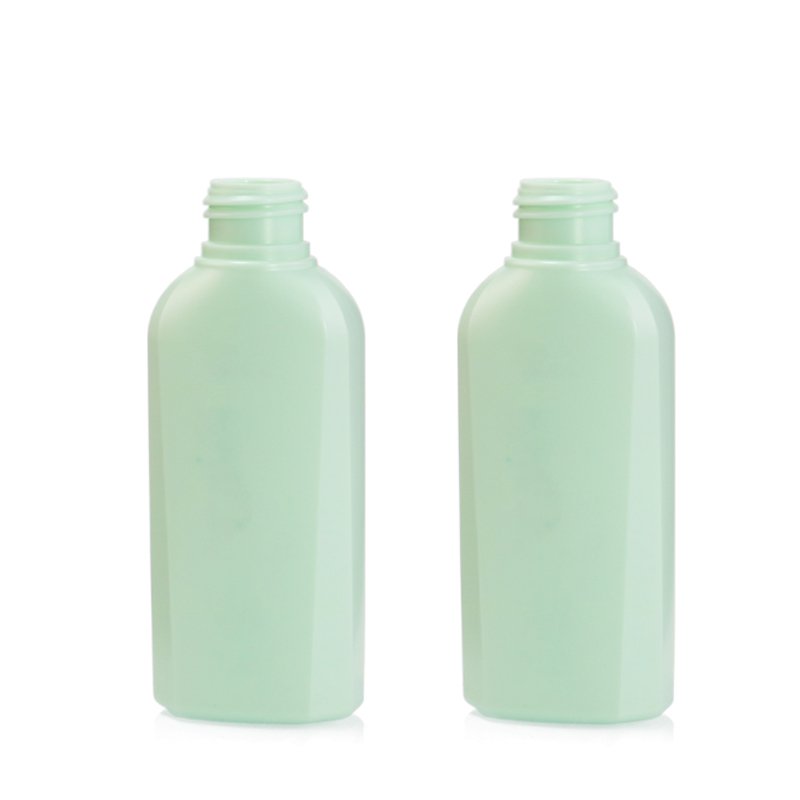
100ml HDPE Cosmetic Bottle – Custom Logo
HDPE · 100 ml

100ml PE Cosmetic Bottle for Facial Cleanser & Lotion – 20mm Neck, 18g
PE · 100 ml

100ml PE Soft Touch Cosmetic Bottle – 24mm Neck
PE · 100 ml