
PE Plastic Packaging: LDPE, MDPE and HDPE Explained
The workhorse of personal care, home care and detergent packaging. The specification decision is not “PE” — it is which PE, and the density figure on the data sheet tells you.
What PE is, and why “PE” on its own is not a specification
PE (polyethylene) is chosen for chemical resistance, squeeze recovery and stress-crack performance rather than for clarity. Two bottles can both be sold as “PE” and behave completely differently in the hand and on the filling line, because polyethylene is graded by density and density drives stiffness, barrier and clarity.
Shenzhen Shijin runs 427 PE bottle moulds, all on prime virgin resin with a per-lot COA covering melt flow index, density and ash content.
LDPE, MDPE, HDPE and the density number that separates them
Polyethylene is a family, not a material. The density figure on the data sheet is the fastest way to tell which member of it you have been quoted.
| Type | Density (g/cm³) | Feel & behaviour | Typical use |
|---|---|---|---|
| LDPE | 0.910 – 0.925 | Soft, very squeezable, translucent | Squeeze tubes, soft dropper bottles |
| MDPE | 0.926 – 0.940 | Balanced stiffness and squeeze | Lotion and shampoo bottles |
| HDPE | 0.941 – 0.965 | Stiff, opaque, excellent moisture barrier | Detergent, chemical, bulk packs |
For PE we track melt flow index (MFI) rather than the intrinsic viscosity used for PET. MFI tells you how the resin will flow into the mould, and it is reported per lot on the COA alongside density and ash content.
Why PE is specified for detergent, home care and squeeze packs
PE is the default where the formulation is aggressive or where the pack has to be squeezed. It resists the surfactants, solvents and alkalinity that attack PET, and it has very good environmental stress-crack resistance — the failure mode that quietly kills packs months after they ship.
- ▸Squeeze bottles and tubes — LDPE for the softest recovery, MDPE for a balanced feel.
- ▸Lotion, shampoo and body-wash bottles — MDPE and HDPE with pumps, flip caps or disc caps.
- ▸Dropper and small-capacity soft bottles — LDPE in the smallest formats.
- ▸Detergent, sanitising and cleaning packs — HDPE for the aggressive end of the range.
- ▸Travel and sample formats — where the pack has to flex without cracking.
- ▸Bulk containers — HDPE where impact resistance and moisture barrier outrank appearance.
The appearance trade-off
PE is opaque or translucent, so it will not show off a coloured fill the way PET will, and it prints differently. PE and PP surfaces are non-polar, so they must be flame or corona treated to reach at least 38 dynes/cm before ink or label adhesive will hold. We verify with the ASTM D3359 cross-hatch test, targeting 4B to 5B.
How PE is moulded at Shijin
PE is extrusion blown in a single step on our PE / PP lines: raw resin is formed into the finished bottle in one operation, then it goes to decoration, QC, warehouse and dispatch. That is a shorter route than PET, which needs an injection-moulded preform first.
What changes the specification
- ▸Density grade. LDPE, MDPE or HDPE decides the feel, the stiffness and the barrier — and therefore the brief it can serve.
- ▸MFI. The grade has to match the mould and the cycle. The wrong MFI shows up as inconsistent wall thickness or surface defects.
- ▸Wall section for squeeze recovery. In a squeeze pack, recovery rather than stiffness sets the minimum wall.
- ▸Surface treatment. Non-polar PE needs flame or corona treatment to at least 38 dynes/cm before printing or labelling.
- ▸Closure and neck as a matched pair. The closure has to be rated for the fill temperature and the liner specified with it.
Resin and documentation controls
- ▸Prime virgin resin only for cosmetic and personal-care work — a single heat history, full data sheet and full COA. That is a different material from wide-spec off-grade, post-industrial regrind (PIR), post-consumer recycle (PCR) or in-house rework.
- ▸Per-lot Certificate of Analysis. Intrinsic viscosity and ash content for PET and PETG; melt flow index (MFI), density and ash content for PE and PP (ISO 3451 / ASTM D5630).
- ▸Two-way traceability. Resin lot → work order → finished-goods lot, walkable in both directions, so a question about a shipment eighteen months later can be answered.
- ▸In-process and outgoing inspection. Wall thickness at four points per cavity, weight tolerance ±2%, visual defect inspection every 30 minutes, then AQL 2.5, a 1.2 m drop test, air-pressure leak testing on all closures and a QC report per lot.
For food-contact and cosmetic work we test to EU 10/2011 (overall migration limit 10 mg/dm², plus specific migration limits and a NIAS risk assessment) and frame cosmetics against EC 1223/2009. Decoration uses low-migration UV-cured inks aligned with the Swiss Ordinance SR 817.023.21 and the Nestlé packaging ink guidance, with surface energy verified before printing and adhesion checked by ASTM D3359 cross-hatch at 4B–5B.
Advantages of PE, and the limits that go with them
- ▸Excellent chemical resistance across surfactants, acids and alkalis
- ▸Squeeze recovery — the pack returns to shape after repeated use
- ▸Very good environmental stress-crack resistance
- ▸Wide density range, so one family covers soft through rigid formats
- ▸Low cost per kilogram and fast single-step moulding
- ▸Widely accepted in mainstream recycling streams
- ▸Opaque or translucent — clarity is not available at any density
- ▸Lower gloss and softer surface appearance than PET
- ▸Non-polar surface requires treatment before printing
- ▸Density grade must be chosen carefully; “PE” alone is not a specification
- ▸Not a material for premium clarity-led briefs
PE and the recycling stream
LDPE and HDPE are both accepted in mainstream recycling streams, though collection rules vary by market. That makes PE a practical choice for a recyclability claim, provided the claim is checked against the market the product actually sells in.
- ▸Check what your market collects. Film, bottles, closures and labels are not always collected together.
- ▸Recycled content is quoted, not assumed. PCR HDPE is available as a documented specification with the content level you set.
- ▸The evidence is a transaction certificate. Ask for a GRS Transaction Certificate naming your product and lot — an annual scope certificate only proves the factory was audited.
PE against PET and PETG
| Property | LDPE / MDPE | HDPE | PET | PETG |
|---|---|---|---|---|
| Clarity | Translucent | Opaque | High, glass-like | Very high, thick-wall clear |
| Squeeze recovery | Best | Stiff — limited | Poor | Poor |
| Chemical resistance | High | High | Medium | Medium |
| Stress-crack resistance | Very good | Very good | Moderate | Sensitive to some oils and alcohols |
| Fill temperature | Moderate | ~90–110 °C | ~60–70 °C | ~70–75 °C |
| Consider when | The pack must be squeezed | Bulk or aggressive fills | Clarity sells the product | A heavy glass look is the brief |
Suitable PE products
Every bottle below is a live stock mould. Capacities, neck finishes, weights and compatible closures are listed on each product page.
PE bottles in stock
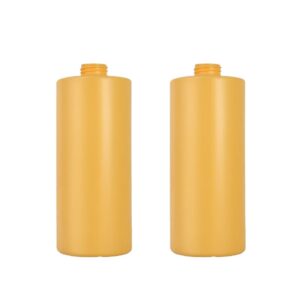
1000ml PE Bath Bottle for Bulk Refill & Family Size – 38mm Neck, 75g
PE · 1000 ml
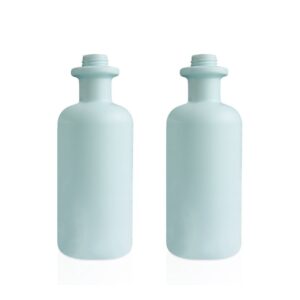
1000ml PE Plastic Bottle 28mm Neck 85g for Lotion, Shampoo & Detergent
PE · 1000 ml
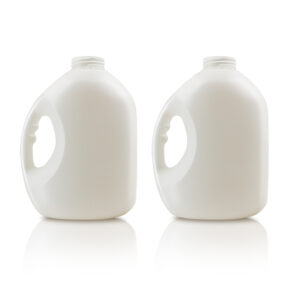
1000ml PE Plastic Detergent Bottle with Handle
PE · 1000 ml

1000ml Rectangular PE Plastic Bottle – 28mm Neck
PE · 1000 ml
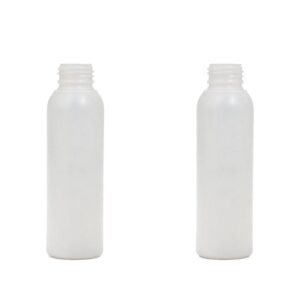
100ml HDPE Cosmetic Bottle
PE · 100 ml
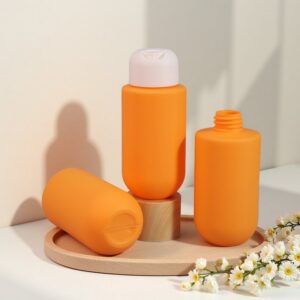
100ml PE Cosmetic Bottle for Facial Cleanser & Lotion – 20mm Neck, 18g
PE · 100 ml

100ml PE Soft Touch Cosmetic Bottle – 24mm Neck
PE · 100 ml
100ml PET Foam Pump Bottle
PE · 100 ml
Where PE-family programmes have shipped
Published customer programmes built on this material family. Regional customer names are withheld; material, format, order data and outcomes are as delivered.
HDPE body wash bottle
- ▸200–500 ml formats on a matched closure set
- ▸4 reorders since first delivery
- ▸140,000+ units since 2024 with zero defect claims
PCR PET trigger spray
- ▸Aggressive cleaning formulation, chemical resistance specified
- ▸25,000 pcs initial order, 80,000 pcs follow-on in Q2
- ▸Recycled-content documentation issued per order
See the full programme write-ups on the customer projects page.
Related engineering and material guides
PE packaging: buyer questions
What is the difference between PE and HDPE?+
HDPE is a subset of PE, not a different material family. HDPE is stiffer, more opaque and has a better moisture barrier; LDPE is softer and more squeezable. The density figure on the data sheet tells you which one you have: LDPE 0.910–0.925, MDPE 0.926–0.940, HDPE 0.941–0.965 g/cm³.
Will PE bottles crack with aggressive formulations?+
PE generally handles aggressive fills better than PET, but environmental stress cracking is still the main long-term risk, and it shows up weeks or months after filling rather than on day one. Tell your supplier the full formulation — including surfactant type and pH — so the resin grade and wall section can be chosen for it.
Can PE bottles be printed?+
Yes, but the surface is non-polar and must be flame or corona treated to at least 38 dynes/cm first. We use low-migration UV-cured inks and verify adhesion with the ASTM D3359 cross-hatch test targeting 4B to 5B.
What is the MOQ for PE bottles?+
5,000 pcs per SKU on stock tooling. Custom shapes requiring new tooling are quoted with the tooling charge together, since the tool has to be amortised over the first run.
Are PE bottles recyclable?+
Yes — HDPE and LDPE are both accepted in mainstream recycling streams, though collection rules vary by market. If recycled content is a requirement, ask for a GRS Transaction Certificate naming your product and lot rather than a scope certificate.
How do I know the resin is virgin rather than regrind?+
Ask for the per-lot COA and the resin lot number, then ask the supplier to trace it through to your finished goods. Prime virgin resin can be traced in both directions; a blended regrind cannot.
How many PE moulds do you hold?+
427 PE bottle moulds, covering LDPE, MDPE and HDPE formats from small dropper bottles to bulk containers. Browse the PE range or the full product library.
Which PE grade should I choose?+
Start from the pack, not the resin: if it has to be squeezed, LDPE or MDPE; if it has to be stiff, opaque and chemical-resistant, HDPE. Send the format and the formulation and we will name the density grade and the MFI window.
Send the format and the formulation
Tell us whether the pack has to be squeezed, what it will contain, and the capacity. We will name the density grade, the wall section and the closure.