
PET Plastic Packaging: Properties, Applications & Manufacturing
The transparent polyester behind most cosmetic and personal-care bottles. Two numbers decide whether a PET bottle performs: intrinsic viscosity, and whether the converter runs prime virgin resin with a per-lot COA.
What PET is, and when it is the right specification
PET (polyethylene terephthalate) is a transparent thermoplastic polyester, made by condensing terephthalic acid with ethylene glycol. Buyers specify it for three reasons: optical clarity, a good moisture barrier, and acceptance in the mainstream recycling stream. For cosmetic blow-moulding grades the resin's intrinsic viscosity (IV) runs 0.70–0.85 dl/g — that single figure governs whether the parison sags and the bottle blows thin.
Shenzhen Shijin holds 646 PET bottle moulds, run on prime virgin resin with a per-lot Certificate of Analysis and batch-level traceability from resin lot to finished goods.
Intrinsic viscosity is the number to ask for
PET is a polyester. In packaging it arrives at the converter as resin pellets, and the most important specification on the data sheet is intrinsic viscosity — a proxy for molecular weight. Too low and the parison sags or the bottle blows thin; too high and the resin will not fill a complex mould cleanly.
| Grade | Typical IV (dl/g) | Where it is used |
|---|---|---|
| Bottle / blow-moulding grade | 0.70 – 0.85 | Cosmetic bottles, jars, wide-mouth containers |
| Fibre grade | 0.60 – 0.65 | Polyester fibre — not for bottles |
| Sheet / thermoform grade | 0.60 – 0.95 | Blister packs, trays |
| PCR-modified bottle grade | 0.70 – 0.80 | Recycled-content bottles |
IV is measured on the incoming resin and reported on the COA. A supplier who quotes you a PET bottle but cannot produce an IV figure for the lot is not tracking the one variable that decides whether the bottle survives filling, capping and distribution.
Where PET works, and where it does not
| Property | PET | PE / HDPE | What it means in practice |
|---|---|---|---|
| Clarity | Excellent, glass-like | Opaque or translucent | PET for serums and toners where the fill is visible |
| Moisture barrier | Good | Very good | Both are fine for water-based fills |
| Oxygen barrier | Moderate | Poor | Neither suits oxygen-sensitive actives without a barrier layer |
| Heat resistance | Roughly 60–70 °C | HDPE better, roughly 90–110 °C | Hot fill above 70 °C changes the spec and the tooling |
| Chemical resistance | Attacked by strong alkali and some oils | Strong, especially HDPE | Detergent and solvent fills favour PE |
| Stress-crack resistance | Moderate | Very good (HDPE) | Aggressive fills crack PET over time |
| Recyclability | Mainstream stream | Mainstream stream | Both accepted; check local collection rules |
Typical PET applications
PET is the default for anything sold on shelf appearance. The formats below are the ones this material is normally specified for; the fill has to be below the heat ceiling and low in aggressive solvents.
- ▸Skincare and cosmetic bottles — lotions, toners, essences and creams where the fill is meant to be seen.
- ▸Dropper and serum bottles — small-capacity formats where clarity signals the active ingredient.
- ▸Spray and mist bottles — clear PET bodies paired with mist or trigger sprayers.
- ▸Shampoo and body-care bottles — where a tinted or clear body is part of the brand.
- ▸Sanitiser and hygiene packs — cold-filled alcohol gels in clear or tinted PET.
- ▸Wide-mouth jars and containers — cold-filled mask, scrub and powder formats.
How PET is moulded at Shijin
PET is a two-stage material: an injection-moulded preform is blown into the finished shape. That is different from PE and PP, which are extrusion-blown in a single step. The two-stage route is what gives PET its clarity and strength, and it is also why preform weight and wall distribution have to be set per shape rather than inherited from a stock bottle.
What changes the specification
- ▸Injection stretch blow moulding (ISBM) forms the bottle from a preform; wall thickness and gram weight are adjustable within the mould’s limits.
- ▸Heat-set grades are deliberately crystallised during blowing so they can survive a hot fill without distorting. The cost is a slight loss of clarity.
- ▸Vacuum compensation panels are mandatory on any hot-filled pack, because the internal pressure drop as the bottle cools will otherwise collapse the side walls.
- ▸Neck finish and closure are specified as a matched pair, never sourced separately, because the neck is the most highly stressed area of the pack.
Resin and documentation controls
- ▸Prime virgin resin only for cosmetic and personal-care work — a single heat history, full data sheet and full COA. That is a different material from wide-spec off-grade, post-industrial regrind (PIR), post-consumer recycle (PCR) or in-house rework.
- ▸Per-lot Certificate of Analysis. Intrinsic viscosity and ash content for PET and PETG; melt flow index (MFI), density and ash content for PE and PP (ISO 3451 / ASTM D5630).
- ▸Two-way traceability. Resin lot → work order → finished-goods lot, walkable in both directions, so a question about a shipment eighteen months later can be answered.
- ▸In-process and outgoing inspection. Wall thickness at four points per cavity, weight tolerance ±2%, visual defect inspection every 30 minutes, then AQL 2.5, a 1.2 m drop test, air-pressure leak testing on all closures and a QC report per lot.
For food-contact and cosmetic work we test to EU 10/2011 (overall migration limit 10 mg/dm², plus specific migration limits and a NIAS risk assessment) and frame cosmetics against EC 1223/2009. Decoration uses low-migration UV-cured inks aligned with the Swiss Ordinance SR 817.023.21 and the Nestlé packaging ink guidance, with surface energy verified before printing and adhesion checked by ASTM D3359 cross-hatch at 4B–5B.
Advantages of PET, and the limits that go with them
- ▸Glass-like clarity at a fraction of glass weight
- ▸Rigidity and dimensional stability for clean silhouettes
- ▸Good moisture barrier for water-based formulations
- ▸Excellent print and decoration surface once treated
- ▸Accepted in mainstream recycling streams
- ▸Low unit cost at volume compared with PETG
- ▸Adjustable wall thickness for lightweighting programmes
- ▸Practical heat ceiling of roughly 60–70 °C — not a hot-fill material without a heat-set specification
- ▸Attacked by strong alkali and by some essential oils and solvents
- ▸Moderate resistance to environmental stress cracking under sustained load
- ▸Moderate oxygen barrier, so oxygen-sensitive actives need a barrier layer
- ▸Hazes in thick sections, which is why PET walls are kept thin
For fills above roughly 70 °C, or where the formulation is strongly alkaline, we steer the project to a hot-fill specification or to PE instead. That conversation is cheaper before tooling than after.
PET and the recycling stream
PET is the most widely collected packaging polymer, which is why rPET is the recycled material most brands ask about first. Post-consumer recycled PET is quoted in the range 30–100%, with 50% the most common commercial compromise.
- ▸The trade-off is optical. PCR content carries a grey or green cast, higher haze and a small odour risk, so it suits opaque or heavily tinted bottles far better than crystal-clear ones.
- ▸The evidence is a transaction certificate. For recycled content the document that matters is a GRS Transaction Certificate naming your product and lot — an annual scope certificate only proves the factory was audited, not that your goods contain recycled material.
- ▸Cosmetic-contact bottles. Our cosmetic-contact bottles are run on food-grade prime virgin resin as standard; PCR is specified when a brand commits to a recycled-content target and accepts the colour shift.
PET against HDPE, PETG and PP
| Property | PET | HDPE | PETG | PP |
|---|---|---|---|---|
| Clarity | High, glass-like | Opaque | Very high, stays clear in thick walls | Low to medium, milky |
| Moisture barrier | Good | Very good | Good | Very good |
| Fill temperature | ~60–70 °C | ~90–110 °C | ~70–75 °C | Heat-resistant; used for closures and hot-fill adjacent packs |
| Chemical resistance | Medium | High | Medium | High |
| Impact toughness | Good | Excellent | Excellent | Good |
| Relative cost per kg | Baseline | Low | Highest | Low |
| Recycling stream | Widely accepted | Widely accepted | Not accepted everywhere | Widely accepted |
| Consider when | Clarity and rigidity sell the product | The fill is aggressive or distribution is rough | The brief needs a heavy glass look | Heat resistance or closure performance leads |
Suitable PET products
Every bottle below is a live stock mould, so sampling comes from existing tooling rather than a new tool. Capacities, neck finishes, weights and compatible closures are listed on each product page.
PET bottles and jars in stock
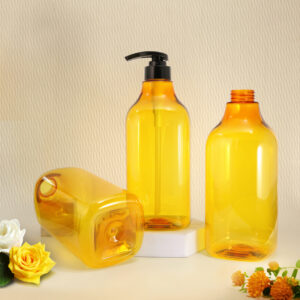
1000ml PET Bath Bottle
PET · 1000 ml
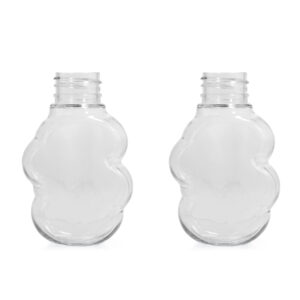
100ml PET Cosmetic Bottle with Dropper & Mist Sprayer (28/410 Neck)
PET · 100 ml
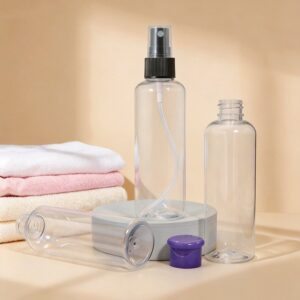
100ml PET Cosmetic Bottle with Lotion Pump & Disc-Top (24/410 Neck)
PET · 100 ml

100ml PET Cosmetic Bottle with Roll-on Applicator (24/410 Neck)
PET · 100 ml
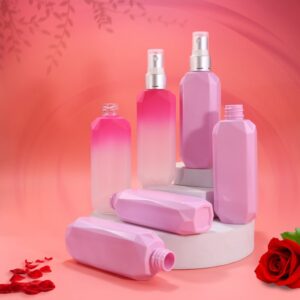
100ml PET Flat Bottle for Lotion & Treatment – 24mm Neck, 18g
PET · 100 ml

100ml PET PET Cosmetic Bottle for Facial Toner Packaging
PET · 100 ml

100ml PET Round Bottle for Serum & Lotion – 20mm Neck, 18g
PET · 100 ml
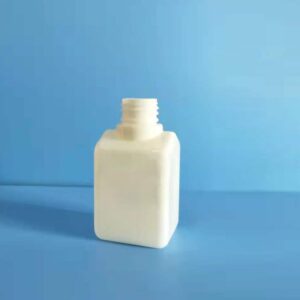
100ml PET Round Bottle for Serum & Sample – 20mm Neck, 18g
PET · 100 ml
Where PET-based programmes have shipped
The cases below are published customer programmes. Regional customer names are withheld; material, format, order data and outcomes are as delivered.
PCR PET trigger spray
- ▸30% post-consumer recycled PET content
- ▸25,000 pcs initial order, 80,000 pcs follow-on in Q2
- ▸Recycled-content supply-chain documentation issued per order
Custom PETG airless jar
- ▸30 ml and 50 ml formats
- ▸45-day mould lead time on a private design
- ▸8,000 pcs delivered June 2026 — same two-stage ISBM line as our PET work
See the full programme write-ups on the customer projects page.
Related engineering and material guides
PET packaging: buyer questions
What is the minimum order quantity for PET bottles?+
5,000 pcs per SKU on stock tooling. For a fully custom shape requiring new tooling, the MOQ and the tooling charge are quoted together, because the tool has to be amortised over the first run.
Can PET bottles be hot filled?+
Standard PET is limited to roughly 60–70 °C. Above that the bottle will distort unless it is a dedicated heat-set grade with heat-set tooling and a modified preform. Tell us the fill temperature before we quote — the specification and the tooling both change.
Is PET safe for cosmetic formulations?+
PET is widely used for cosmetics and personal care. Packaging is not an ingredient under EC 1223/2009, but in practice it is assessed against food-contact migration limits: EU 10/2011 overall migration of 10 mg/dm², plus specific migration limits and a NIAS risk assessment. Ask for the migration report on the finished article, not just a resin data sheet.
How do I know the resin is actually virgin?+
Ask for the per-lot Certificate of Analysis and the resin lot number, then ask the supplier to trace that lot through to your finished goods. A supplier running prime virgin resin can do this in both directions; a supplier blending regrind cannot.
Can you supply PCR-content PET bottles?+
Yes, typically 30–100% with 50% the common commercial compromise. PCR carries a grey or green cast, higher haze and a small odour risk, so it suits opaque or heavily tinted bottles rather than crystal-clear ones. The evidence to ask for is a GRS Transaction Certificate naming your product and lot.
What decoration options work on PET?+
Silk screen, hot stamping, labelling and spray finishing all run in-house. We use low-migration UV-cured inks, treat the surface to at least 38 dynes/cm before printing, and verify adhesion with the ASTM D3359 cross-hatch test targeting 4B to 5B.
Why does PET haze in thick sections?+
PET is semi-crystalline: as it cools it forms ordered regions that scatter light, so thick walls read translucent rather than clear. That is a property of the polymer, not a moulding defect. If the design needs a thick, clear wall, PETG is the material for that brief.
Which PET bottles do you hold in stock?+
646 PET bottle and container moulds are held in-house, covering capacities from small dropper formats up to wide-mouth containers. Browse them in the PET bottle range or the full product library.
Tell us the fill, the temperature and the format
Send the capacity, neck finish, fill temperature and whether the pack has to be clear. We will confirm the resin, the mould and the closure as one specification.