
PETG Plastic Packaging: Thick-Wall Clarity and Its Trade-Offs
Glycol-modified PET. It holds a 4 mm wall clear where PET hazes, absorbs impact rather than shattering, and costs more per kilogram than any other material we run.
What PETG is, and the problem it solves
PETG is PET modified with a second glycol during polymerisation. That modification disrupts chain packing and largely suppresses crystallisation, which is what lets PETG hold thick, glass-like walls with high clarity while remaining tough enough to pass a drop test — a combination standard PET cannot deliver at the same section thickness.
The trade-offs are real: PETG costs more per kilogram than PET, has a lower practical heat ceiling (roughly 70–75 °C) and is more sensitive to environmental stress cracking with certain oils and alcohols. Specify PETG when the brief calls for a premium glass look, a heavy base or a squat thick-walled jar. Stay with PET when you need hot filling, the lowest unit cost, or very high volume. Shenzhen Shijin runs 13 PETG moulds on prime virgin resin with per-lot COA.
What the glycol modification actually changes
Standard PET is a semi-crystalline polymer. As it cools from the melt it wants to form ordered crystal regions, and those crystals scatter light — which is why thick PET sections go hazy and PET bottle walls are kept thin. Adding glycol to the chain disrupts the packing, so crystallisation is largely suppressed.
- ▸Thick sections stay clear. A 4 mm PETG wall still reads as glass. The same wall in PET would be translucent at best.
- ▸Toughness improves. PETG absorbs impact rather than shattering, which matters for a heavy base that will be dropped on a tiled bathroom floor.
- ▸Processing is easier. PETG is more forgiving in extrusion blow moulding and does not need the same tight heat-set control.
- ▸Heat resistance drops. Suppressed crystallisation means the material softens sooner.
The trade is essentially optics and toughness for temperature resistance and cost. Once the brief is framed that way, the specification decision becomes straightforward.
| Property | PETG vs PET | Practical consequence |
|---|---|---|
| Thick-wall clarity | Better | Heavy-wall cosmetic bottles stay clear |
| Impact strength | Better | Survives drops that craze PET |
| Chemical resistance | Lower | Check essential-oil and solvent content carefully |
| Heat resistance | Lower | Not a hot-fill material |
| Cost | Higher | Specified to solve a problem, not by default |
| Decoration | Easier to bond and print | Wider finishing options |
Typical PETG applications
PETG solves a narrow set of problems well. It is worth checking the other materials first, then specifying PETG where appearance genuinely depends on wall thickness.
- ▸Premium serum and essence bottles — where the pack is meant to read as glass.
- ▸Thick-wall jars for creams and masks — heavy base, glass look, cold filled.
- ▸Airless bodies and inner containers — thick sections that must stay clear.
- ▸Luxury gel and treatment packs — where weight in the hand is part of the price point.
- ▸Dropper bottles with a heavy base — small formats where the glass look carries the brand.
- ▸Decorated statement packs — hot stamping and spray finishes bond well to PETG.
What to tell your supplier when you ask for the glass look
- ▸Target wall thickness at the thickest point, not just the overall weight. A bottle can hit a gram weight with thin walls and a thick base, which looks cheap.
- ▸Gram weight. This drives both cost and perceived quality. Heavier is not automatically better — it needs to balance in the hand.
- ▸Base design. A thick base is where PETG earns its cost. Push weight here rather than into the shoulder.
- ▸Gate position and moulded-in stress. Thick sections cool unevenly, and residual stress is what later becomes a crack. A competent toolmaker gates and cools for this.
How PETG is moulded and decorated at Shijin
Because PETG is more sensitive to certain chemicals, the formulation matters more than it does with PET. High essential-oil loads and some solvents will craze PETG. That is a conversation to have before tooling, not after a failed compatibility test.
Decoration notes for PETG
- ▸Surface energy. PETG sits lower than PET for printing. We check dyne levels before the first production run and, where needed, treat the surface to at least 38 dynes/cm before silk screen or hot stamping.
- ▸Ink system. Low-migration UV-curable inks, selected against the Swiss Ordinance SR 817.023.21 list and the Nestlé packaging ink guidance. This matters because ink components can migrate through the wall or rub off in transit.
- ▸Adhesion verification. ASTM D3359 cross-hatch targeting 4B to 5B. On PETG this is not optional — the thick wall and the lower surface energy make adhesion failure more likely than on PET.
- ▸Hot stamping. Works well and is the usual choice for a luxury look. Foil selection should be tested against your actual formula, since foil can lift where product reaches the surface.
Resin and documentation controls
- ▸Prime virgin resin only for cosmetic and personal-care work — a single heat history, full data sheet and full COA. That is a different material from wide-spec off-grade, post-industrial regrind (PIR), post-consumer recycle (PCR) or in-house rework.
- ▸Per-lot Certificate of Analysis. Intrinsic viscosity and ash content for PET and PETG; melt flow index (MFI), density and ash content for PE and PP (ISO 3451 / ASTM D5630).
- ▸Two-way traceability. Resin lot → work order → finished-goods lot, walkable in both directions, so a question about a shipment eighteen months later can be answered.
- ▸In-process and outgoing inspection. Wall thickness at four points per cavity, weight tolerance ±2%, visual defect inspection every 30 minutes, then AQL 2.5, a 1.2 m drop test, air-pressure leak testing on all closures and a QC report per lot.
For food-contact and cosmetic work we test to EU 10/2011 (overall migration limit 10 mg/dm², plus specific migration limits and a NIAS risk assessment) and frame cosmetics against EC 1223/2009. Decoration uses low-migration UV-cured inks aligned with the Swiss Ordinance SR 817.023.21 and the Nestlé packaging ink guidance, with surface energy verified before printing and adhesion checked by ASTM D3359 cross-hatch at 4B–5B.
Where the formula is aggressive we run a compatibility check before tooling. If you tell us the formula, we will tell you whether PETG is safe for it before you pay for a mould.
Advantages of PETG, and the limits that go with them
- ▸Glass-like clarity that survives a thick wall section
- ▸Excellent impact toughness — absorbs impact rather than shattering
- ▸More forgiving to mould than PET, with easier bonding and decoration
- ▸Wide finishing options: hot stamping, spray coating, silk screen
- ▸Premium hand weight that carries a higher price point on shelf
- ▸Practical heat ceiling around 70–75 °C — not a hot-fill material
- ▸Sensitive to environmental stress cracking with some essential oils, alcohols and aggressive surfactants
- ▸Highest cost per kilogram of the four main materials
- ▸Two to three times the material of a thin-wall PET bottle at the same capacity
- ▸Not universally accepted in PET recycling streams
Where PETG is the wrong choice
- ▸You need hot filling above roughly 75 °C — specify heat-set PET or PP instead.
- ▸The formula is high in alcohol or aggressive essential oils and you cannot run a compatibility test first.
- ▸The pack is a commodity high-volume item where resin cost dominates the business case.
- ▸Your brand has committed to a recycled-content claim and your market’s recycling stream does not accept PETG.
PETG and the recycling stream
PETG is chemically distinct from PET and is not universally accepted in PET recycling streams. That matters for brand claims, not just for the material choice.
- ▸Check the rules in your market. PETG is technically recyclable, but because it is a different polymer with different melt behaviour it can be treated as a contaminant in a PET stream.
- ▸Recyclability claims need local evidence. If recyclability is part of the brand claim, confirm acceptance in the specific market the product sells in before specifying PETG.
- ▸Recycled content. PETG recycled feedstock is far less established than rPET or rHDPE, which is why we do not present a PCR PETG specification.
PETG against PET, HDPE and PP
| Property | PETG | PET | HDPE | PP |
|---|---|---|---|---|
| Clarity | Very high, stays clear in thick walls | High, but only in thin walls | Opaque | Low to medium, milky |
| Thick-wall capability | Excellent | Poor — hazes as thickness rises | Good, but never clear | Moderate |
| Impact toughness | Excellent | Good | Excellent | Good |
| Practical heat ceiling | ~70–75 °C | ~60–70 °C | ~90–110 °C | Heat-resistant |
| Stress-crack sensitivity | Sensitive to some oils and alcohols | Moderate | Low | Low |
| Cost per kilogram | Highest | Baseline | Low | Low |
| Consider when | The brief needs a heavy glass look | Clarity and rigidity sell the product | The fill is aggressive | Heat resistance or closures lead |
Stress cracking is the field failure to watch
A formulation containing certain essential oils, high alcohol content or aggressive surfactants can initiate crazing at the neck or the base, where moulded-in stress is highest. It is not a material defect — it is a compatibility question, and it should be settled with a compatibility test before tooling rather than after.
Suitable PETG products
PETG is one of our smaller but most technically demanding lines. Browse the range below, or read the deeper PETG sourcing guide for the full comparison and specification checklist.
PETG bottles in stock
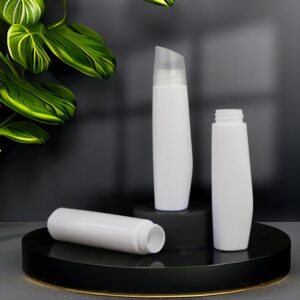
SJE-1667-15 15ml PETG Bottle
PETG · 15 ml

SJE-1748-300 300ml PETG Bottle
PETG · 300 ml
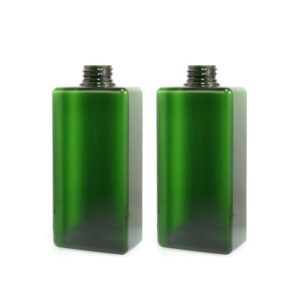
SJE-1793-400 400ml PETG Bottle
PETG · 400 ml
/SJE1683-100(PETG)-300x200.jpg)
SJE1683-100PETG 100ml PETG Bottle
PETG · 100 ml
/SJE1684-250(PETG)-300x200.jpg)
SJE1684-250PETG 250ml PETG Bottle
PETG · 250 ml
/SJE1687-500-02-300x300.jpg)
SJE1687-500PETG 500ml PETG Bottle
PETG · 500 ml
/01-300x300.jpg)
SJE1688-290PETG 290ml PETG Bottle
PETG · 290 ml
-300x300.jpg)
SJE1697-500 500ml PETG Bottle
PETG · 500 ml
Where PETG programmes have shipped
Published customer programmes built on this material. Regional customer names are withheld; material, format, order data and outcomes are as delivered.
PETG serum dropper
- ▸15–50 ml formats
- ▸12,000 pcs first order, 8 days sampling
- ▸Third reorder — 68,000 pcs over 18 months
Custom PETG airless jar
- ▸30 ml and 50 ml formats, exclusive design
- ▸45-day mould lead time
- ▸8,000 pcs delivered June 2026
See the full programme write-ups on the customer projects page.
Related engineering and material guides
PETG packaging: buyer questions
When should I choose PETG over PET?+
When the design needs a thick wall section that would haze in PET, or when impact strength is a genuine risk. PETG is more expensive, so it is worth specifying only when it solves a problem PET cannot.
Is PETG more brittle or less?+
PETG is tougher than PET in impact terms — that is usually why it is chosen. Its weakness is chemical: high essential-oil loads, high alcohol content and some solvents will craze it.
Can PETG be hot filled?+
No. PETG’s practical heat ceiling is around 70–75 °C, which sits below the 82–93 °C hot-fill window. Use heat-set PET or PP instead.
Why does PETG cost more than PET?+
Two reasons. The resin itself carries a premium over bottle-grade PET, and the thick walls that make PETG attractive mean more resin per bottle. A PETG bottle can easily use two to three times the material of a thin-wall PET bottle of the same capacity.
Will PETG craze with my formula?+
It can, if the formula contains aggressive solvents, high alcohol or certain essential oils. Crazing is environmental stress cracking: micro-cracks that form where moulded-in stress meets a hostile chemical environment. It is predictable if tested — send us the formula and we will run a compatibility check before tooling.
Is PETG recyclable?+
It is chemically recyclable but is not accepted in all PET recycling streams, because it is a different polymer with different melt behaviour. If recyclability is part of your brand claim, check acceptance in your specific target market before specifying PETG.
Is PETG food safe?+
PETG is widely used for food-contact articles and can comply with EU 10/2011 and FDA food-contact requirements, but compliance is a property of the finished article with its specific formulation and processing, not of the resin name. Ask for a Declaration of Compliance and a migration report for the actual bottle.
What is the minimum order for a PETG bottle?+
From 5,000 pcs on existing tooling. New tooling for a custom PETG shape is a separate cost and, because of the thicker walls, tooling and cycle times are typically longer than for an equivalent PET bottle.
Send the design intent and the formula
Tell us the target wall feel, the capacity, the decoration and the formula. We will tell you whether PETG is the right specification or whether a thick-wall PET alternative does the job for less.